.jpg)
.jpg)
Photo Credit
It’s that time of year! Time to find the perfect present for our adventurous loved ones. For that person in your life who loves all things cold weather, check out our gift guide for skiers and snowboarders. For ideas tailored to other pursuits, we also have more editor-recommended gift guides to explore. Happy gift giving!
Ski boots might be the most important part of your downhill setup. They’re the crucial link between you and your skis, and the right pair can make all the difference in performance and comfort. Boot designs vary by skill level and intended use: Experienced skiers often prefer stiff, performance-driven models, while beginners appreciate a softer, more forgiving fit. To help you find the best option for your ability level, skiing style, and budget, we’ve rounded up the top boots for the 2025–2026 season, with Tecnica’s Mach1 MV 120 (and women's Mach1 MV 105) as our top overall pick for most skiers. For more information, see our comparison table and buying advice. To complete your alpine kit, check out our articles on the best all-mountain skis and ski bindings.
Editor’s note: We updated this guide on November 15, 2025, to refine our list based on evaluating use cases, testing notes, and removing boots that no longer stand out–see our list of tested and dismissed ski boots. We also revised the formatting to make it a true unisex guide by highlighting the women's versions of our favorite boots. Lastly, we added the Scarpa 4-Quattro Pro as our favorite hybrid boot, included new test photos, and ensured that all other information was up to date at the time of publication.
Last: 98, 100, or 103mm (narrow, medium, wide widths)
Flex: 120 (advanced/expert skiers)
Other flexes: 95W, 105W, 110, 115W, 130
What we like: Top-end fit customization and all-around performance.
What we don’t: Experts might want a stiffer flex.
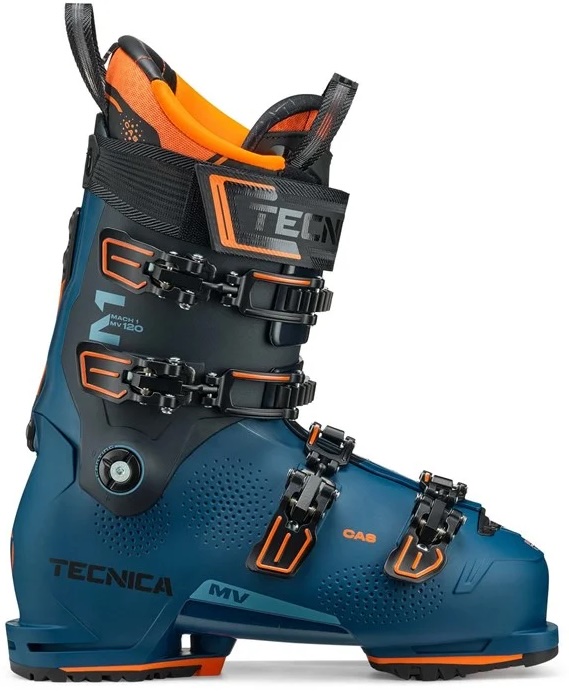
With so many options, it’s tough to narrow down the best overall ski boot, but we keep returning to Technica’s Mach1 collection year after year. We found it easy to get comfortable with: It has a natural stance and predictable power transfer, both on and off trail. It’s equipped with a carbon fiber spine that connects the cuff to the shell for a true 120 flex (105 for women). And we’re big fans of the power strap at the top of the boot, which allows you to ratchet the boot down as much as you want. It’ll take a confident skier (intermediate and beginner skiers will have better luck with the Supra and Mach Sport). Still, advanced riders will find it comfortable, powerful, and trustworthy, even through crud and bumps.
A lot of brands tout fit customization as a key feature of their boots, but few go as far as Tecnica with their well-loved Mach1 collection. Built to match the anatomical shape of your foot, you get a customizable liner and a tough but light polyether shell that can be punched, ground, and all-around manipulated by a bootfitter. In addition, thanks to a proliferation of medium- and high-volume boots, the latest Mach1 120 is offered in a class-leading range of last widths, including low (98mm), medium (100mm), and high (103mm). It’s worth noting that expert skiers might feel they need more power. We’d turn them to the Lange Shadow, which has even better power transfer. But overall, the Mach1 is the easy choice for advanced skiers who are looking for stellar all-mountain performance.
See the Men's Tecnica Mach1 MV 120 See the Women's Tecnica Mach1 MV 105

Last: 100mm (medium width)
Flex: 100 (intermediate/advanced skiers)
Other flexes: 80W, 90, 105W, 110, 120, 130
What we like: A great step up from a beginner boot; still easy to control, but it will help push the comfort zone.
What we don’t: Powerful or expert skiers will be left wanting more; the women's version is especially soft.
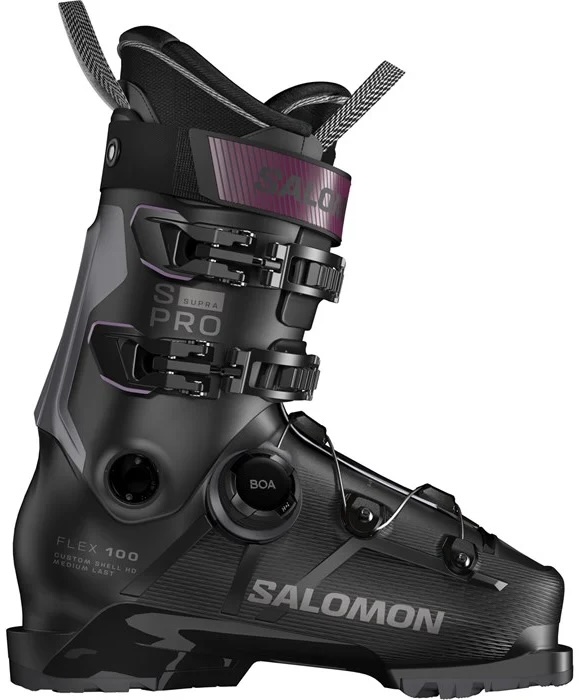
For those who have moved on from pizza and rigid stances, who are becoming more confident in linking their turns, and who are working on refining technique, it’s a good idea to upgrade from your super flexy beginner boot to something a bit more performance-oriented. The Salomon S/Pro Supra 100 is our favorite in this category. This boot has a smooth and predictable drive, a plush liner that cradles the foot, and a lightweight construction that’s still easy to control. But the 100-flex should give advancing intermediates a chance to push their comfort zone. We found the Supra’s 100 millimeter last accommodating for most foot types, but the thin shell is easy to heat-mold, and the latest version features a Boa closure on the front of the foot for a more customized fit.
Bolder skiers looking for a bit more performance and drive might find the Supra a bit too soft. We think the women’s version is especially soft with only an 85 flex value. It might be worth opting for the women’s 95, but that comes with a price increase. Those looking for something even stiffer can find the Supra in 120- or 130-flex versions (105 and 115 for women), both of which are available with dual Boa closure for a higher price. We think the Boa closure is a nice addition to this year’s Supra 100, but it comes with a price bump. If you want to save some money, you can still get last year’s version with traditional buckles for cheaper while supplies last. If comfort is a priority, check out Nordica’s Speedmachine, which offers an even more customizable shell and a cushier, cozier liner. But in most cases, we’re quick to recommend the Supra for its great mix of price and performance.
See the Men's Salomon S/Pro Supra Boa 100 See the Women's Salomon S/Pro Supra Boa 85

Last: 97 or 100mm (narrow or medium width)
Flex: 130 (advanced/expert skiers)
Other flexes: 85W, 95W, 110, 115W, 120
What we like: Delivers fantastic precision and power transfer.
What we don’t: Pricey, and men's is more expensive than women's.
It’s not too often that a downhill ski boot shakes things up, but that’s just what Lange did with their Shadow. Replacing the ever-popular RX series, the Shadow represents a significant departure in design, featuring the Suspension Blade and Dual Pivot concepts. To provide a little context, traditional ski boots are built with two overlapping pieces (the cuff and the shell), which are attached via a spine along the back. With the Shadow, Lange places a “Suspension Blade”—a vertical bar that’s shorter and positioned higher than a traditional spine—that connects the cuff to the lower shell via two pivot points on either side of the heel. In theory, this allows the skier to transfer power more efficiently from their legs to their skis—thus saving energy while maintaining power and control.
In the top-end 130-flex version, the Shadow delivers big-time power transfer, standout precision, and excellent shock absorption. And as expected from the brand, the rest of the design is well sorted, with a quality shell that’s moldable, reliable buckles, and an asymmetrical liner that forms to your feet and offers great heel lock. Our immediate concern with the Shadow was durability—more moving parts means there’s more to break—but so far, we have no major issues to report. Lastly, it’s worth noting that we included the low-volume (97mm) version for our performance pick, but Lange also makes the Shadow 130 MV for men, which features a roomier 100-millimeter last.
Read more: Lange Shadow 130 LV review
See the Men's Lange Shadow 130 LV See the Women's Lange Shadow 115 LV


Last: 100mm (medium width)
Flex: 130 (advanced/expert skiers)
Other flexes: None
What we like: Well-rounded performance for resort and backcountry use.
What we don’t: Not ideal for dedicated backcountry skiers; women might find it too stiff.
A quick glance at the Scarpa 4-Quattro Pro reveals that this is no ordinary downhill boot. The slim shape, large walk/ride lever, and tech-binding-compatible toe inserts are built for backcountry adventure. But what earns the Scarpa a spot on this list is its versatile nature—if you split your time between touring and the resort, this is one of the best options yet. The Scarpa is lightweight (6 lb. 13.7 oz.) and flexes freely while hiking (a 61-degree tilt), giving it a lot of strength on the skin track. But it’s no slouch on the downhill, either: With a stiff 130 flex, this boot is powerful and confidence-inspiring. It performs well on groomers as well as the techy, steep, and gnarly conditions that backcountry skiers often find themselves in. If you want something a bit less aggressive, the 4-Quattro SL and GT have flexes of 120 and 110, respectively. The SL is better suited for weight-conscious skiers, and the GT is more comfort-minded, with a warmer insole and a higher-volume fit (plus, both are cheaper than the Pro).
That said, dedicated backcountry skiers may find the 4-Quattro a bit too heavy, and its GripWalk sole can make it tricky to pair with crampons. It’s also worth noting that the Pro version isn’t offered in a women’s-specific model. While Scarpa doesn’t market the 4-Quattro specifically as a men’s boot, many women may find its 130 flex too stiff. For those skiers, the women’s 4-Quattro SL offers everything we like about the Pro with a softer 100 flex. We’d be remiss not to mention Atomic’s Hawx Ultra XTD 130 Boa (and the women’s 115), which initially held this spot. In our experience, it’s an excellent, hard-charging hybrid boot with a customizable Boa fit. However, the 4-Quattro edges it out for several reasons: It’s about 2 pounds lighter per pair, features a wider last that accommodates more foot shapes, and has simpler, more serviceable buckles for backcountry use. Ultimately, we think the 4-Quattro is the clear choice for skiers who split their time between the resort and the backcountry and refuse to compromise on performance in either setting.
See the Scarpa 4-Quattro Pro


Last: 103mm (wide width)
Flex: 80 (beginner skiers)
Other flexes: 65W, 75W, 80, 85W, 90, 100
What we like: Nice mix of price, comfort, and performance for beginners.
What we don’t: Too wide for narrow feet, and fast learners will want more stiffness.
Beginning skiers look for comfort, ease of use, and warmth for their first pair of boots, and the Tecnica Mach Sport HV 80 provides all of those in spades. This popular design includes nice touches like high-quality aluminum buckles, a cozy liner, and a smooth, reliable flex. You also get a medium-to-wide last and an accommodating shape, which limits pinch points to maximize warmth and comfort for most foot types. Plus, the shell can be customized by a bootfitter. We also like that Technica keeps things (relatively) cheap with the Mach Sport, so you won’t feel too bad when you outgrow this boot in a couple of seasons.
What are the downsides of Tecnica’s Mach Sport HV? Its 103-millimeter last isn’t the widest available, but the fit is pretty generous all around, which can be a problem for those with narrow calves and feet. Moreover, we think fast learners should invest in a boot with a stiffer flex (Tecnica does offer the Mach Sport in a 90 flex for men and an 85 flex for women, though the prices increase). Some taller, heavier women might find the 65 flex too soft—the 85 or 75 flex versions will be better matches. Overall, despite a couple of nitpicks, we think the Mach Sport HV is a great value and a fantastic starter boot for those looking to ditch rental gear.
See the Men's Tecnica Mach Sport HV 80 See the Women's Tecnica Mach Sport HV 65

Last: 100mm (medium width)
Flex: 100 (intermediate skiers)
Other flexes: 75W, 85W, 90, 95W, 105W, 110, 115W, 120, 130
What we like: Excellent fit customization, comfort, and value.
What we don’t: Not a high-performance piece.
Nordica boots are known for comfort, and the Speedmachine 3 100 is no exception. This all-mountain boot has a cushy, warm liner filled with PrimaLoft insulation and fantastic fit customization. Using their proprietary infrared lamp and suction-cup system, a Nordica bootfitter can mold the liner, shell, and even some hardware pieces. Additionally, the latest version features a Boa closure along the front of the foot, allowing for even more precise tuning. Tack on two sturdy top buckles and a smooth flex, and the Speedmachine 100 makes a great option for lightweight or intermediate skiers.
Within the 100-flex, 100-millimeter last category, the mid-range Nordica is a fine alternative to the Salomon S/Pro Supra above, and we’ve found it similarly maneuverable and confidence-inspiring. Though skiers who get out a lot may appreciate the Salomon’s upgraded seamless liner and more proven track record. Plus, you won’t need to go out of your way to find a brand-specific boot fitter to help punch and heat-mold the Supra. But comfort shouldn’t be an issue with the Speemachine, and we like that Nordica has recognized that a customizable shell has real appeal even for casual skiers. Those wanting something stiffer can opt for the 120 or 130 flex versions (both available with double Boa closures). Finally, for a wider variation, check out Nordica’s Sportmachine 3 100 (115 for women), which features a similar construction but in a 102-millimeter last.
See the Men's Nordica Speedmachine 3 100 Boa See the Women's Nordica Speedmachine 3 85 Boa

Last: 98 or 100mm (narrow or medium width)
Flex: 120 (advanced skiers)
Other flexes: 100, 105W, 110, 115W, 130, 140
What we like: Lightweight and a solid value.
What we don’t: We wish it had a walk/hike mode; the women's version is only available in the pricier Boa model.
K2 is well-known in the ski world for its high-performing yet reasonably priced boots, and this all-mountain boot has been designed from the ground up to trim weight wherever possible. The result is impressive: The Recon weighs half a pound less per boot than the Mach1 above. It’s true that an ultralight design isn’t as important for downhill use as in the backcountry, but the Recon has a very nimble feel on the slopes that’s easy to control. And at a true 120 flex, it’s still plenty strong for most skiers when powering through high-speed turns.
The Recon is one of the least expensive boots on this list, but from a performance standpoint, you don’t give up much. Expert-level skiers will want to stick with the Technica and Lange options from K2 for their premium feel, but most should find little to complain about. Another nitpick is that the boot lacks a walk mode, which we think would be a logical addition given its trimmed-down build for sidecountry bootpacks. You can also get the Recon with a Boa closure, but most budget shoppers will find the traditional buckles just as effective. The women's 2025/26 Anthem only comes in the pricier Boa version. That aside, the Recon nails the fun factor, and its excellent price makes it an intriguing resort option.
See the Men's K2 Recon 120 See the Women's K2 Anthem 105 Boa
 Last: 96mm (narrow width)
Flex: 140-150 (expert skiers)
Other flexes: 95W, 115W, 120, 130
What we like: Race-level fit and feel.
What we don’t: Snug fit is best for narrow feet and serious riders; no women's specific version.
120- and 130-flex boots should do the trick for most aggressive riders, but super-strong skiers or those with a racing background may be left wanting more. If this sounds like you, the Head Raptor WCR 140S deserves a serious look. This boot packs an extremely rigid 140 flex (adjustable up to 150), top-tier power transfer and feel, and a very snug fit. In addition, its liner is just thick enough to offer decent protection and comfort while not compromising performance, and the buckles, power strap, and shell all have a quality feel. All told, the Raptor WCR 140S is a fantastic boot for hard-charging, on-piste skiers.
While the steep price and sky-high flex push the Raptor into the racing category, it’s surprisingly versatile. Unlike standard WCR models, you get a little extra wiggle room for all-day riding, and the included liner can be custom-molded at an authorized dealer. It’s still not as comfortable when exploring the sidecountry or the bumps as all-mountain designs, and the narrow foot might not be the most comfortable for all-day wear (at the time of publishing, it’s only available in a 96mm last). Still, it’s warmer and a bit softer than expected. Lastly, the 140s model isn't available in a women's-specific, softer-flex version, but it is available in a 130 flex, as well as women's-specific 95 and 115 flexes. However, they won't have the same race-level performance.
See the Head Raptor WCR 140S PV

Last: 99mm (medium width)
Flex: 110 (intermediate skiers)
Other flexes: 95W, 105W, 110, 115W, 130
What we like: Good price considering its hybrid design; solid downhill performance.
What we don’t: Too heavy for more than the occasional ski tour.
If you’re looking for a hybrid boot that won’t break the bank, look no further than Tecnica’s Cochise 120. Like the 4-Quattro, the Cochise can keep up just fine on both the way up and down. On the uphill, the tech binding inserts, easy-to-access hike lever, and 50-degree range of motion provide smooth and efficient gliding. And pointed downhill, the stiff flex and medium-narrow last add a nice dose of precision. Outfitted with a substantial liner and shell for this hybrid class, the boot won’t beat you up skiing in bad snow and is warm, too. Toss on a pair of hybrid bindings like Salomon’s Shift, Marker’s Duke PT, or a Cast Freetour kit, and you can enjoy everything from pre-dawn tours to lift-assisted hot laps.
Among hybrid resort/backcountry boots, the Cochise strikes a good balance between on- and off-piste performance, but it isn't a standout in either discipline. The 4-Quattro has the Cochise beat on the uphill with a more flexible forward tilt and a lighter weight, but it comes close to matching the Quattro in downhill performance, especially if you opt for the 130 flex. In the end, the Cochise 120 earns a spot on our list as a great match for intermediate- to advanced-level riders who spend most of their time at the resort but want to hit the skin track a few times each winter.
See the Men's Tecnica Cochise 120 See the Women's Tecnica Cochise 105

Last: 99mm (narrow width)
Flex: 100 (intermediate skiers)
Other flexes: 70/90 (Revolve), 110/120 (Revolve Team)
What we like: Born to fly: Lightweight, flexible, and good shock absorption.
What we don’t: Design favors freestyle over all-mountain riding.
Freestyle riders who have been in the sport long enough will recognize the name Full Tilt, a brand that earned its popularity due to its super-flexible three-piece ski boots. The brand has since been dissolved (rumor has it you can still find them in the depths of eBay), and K2’s Flex series has sought to replace it. The Revolve Pro is the series’s versatile all-arounder, highlighted by a stiff build (rated at 100), premium Intuition liner, and low weight. Tack on the brand’s familiar three-piece shell, extra-smooth flex, and shock-absorbing build, and you get standout freestyle performance, whether at the park or hitting natural features on the hill. And the styling is still park-approved with a fun patterning and a tri-buckle layout.
In terms of all-mountain performance, the K2 Flex’s lightweight materials allow for playfulness over moguls and in the park, and these boots can snap into turns when necessary. The boot is available in a softer Revolve and stiffer Revolve Team, but the Revolve Pro hits the middle sweet spot. And we love the simplicity: There aren’t many moving parts with this boot. That said, the Revolve Pro isn’t for everyone, as its focus on park performance translates to a drop in stiffness and precision on groomers. But for the right rider—and you know who you are—the Flex is hard to beat.
See the K2 Flex Revolve Pro
The list above is a result of several years of testing downhill ski boots, and we are always testing new and intriguing models. But we have high standards for our favorite picks, and we often choose to remove or not include a ski boot based on its performance, price, fit, or availability. Our goal is to recommend boots that best balance these factors and perform best in their use case. However, we want to be transparent about the models we have tested and the reasons we included or excluded them from this list.
We replaced the Atomic Hawx Ultra XTD 130 Boa GW boot with the Scarpa 4-Quattro Pro as our favorite hybrid ski boot. The Scarpa is much lighter than the Atomic, which matters a lot for efficient backcountry travel. The Scarpa is also less expensive, and we prefer its traditional buckle design over the Atomic's Boa, which is tougher to service if it breaks in the backcountry.
We also removed the K2 BFC 90 from this list due to its poor performance during testing. It's a comfortable boot, but it lacked adequate precision and power, even in its stiffest 120 variation. Those looking for a comfortable boot will be better off with Nordica's Speedmachine 3 or Tecnica's Mach Sport series.
The Lange XT3 Free 120 MV GW also didn't make the update. Though we liked its downhill performance, it doesn't climb as well as the Scarpa 4-Quattro thanks to its heft and range of motion. We also found the Tecnica Cochise to be a more well-rounded boot in testing.
We removed the Rossignol Alltrack 90 HV for similar reasons: It doesn't stand out as a hybrid boot when compared to the 4-Quattro and Tecnica Cochise. It's cheap, but at the sacrifice of heft, climbing performance, and downhill ability.
We tested but decided not to include the Fisher RC4 120 MV Boa boot because it didn't outperform any of the boots on this current list.
| Boot | Price | Last | Flex | Other Flexes | Hike |
|---|---|---|---|---|---|
| Tecnica Mach1 MV 120 | $750 | 98, 100, 103mm | 120 | 110, 130 | No |
| Salomon S/Pro Supra 100 | $520 | 100mm | 100 | 90, 110, 120, 130 | No |
| Lange Shadow 130 LV GW | $900 | 97 or 100mm | 130 | 110, 120, 140 | No |
| Scarpa 4-Quattro Pro | $899 | 100mm | 130 | None | Yes |
| Tecnica Mach Sport HV 80 | $330 | 103mm | 80 | 80, 90, 100 | No |
| Nordica Speedmachine 3 100 | $530 | 100mm | 100 | 90, 110, 120, 130 | No |
| K2 Recon 120 | $650 | 98 or 100mm | 120 | 90, 100, 110, 130, 140 | No |
| Head Raptor WCR 140S | $899 | 94, 96, 98mm | 140 | 120, 130 | No |
| Tecnica Cochise 120 | $750 | 99mm | 120 | 110, 130 | Yes |
| K2 Flex Revolve Pro | $600 | 99mm | 100 | 70/90, 110/120 | No |
| Boot | Price | Last | Flex | Other Flexes | Hike |
|---|---|---|---|---|---|
| Tecnica Mach1 MV 105 | $750 | 98, 100, 103mm | 105 | 95, 115 | No |
| Salomon S/Pro Supra 85 | $520 | 100mm | 85 | 95, 105 | No |
| Lange Shadow 115 LV GW | $800 | 97 or 100mm | 115 | 85, 95 | No |
| Scarpa 4-Quattro Pro | $899 | 100mm | 130 | None | Yes |
| Tecnica Mach Sport HV 65 | $330 | 103mm | 65 | 75, 85 | No |
| Nordica Speedmachine 3 85 | $530 | 100mm | 85 | 75, 95, 105, 115 | No |
| K2 Anthem 105 Boa | $800 | 98 or 100mm | 105 | 85, 95, 105, 115, 125 | No |
| Head Raptor WCR 140S | $899 | 94, 96, 98mm | 140 | 95, 115, 120, 130 | No |
| Tecnica Cochise 105 | $750 | 99mm | 110 | 95, 115 | Yes |
| K2 Flex Revolve Pro | $600 | 99mm | 100 | 70/90, 110/120 | No |
Downhill skiing is just plain fun, which is why many editors at Switchback Travel are avid resort skiers. We've been testing and compiling performance notes since 2015, and now, ten years later, it is maintained and reviewed by contributing editor Brooke Maushund, who's had a major hand in choosing which models make the list. From ski guiding to avalanche forecasting, Brooke is acutely aware of the importance of comfortable and well-fitting boots on long trips into the mountains.
Our current lineup of 10 boots reflects our ongoing field experience, firsthand insights from testers and gear-savvy friends, and feedback from the online skiing community. When we test downhill boots, we examine factors such as construction, flex, stiffness, and weight. We also consider price, prioritizing designs that strike a good balance between cost and overall performance. And although subjective, comfort and fit are top of mind when we're reviewing boots. Depending on the design and its intended use, we're sure to test each boot under variable conditions, on different types of terrain, and even in the backcountry (if they have walk mode). We continue to test new and noteworthy designs as they hit the shelves, adding any standouts to the list.

A great place to start your boot search is choosing the proper flex. Nearly every downhill boot is given a flex index number ranging from approximately 60 to 140. Lower numbers are softer, have more give, and are more comfortable, making them ideal for beginner skiers. We cover a couple of our favorite entry-level models on this list, but for a complete look at the best options, check out our ski boots for beginners article. Those who spend a lot of time freestyle skiing or in the park will appreciate a flexible boot, too, such as K2's Flex Revolve Pro.

Moving up in stiffness to intermediate, advanced, and expert models gets you a boot that isn't as cushy but transfers your inputs to the bindings and skis more efficiently. Less energy is wasted flexing the boot forward, and the response is instantaneous, which is why racers opt for a super-stiff boot like the Head Raptor WCR 140S. It's worth noting that a preferred stiffness also correlates with body weight: heavier, more powerful skiers need a higher number:
Beginner: 70-90
Intermediate: 90-110
Advanced: 100-120
Expert: 120+
Ski boot sizing is one of the most difficult things to figure out online. It’s not as simple as taking your shoe size and matching it to a Mondo size (ski boot sizing nomenclature) on a chart. The length, width, volume, and underfoot profile need to be dialed in for a boot to be “the one.” As a result, we recommend visiting a local shop to be sized. If this is not an option, find a reputable online ski gear retailer that allows returns and order a couple of sizes. For a good baseline level of knowledge, here are the most common boot sizing terminology and considerations:
Mondo
Both men’s and women’s ski boots are available in unisex Mondo (or Mondopoint) sizing, which measures your foot length in centimeters. You can measure your foot by tracing its outline on a piece of paper or marking the bottom of the heel and top of the toes. If your foot measures 30 centimeters in length, your Mondo size is 30. Getting measured in a ski shop is preferred, but this is a rough way to do it at home.
Every manufacturer or retailer provides a sizing chart that matches shoe sizes to ski boot sizes, but your actual Mondo size may be a size or two smaller than what you see on the chart. This is because a tight fit is recommended with ski boots. Ski boot liners are made of foam and will mold to your feet over time, so it’s best to start with a very snug fit and wear them in.

Last
Footbed width, also known as the last, is another important specification for ski boots. This measurement is based on the width of the forefoot and is listed in millimeters. Most manufacturers make ski boots with varying lasts to accommodate those with narrow, average, and wide feet. And some models, including the Lange Shadow 130 and K2 Recon 120, are made with multiple last options. It’s important to get this part of the fit right because side-to-side motion is a given when descending a hill, and a boot that’s loose around the sides of your feet will negatively affect performance.
For those with narrow feet or looking for performance boots with a more precise fit, look in the 96-98mm range. Average lasts are around 100-102 mm wide for men and 99-100mm wide for women. Those work well for most skiers with normal-width feet. For folks with wide feet, finding the right pair can be a challenge. But there are a growing number of boots made in 103mm or wider lasts, including the Tecnica Mach1 HV.
.jpg)
Replaceable Footbeds/Insoles
No matter how well you select the proper fit, you may still experience discomfort during a full day of skiing. That’s where the final piece of the fit puzzle comes in: replaceable insoles. Most downhill ski boot liners have a removable insole, much like a hiking boot. Swapping these out for a quality aftermarket insole that better matches your foot profile can make a difference. New insoles can provide better arch support, more or less volume, and a heel cup that better locks your feet in place. Good aftermarket insoles can be found from brands like Superfeet and SOLE.
Another alternative is getting a custom footbed from a bootfitter, which requires getting fit in person. This is an expensive process, but it can be worthwhile for those with stubbornly shaped feet or who ski a ton each year. You can call your local ski shop and ask if they make custom footbeds.
Most all-mountain ski boots are made up of two independent pieces: a hard plastic outer shell that provides structure and strength, and a removable liner that delivers comfort, support, and insulation. The liner is filled with varying amounts of foam, depending on the type of skiing the boot is intended for. It’s not always the best idea to get the most plush and cushiest liner (beginners and comfort-oriented skiers are an exception). The softer foam will not hold your foot and shin as well while carving, and it may not mold to your feet as well over time.
Supportive but comfortable is the preferred place to be for most intermediate and advanced skiers. As we mentioned, your liner will conform to your feet, so don’t be too concerned if it feels snug at first (but make sure it’s not restricting or that your toes aren't smooshed against the hard-sided shell).
%20.jpg)
Heat-moldable liners can be custom fit to your feet at a ski shop that has the necessary equipment, as styles and equipment can vary by boot brand. The best liners are made by Intuition and ZipFit. This is a nice way to get the liner to fit your feet right out of the box, but it isn’t mandatory for many folks. You can get much of the same fitting accomplished just by following home instructions and wearing the liners around the house or on a few early-season ski days. That said, these liners are a useful tool for dialing in comfort.
To start, it’s helpful to know that buckles and strap designs don't vary dramatically between brands. The buckle systems on most downhill ski boots follow a similar methodology: two buckles across the foot, one at the bend near the ankle, and another along the shin. Look for buckles made with aluminum for greater durability (plastic is cheaper but a bit more prone to breaking). Some boots try to cut weight by removing the ankle buckle, but for downhill use, when total boot weight isn’t as important, we find it well worth keeping the more supportive four-aluminum buckle design.
.jpg)
The strap at the top of the boot near the cuff is another important piece of the design. Sometimes referred to as the power strap, it keeps that top portion securely locked in place to help unleash the full performance potential of your boots—and at a lower weight and greater comfort than adding a 5th buckle. Having a full complement of buckles, as well as a quality power strap, really helps dial in the fit, making it easier to accommodate varying leg and calf sizes.
.jpg)
Boa Closures
Boa closures have become popular in recent seasons, and for good reason. Aside from being flashy new tech, Boa closures provide a more precise fit than most boots can achieve with a traditional buckle design. And unlike traditional buckles, Boa closures distribute pressure evenly across the top of the foot, preventing hotspots and improving overall comfort. Those who prioritize comfort might find it worth spending up for Boa closures (such as on the Nordica Speedmachine 3 100), but, in our experience, they don't offer enough performance benefits to recommend them to everyone. Most stiff boots for expert skiers still use traditional buckles because they can be cranked down tighter than Boa buckles. We also avoid recommending Boa boots for dedicated backcountry skiers, as the system is much harder to service in the backcountry than traditional buckles. At the end of the day, the choice is up to you.

Shifting to the bottom of the boots, downhill ski boot soles fall into two categories: traditional ISO 5355 models and newer, GripWalk-equipped designs. Starting with the former, ISO 5355-compatible boots are mostly flat underfoot and sized to fit and release from the toe piece on a traditional alpine binding. The main downside is that they’re uncomfortable and awkward when you’re walking around without skis on or hiking up a bootpack—their shape and simple outsoles lead to an awkward gait and can be slippery on anything from hardpack snow and ice to slick bathroom floors.
Enter the GripWalk sole, which has a rockered shape for a more natural stride and a softer plastic/rubber compound for improved traction. GripWalk soles are commonly found on higher-end boots with an all-mountain focus (the extra grip is a big benefit on sidecountry hikes), though they’re becoming more common each year. If you go the GripWalk route, you’ll want to verify that your bindings are compatible–look for an ISO 23223 designation. The good news is that many alpine bindings are now multi-norm-ready, including popular models like the Marker Griffon, Look Pivot, and the versatile Salmon S/Lab Shift (also sold under the Atomic name).
.jpg)
Until recently, the weight of a downhill ski boot was largely ignored (it’s still not listed as a spec on most retailer websites). But with the dramatic growth in backcountry and sidecountry skiing—and an increased spotlight on weight in general in the outdoor gear world—we’re starting to see the same lightweight focus in the downhill ski boot market. The benefits of lighter footwear for uphill travel and bootpacking are obvious: You have less weight to move with each step. With that in mind, it's no surprise that tech-binding-compatible models like the Scarpa 4-Quattro Pro and Tecnica Cochise 120 are among the lightest on our list. But even for those riding the chairlift, lightweight boots can make it easier to control and maneuver your skis in tight spaces like bumps and trees, and can reduce leg fatigue on long days.
That said, we don't expect ultralight boots to take over the resort anytime soon. Downhill boots are heavy for a reason: The substantial linings provide excellent insulation, the relatively thick shells are durable and transfer power well, and quality aluminum parts on the buckles add weight. In the end, unless you're a big off-trail explorer, we don't recommend putting much stock in a trimmed-down design.
You’ll see a number of downhill boots that tout a walk/hike mode. In reality, these modes are best enjoyed during the trek from the car to the resort, as they don’t have the necessary range of motion and flex to be comfortable for long walks. In addition, downhill-focused boots are heavier than dedicated backcountry and randonee boots. It's not all bad news, and the walk feature has its appeals for folks who primarily ski downhill but want the option to do some light skinning or hiking. Just steer clear if you need to spend any more than a few minutes heading uphill. Exceptions to this rule include crossover backcountry/resort boot designs.

Backcountry skiing has exploded in popularity in recent years, and many downhillers are adding an alpine touring setup to their quiver. To help make things easier, there are a growing number of crossover boots that perform well on both resort days and while touring, including models like the Scarpa 4-Quattro Pro and Tecnica Cochise. All have sturdy flex ratings (up to 140 at the stiffer end), are light enough, and boast tech fittings and a walk mode with a decent range of motion for occasional uphill use.
.jpg)
That said, if you plan to use them primarily at the resort, there are some compromises to be aware of. The lightweight construction isn't as warm and sacrifices some precision when carving on hardpack, and they can feel harsher in choppy conditions than downhill-only models. Additionally, crossover boots are heavier than the vast majority of specialized backcountry designs—often by a pound or more for the pair. But if you don't like the idea of buying two sets of pricey boots or plan to tour only a few times a season, the hybrid downhill/touring concept can be a logical move.

Most ski boots are technically unisex, but many manufacturers offer women’s-specific versions of their key models. But the question remains: What are the differences between a woman's ski boot and a unisex/men's ski boot? To start, women's boots feature unique graphics and are usually available in smaller sizes. For example, the unisex Lange Shadow begins at size 24, while the women’s Lange Shadow W starts at 22.0. But most importantly, many women's-specific boots have lower flex ratings, making them softer. All of this assumes, of course, that women prefer different graphics, have smaller feet, and want flexier boots, which is often, but not always, the case.
.jpg)
The bottom line is that each ski brand makes their boots with a unique shape, fit, and features. The unisex/men's and women's models embody the distinct qualities the brand aspires to offer. If you identify as female and have found the perfect pair of boots that only come in a men's model, try them on and don't be afraid to go for it (and vice versa). The most significant factors, by far, are that they feel snug and comfortable and align with the performance characteristics you’re looking for.
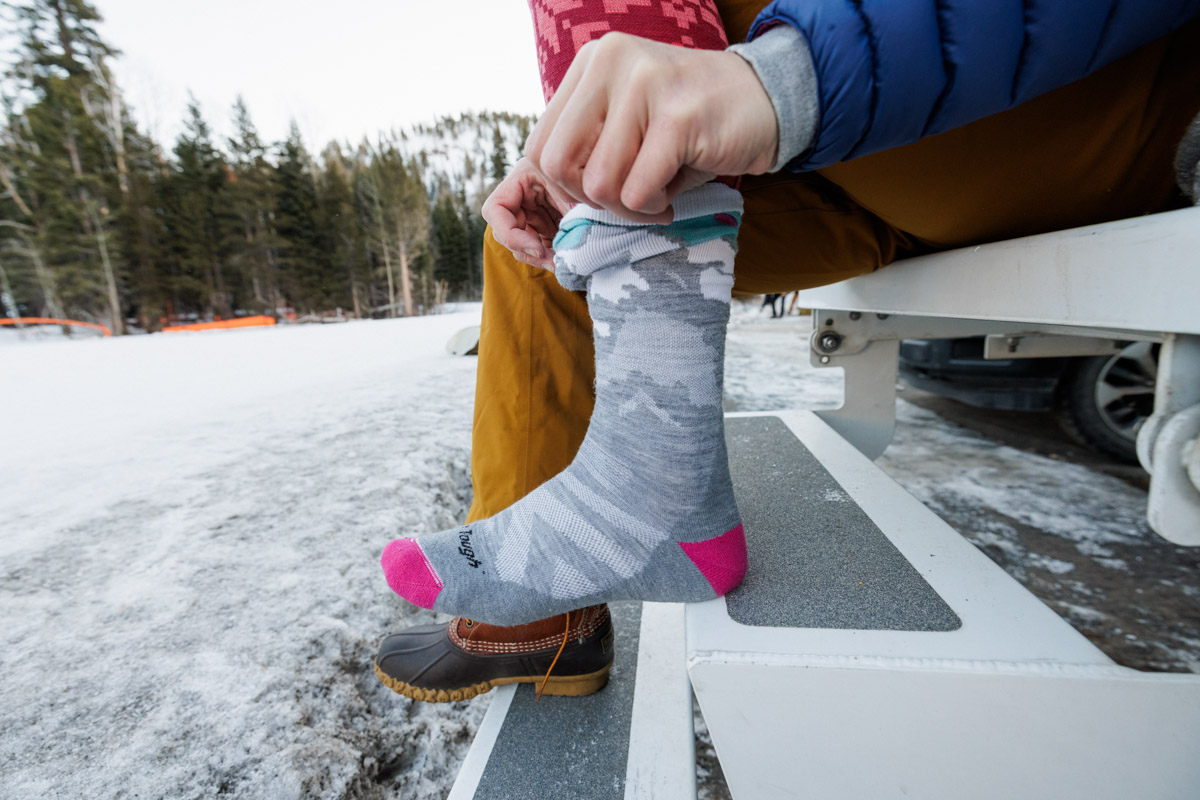
Modern ski socks reflect the improvements made in boot liner technology. You no longer need a thick, heavy-duty sock, as modern boots are better insulators and far more comfortable, which all adds up to a more enjoyable experience. The best socks are either merino wool or synthetic, and if you can swing the added expense, the wool option is our preferred type for stink prevention and temperature regulation. For a full list of options, see our article on the best ski socks.
Boots are a great place to start in assembling your ski kit. For one, it hopefully means you get the pair that fits you best. It also should help guide the rest of your buying considerations. If you choose an advanced boot, you should pick a binding and ski that can deliver the performance the boot is capable of. A stiff boot transfers power efficiently as long as the binding and ski are capable of responding to those inputs. To help you get outfitted, our picks for the best all-mountain skis and ski bindings are organized similarly to boots, broken down by ability level and terrain. And to ensure your bindings will work with your boots, check out our Ski Boot and Binding Compatibility Guide.
Back to Our Top Downhill Ski Boot Picks Back to Our Downhill Ski Boot Comparison Table


%20s7c7c.jpg?h=fbc67360&itok=DQJk-ccw)
14ab.jpg?h=fbc67360&itok=1n06ZZey)

_1fe93.jpg?h=fbc67360&itok=vwdi5atz)
c149.jpg?h=fbc67360&itok=vcIod759)
0ec1.jpg?h=fbc67360&itok=oGaifWVw)
f6af.jpg?h=fbc67360&itok=JShxB9ES)
_01074.jpg?h=fbc67360&itok=LZfjph4c)
