
Photo Credit
It’s that time of year! Time to find the perfect present for our adventurous loved ones. For that person in your life who loves all things cold weather, check out our gift guide for skiers and snowboarders. For ideas tailored to other pursuits, we also have more editor-recommended gift guides to explore. Happy gift giving!
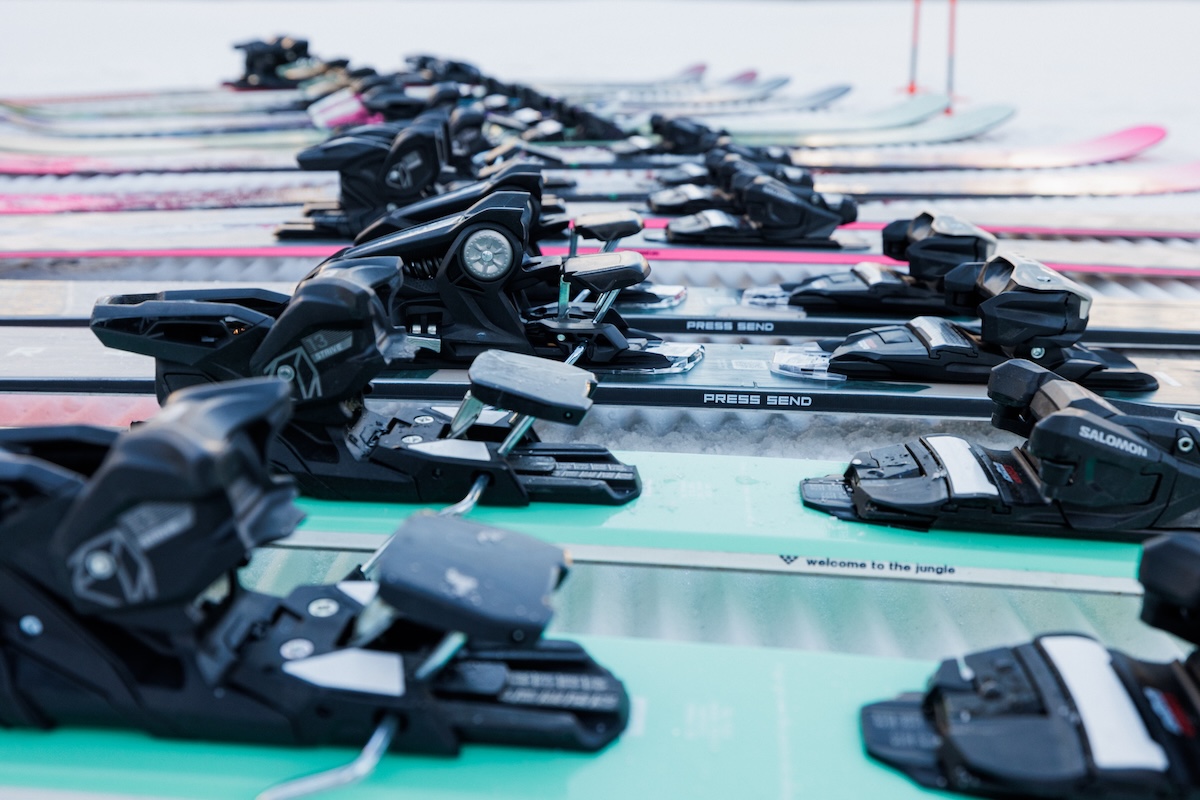
Bindings aren’t the flashiest piece of ski gear you’ll buy, but they’re certainly a foundational one. As the connection between boot and ski, they play a fundamental role in power transfer, responsiveness, and safety. When purchasing an alpine binding, you’ll want to pay attention to DIN, boot sole compatibility, brake width, and more. Our team’s favorite model is the Marker Griffon 13, due to its solid energy transfer, wide DIN range, and reasonable price. For additional background information, see our ski binding comparison table and buying advice below the picks. And to complete your setup, check out our articles on the best all-mountain skis and best downhill ski boots.
Editor's note: We updated this guide on December 15, 2025, to check our lineup for availability, add details about our testing process, and introduce a new tested and dismissed section.

DIN: 4-13
Sole compatibility: Alpine, Touring, WTR, GripWalk
Brake sizes: 90, 100, 110, 120mm
What we like: Solid reputation, great power transfer, and reasonably priced.
What we don’t: Despite recent improvements, it’s still not the easiest to step into in powder.
Quality bindings are safe, reliable, and transfer energy supremely well. Marker’s popular Griffon 13 does all of that with aplomb and is an excellent choice for skiers of nearly all ability levels. With a respectable DIN range from 4-13, premium materials, a wide variety of available colorways, and a long track record of durability and top-end performance, they’ve been a favorite of ours for many seasons. In a recent update, Marker widened the toe piece and revamped the sole plate orientation for improved power transmission, while retaining the rest of the proven design.
Another standout feature of the Marker Griffon 13 is its boot compatibility, which is among the widest on the market. The toe piece is designed to accommodate a range of soles, from standard downhill models to GripWalk, Walk-to-Ride, and even touring-specific soles (ISO 9523). Additionally, the brakes are easily interchangeable for varying ski widths and are available in sizes that should accommodate the vast majority of all-mountain skis. For expert-level skiers seeking a higher max DIN, consider the Marker Jester below, which is essentially the same binding with a 16-DIN release.
See the Marker Griffon 13

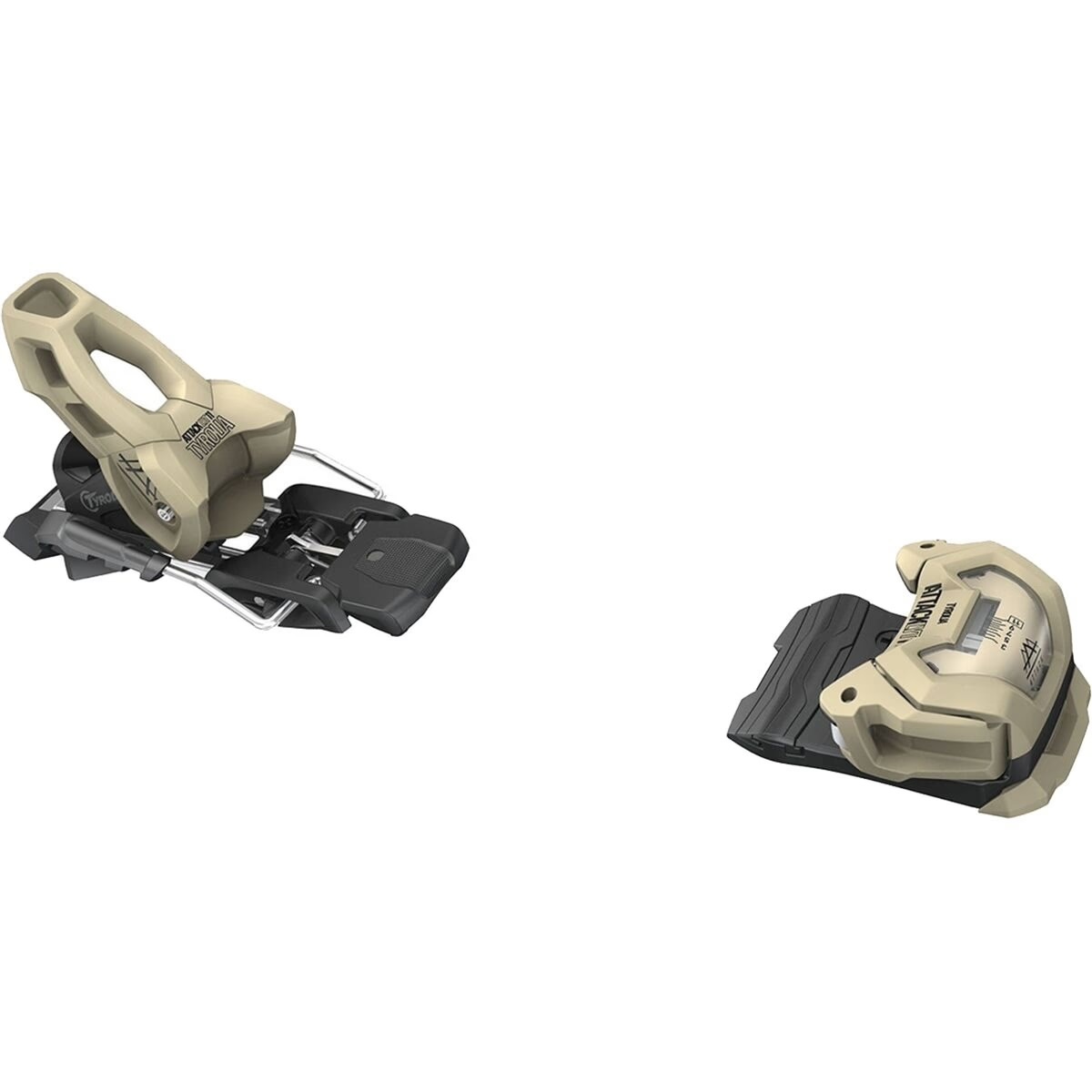
DIN: 3-11
Sole compatibility: Alpine, GripWalk
Brake sizes: 85, 95, 110mm
What we like: Well made and priced right for intermediate skiers.
What we don’t: Lower performance threshold.
Stepping down in price from the Marker Griffon 13 above and many alternatives below, the Tyrolia Attack LYT is a no-brainer for beginners to intermediates putting together a new ski package. Its lightweight toe is strong enough for most resort days and contributes to a very playful feel, and the Tyrolia’s platform is well-suited for an average to moderately stiff setup. The Attack also features a low stack height (17mm), which will increase the feeling of connectedness with your skis.
Considering the lightweight plastics and lower DIN, these bindings are not for hard chargers or heavier skiers trying to extract every last ounce of performance from their skis (the Griffon above and Look Pivot below easily win out for those scenarios). But for casual resort-goers who stick mostly to green and blue runs, the Tyrolia Attack LYT 11 is a solid pick. And compared to Marker’s popular budget offering, the Squire (below), it offers a better step-in feel and weighs around 170 grams (6 oz.) more per pair, which translates to better overall durability.
See the Tyrolia Attack LYT 11 GW
.jpg)

DIN: 6-15
Sole compatibility: Alpine, GripWalk
Brake sizes: 95, 105, 115, 130mm
What we like: Standout elasticity with its heel piece; high-quality metal construction.
What we don’t: Pricey and overkill for casual skiers.
The Look Pivot series is a classic in the world of alpine skiing. Its signature piece is the Pivot heel, which the brand nailed the mechanics on over a quarter-century ago: It gives the binding a short footprint on the ski, allowing for natural flex, and has industry-leading elastic travel to help prevent knee injuries and avoid pre-releasing (a plus for aggressive skiers and those hitting big features). This binding has served some of the world’s best skiers for decades and continues to be a solid choice for intermediate to expert-level riders.
Essentially a toned-down version of the legendary Pivot 18, the 15-DIN Pivot offers full metal construction (including the toe piece) for standout durability. What’s more, the design is compatible with GripWalk as well as standard alpine (ISO 5355) boot soles, which is a nice modernization that brings it up to speed with most bindings here. It’s true that the Pivot line is overkill and pricey for casual riders—even the “entry-level” 12 model comes in at $330—but it’s difficult to beat the combination of build quality, lateral release, and longevity. For those who like to drive their skis hard, you’d be hard-pressed to find a more capable binding.
See the Look Pivot 15 GW
.jpg)

DIN: 6-13
Sole compatibility: Alpine, Touring, WTR, GripWalk
Brake sizes: 90, 100, 110, 120mm
What we like: Uncompromised uphill and downhill performance.
What we don’t: Expensive and heavy compared to touring-specific tech bindings.
For those who like to split their time between the resort and backcountry, the Salomon S/Lab Shift2 MN 13 is our favorite quiver-of-one binding. The key ingredient is the toe piece, which functions like a touring-specific tech binding for uphill travel but converts into a traditional downhill design once you’re in ski mode. This gives the Shift2 impressive versatility: you can wear your downhill boots and put down the power on hardpack and crud, or go lightweight with your touring setup on a backcountry adventure. And when Salomon updated to version "2," they made some thoughtful changes to the versatile design, including a revamped AFD plate for a more precise boot-to-binding connection, a more reliable brake lever, reinforcements in key areas like the toe lever, and a higher climbing aid for improved uphill performance.
Skiers looking for a do-it-all binding simply won’t find a better design than the S/Lab Shift2. It’s noticeably lighter and lower-slung than hybrid frame styles like the Tyrolia Ambition below, and unlike Marker’s similarly intentioned Duke PT, it doesn’t have removable parts that might get lost in the bottom of your pack. Plus, the Shift is certified to alpine safety standards, and we have no hesitations about subjecting it to regular resort use. But the Salomon is heavier than standard tech bindings, and you’ll have to be a bit choosy with your boots (it’s not compatible with boots that don’t meet the ISO 9523 touring standard, including many racing and ski mountaineering models). Of note: the Shift is also sold under the Armada and Atomic brand names (all three are part of the Amer Sports group), with the only difference being color.
Read more: Salomon S/Lab Shift2 review (prior version)
See the Salomon S/Lab Shift2 MN 13
.jpg)

DIN: 5-14
Sole compatibility: Alpine, GripWalk
Brake sizes: 90, 100, 115, 130mm
What we like: A low-profile binding that helps you get the most out of your skis.
What we don’t: Not time-tested; lightweight materials often have durability issues.
A relatively new offering, the Atomic Strive (also sold under the Salomon and Armada names) represents an evolution in binding design, prioritizing a responsive, close-to-the-snow feel and high-end power transfer. The philosophy is this: If you can lower the boots’ center of mass and reduce the weight of the toe piece, you can effectively eliminate the binding from the ski-boot-binding equation, thus allowing the ski (and the skier) to shine. True to form, the Strive’s toe piece is significantly lighter than similar Salomon designs, and the binding sets the boot a lot lower than most of the multi-norm competition. To further enhance the strong base, it also features an extra-wide toe pedal, which helps you generate power to your edges with ease.
Similar to the debate between minimum and maximum cushioning in the running shoe world, there will always be skiers who appreciate the added leverage of a binding that towers over their racing skis. But tall stand heights are less effective the wider a ski gets, which is where the need for a binding like the Strive comes in (we mounted it on the 102mm-wide Blizzard Sheeva 10). Our tester didn't find it to be the easiest binding to step into, but it wasn’t enough to affect her overall experience. Finally, keep in mind that the Strive is also available in a 16-DIN version, which offers the versatility of multi-norm compatibility.
See the Atomic Strive 14 GW

DIN: 6-16
Sole compatibility: Alpine, Touring, WTR, GripWalk
Brake sizes: 90, 100, 110, 120mm
What we like: Bomber construction that isn't overly hefty.
What we don’t: Too much binding for most skiers; expensive.
Marker’s Royal Family of bindings covers a wide range, from the intermediate-friendly Squire (below) to the burly Duke PT for backcountry specialists. For the hardcore alpine skier that needs a high DIN, the Jester amounts to a beefed-up version of the Griffon above. In short, you get a bump up in max DIN from 13 to 16 and the addition of magnesium in a few strategic places. The extra metal increases rigidity without a big weight penalty, and it also adds a degree of security for those who like to hit big jumps in the park (although the plastic Griffon is very tough).
Despite its reputation and popularity among professional skiers, the Jester is bumped down on our list because it’s more binding than most skiers will ever need. Even expert-level riders will be plenty happy with the 80-gram-lighter Griffon in most instances. And tacking on more cash to what is essentially the same design feels pretty steep. But for the skier who's out every day all season and likes to drive hard, the Jester is a proven option. And if 16-DIN is (somehow) not enough for you, there is an 18-DIN Jester Pro, which is made for those tackling big-mountain lines and drops.
See the Marker Jester 16

DIN: 3-10
Sole compatibility: Alpine, Touring, GripWalk
Brake sizes: 85, 95, 105, 125mm
What we like: A reasonably priced backcountry binding that’s compatible with standard downhill boots.
What we don’t: Lacking in stability and power on the descent.
Some people want the option to tour or step through the access gates for the occasional sidecountry run, but don’t want to empty their bank accounts on all new boots and bindings. Enter the Tyrolia Ambition: a frame-style touring binding that’s compatible with a range of boot designs (including downhill, touring, and GripWalk soles) thanks to its sliding, tube-like frame and toe piece. This translates to easy versatility—unlike the Shift above, you don’t need tech fittings for uphill travel, which is great for skiers who want to dip their toes into the backcountry without investing in a new (and expensive) pair of boots.
The Tyrolia Ambition manages to stay fairly lightweight for a budget frame-style binding, which is good news for the ascent. Cutting weight does result in compromised stability and power on the descent (including a towering 38mm stack height), and aggressive riders will be better off with a harder-charging and lower-slung design like the Shift. But the Ambition is completely serviceable for beginner to intermediate skiers, and it’s also a nicely stable option for those new to the skin track: You get a grand total of four climbing heights (some may find this overkill) and the option to add a crampon. All told, for backcountry-curious resort skiers or those on the hunt for a cheap and versatile touring setup, the Ambition 10 is well worth a look.
See the Tyrolia Ambition 10
 DIN: 3.5-11
Sole compatibility: Alpine, GripWalk
Brake sizes: 90, 100, 115mm
What we like: Purpose-built for smaller skiers; makes stepping in easier than most.
What we don’t: Trimmed-down build isn’t good for heavy or aggressive riders.
Getting into your bindings in soft and deep snow isn’t always an easy task, especially for particularly lightweight skiers. Salomon’s Stage tackles this issue head-on, with a smooth-triggering heel piece that doesn’t require too much force to lock in the boot. Further catering to its user group, you also get a short footprint for better ski flex on small skis and a competitively low weight (1720g or 3 lb. 12.6 oz. for the pair). In fact, Salomon claims the Stage to be the lightest 11-DIN flat binding on the market—great news for beginner or intermediate riders who don’t want to throw a ton of weight around with every turn.
The Stage is an ideal ski binding for teenagers and smaller adults who are new to skiing, and the price is right. But it’s important to recognize the limitations of the design. The Stage is not built to handle the force exerted by heavy or aggressive skiers, and younger riders are bound to grow out of it. Further, it’s only compatible with standard alpine boots (ISO 5355) or those with GripWalk soles. But if you’re a casual resort skier who’s had difficulty stepping into bindings in the past, the Stage is certainly worth a look.
See the Salomon Stage GripWalk 11
 DIN: 3-11
Sole compatibility: Alpine, GripWalk
Brake sizes: 85, 95mm
What we like: An innovative option for those particularly worried about their knees.
What we don’t: Pricey, hard to get into, and tall stack height.
Every year, thousands of skiers have season-ending knee injuries, which gives the aptly named Tyrolia Protector a lot of appeal. Here’s how this binding works: Rather than a standard alpine binding that releases either laterally at the toe or upward at the heel, the Protector adds a lateral heel release to alleviate potentially dangerous pressure on your ligaments. If your boot moves 7 millimeters (or more) laterally, the heel will twist 30 degrees to release it. And to address potential unwanted ejections, Tyrolia developed a system that quickly re-centers your boot following small lateral shifts. For skiers with knee issues (or those wary of joining the club), the Protector is an innovative option to consider.
What are the downsides of this unique setup? The Protector requires a lot of force to step into, especially for those with shorter boot sole lengths or at the higher DIN settings. What’s more, its tech requires a tall stack height (33.5mm), which can leave you feeling like you’re skiing on demo bindings (it's especially noticeable when mounted on wide skis). And finally, they’re not cheap when you factor in the relatively low 11-DIN max. But for skiers with pre-existing injuries or weak knees, the Protector could mean the difference between getting out or staying home on the couch.
See the Tyrolia Protector PR 11 GW
In our quest to seek out and test the best gear, we often come across products that are decent but don’t quite shine in any way. Rather than keeping that information to ourselves, we like to inform our readers what else we have tested and why it isn't one of our top recommendations.
The Marker Squire 11 is a dependable and relatively affordable binding suitable for casual skiers. However, it’s not as durable as similar models from other manufacturers that cost less, so we have opted to remove it from our lineup.
We also removed the Cast Freetour Pivot 18 from this list, mainly because it’s overkill for most people. It’s a beefy all-around binding with an innovative touring/alpine hybrid design that offers a high DIN range, numerous brake width options, and no-holds-barred downhill performance. But between the price, the swappable toe pieces to keep track of, and a DIN range that’s too high for all but the most aggressive skiers, the Pivot 18 is ultimately for a very niche crowd.
Lastly, the Look SPX 13 GW is a solid value for intermediate to advanced resort riders; however, we’ve recommended bindings with similar maximum DINs above that are lighter and compatible with a wider range of boots within the same price range.

| Binding | Price | DIN | Sole | Weight (pair) | Brake Sizes | Height |
|---|---|---|---|---|---|---|
| Marker Griffon 13 | $300 | 4-13 | Alpine, Touring, WTR, GW* | 2060g | 90, 100, 110, 120mm | 24mm |
| Tyrolia Attack LYT 11 | $229 | 3-11 | Alpine, GW | 1810g | 85, 95, 110mm | 17mm |
| Look Pivot 15 GW | $480 | 6-15 | Alpine, GW | 2490g | 95, 105, 115, 130mm | 19mm |
| Salomon Shift2 MN 13 | $680 | 6-13 | Alpine, Touring, WTR, GW | 1840g | 90, 100, 110, 120mm | 24.2mm |
| Atomic Strive 14 GW | $280 | 5-14 | Alpine, GW | 2004g | 90, 100, 115, 130mm | 19.6mm |
| Marker Jester 16 | $470 | 6-16 | Alpine, Touring, WTR, GW | 2140g | 90, 100, 110, 120mm | 24mm |
| Tyrolia Ambition 10 | $475 | 3-10 | Alpine, Touring, GW | 1960g | 85, 95, 105, 125mm | 38mm |
| Salomon Stage GW 11 | $190 | 3.5-11 | Alpine, GW | 1720g | 90, 100, 115mm | 18.2mm |
| Tyrolia Protector PR 11 | $319 | 3-11 | Alpine, GW | 2320g | 85, 95mm | 33.5mm |
*Note: WTR stands for walk-to-ride, and GW stands for GripWalk. For more information, check out this helpful article from Evo.
Though it's certainly more fun to drool over the many boot and ski options on the market, arguably no piece of gear deserves more scrutiny than your bindings. Essentially the "glue" of your setup, your binding choice will directly impact your safety, performance, and confidence on the mountain. Drawing from decades of experience on the slopes, we kicked off this guide in 2015 with 10 resort and backcountry designs. We've since separated the lists (you can check out our backcountry-specific picks here), with most of the options above being best suited for downhill use (some, like the Salomon Shift, can pull double duty for touring).
This guide is currently spearheaded by editor and avid skier Maddie Downie and our snowsports editor Ross Patton. Maddie is based in Washington state and can often be found touring in the North Cascades during the winter months, but she spends a good amount of time at the resort, too. Ross began skiing as soon as he could stand up, and having skied, snowboarded, toured, and even telemarked for 100 days a year for decades, he is no stranger to the intricacies that separate a top-tier product from one that’s best left on the shelf. To fill in the gaps, we rely on feedback from trusted gear testers and contributors in our community.
In assembling our list of 9 ski bindings above, we took several factors into consideration. Before hitting the slopes, we look closely at overall construction and build quality, ensuring that each binding we test is built to withstand regular use and abuse. User-friendliness is also always top of mind, and we do what we can to test each binding in a variety of conditions and climates throughout the season. Finally, we appreciate when bindings are compatible with a wide range of boot soles, which is why designs like the Marker Griffon and Salomon Shift rank so highly. As the market continues to evolve, we'll be sure to keep our finger on the pulse, updating the list above from time to time to reflect new innovations and standout performers.
.jpg)
A good ski binding stays securely attached to your ski boots while you’re cruising down the slopes, but is built to release under force, such as in the event of a fall (the last thing you want is to tumble down a hill with long planks attached to your feet). Standard ski bindings have two primary release points: the toe, which releases with side-to-side force, and the heel, which responds to front-to-back force (the Tyrolia Protector notably adds a lateral release at the heel). These release points can be tightened or loosened to find the right tension for your body and ski style—and this is where the DIN number comes in.

DIN, which is short for Deutsches Institut für Normung (you can see why it’s shortened), refers to a standardized test that defines the amount of force at which a binding will release a locked-in boot. The numbers range from 1 to 18, and the higher you go, the longer the binding will hold you. High numbers are great for larger folks and those who like to ski aggressively, while lower numbers are well-suited towards skiers with lighter frames or less powerful styles. Understandably, this is a very important number to get right, as a binding that releases either prematurely or too late can have pretty serious safety ramifications—not to mention an impact on performance. And while you’ll see a release range provided for every make and model of binding in the industry, keep in mind that not every binding has actually been DIN certified by the folks in Germany.
.jpg)
For DIN recommendations, let us start by clarifying that even the charts compiled by respected retailers like Evo, REI, or Backcountry are not a replacement for consulting a professional at a ski shop. Our take is that if you’re not qualified and it’s a safety item, let the pros take care of it for you. Tools like the Professional DIN Calculator can help you estimate your DIN setting by compiling information like age, weight, height, boot sole length, and ability level. When shopping for your right setup, it’s a great idea to use this to ballpark your necessary DIN range. Finally, it’s best to choose a binding that doesn’t put you at the maximum DIN setting right off the bat (e.g., don’t get a 12-DIN binding if you’re planning on setting it at 12). Ideally, your calculated DIN setting should fall somewhere near the middle of the range of your binding. That way, you can dial it up if you find that your bindings are releasing too easily or turn the DIN down if you think you took a spill where they should have released and didn’t.
.jpg)
Elastic travel is less marketed than DIN but equally as important. It comes into play after the initial force has been applied and the boot has moved in the binding (in other words, the release has been triggered). Specified in millimeters, a binding’s elasticity describes how far the boot can travel away from the center before releasing completely. A higher elasticity denotes more “give,” which translates to more impact absorption and less unwanted prerelease.
As expected, there’s an important interplay between the release value and elastic travel: With a good amount of elasticity, even aggressive skiers can set a relatively low release value—thus guarding against injury—while still avoiding premature ejection. A case in point is the Look Pivot, a binding that has gained legendary status amongst hard-charging freeriders. The Pivot is known for its swiveling heel piece, which provides industry-leading elastic travel, offering the shock absorption needed to save your legs without losing your skis each time you fall or take a hard turn. In general, you’ll spend up for the added tech that leads to more elasticity, but the trade-off is worth it for those who want the best balance of performance and safety.
.jpg)
Boot sole compatibility has been a moving target in the downhill and backcountry binding worlds for several years, and it’s very important to ensure that your setup(s) match. Starting with traditional downhill boot soles (listed as Alpine DIN or ISO 5355), it’s simple and clear—all the bindings above are compatible. Moving to GripWalk and Walk to Ride (WTR), these designs are found on both downhill and backcountry boots, and not all bindings will work. And finally, an even smaller number of bindings are set up to accommodate touring soles (ISO 9523).
.jpg)
The good news is that there is a growing number of bindings that are compatible with a wide range of sole types, including Marker’s Sole.ID and Salomon’s MNC (multi-norm certified) offerings. For example, the Marker Griffon 13 can be adjusted to fit all of the sole types listed above. This comes with a simple benefit to skiers: You can ski multiple setups with one boot. To help navigate this somewhat messy world, we’ve included a “sole compatibility” spec in our product descriptions and comparison table above. Importantly, the sole types described here cover a good portion of the market, but there are outliers in the skimo racing and ski mountaineering categories (these boots are also referred to as "non-compliant," meaning they don't meet the ISO 9523 touring standard). The takeaway is that you’ll want to thoroughly research both your boots and bindings before purchasing them. To help you navigate the topic, check out our comprehensive Ski Boot and Binding Compatibility Guide.
.jpg)
Sometimes the small details can bite you in choosing ski gear, so make sure not to overlook the brake width of your bindings. There will often be a number of sizes to choose from (listed in millimeters) for a particular model, and it’s a good idea to get a width that closely matches the waist width of your skis—part of the reason it’s always smart to select your skis prior to picking a binding. There are no hard and fast rules about what width to choose, but we recommend selecting one that is at least the exact waist width of your skis (or not less than a few millimeters to allow a ski shop to bend the bars slightly). On the flip side, you also want to avoid a brake that is too wide, as it may drag if you’re carving on hardpack. The typical recommendation is to choose a binding that is no more than 10 to 15 millimeters wider than your ski's waist, although we typically aim to be less than 10 millimeters.

The stack height—also referred to as stand height—of a binding refers to how high it sets your boot off the top of the ski. Just as some runners prefer max-cushioned shoes while others go barefoot, stack height can be a matter of preference, although in most cases we recommend a lower-slung design. With a shorter stack height, you get a better connection to the ski and the snow, improving control and stability on uneven terrain (interestingly, ski racers love a high stand height for better leverage). Stack height is often a few millimeters higher in the heel than the toe, and most bindings here hover in the low-to-mid 20-millimeter range. Frame-style bindings and knee-saving designs like the Tyrolia Protector have higher stack heights due to added tech underfoot (the Tyrolia Ambition is 38mm), which is something to keep in mind when opting for these designs.

The weight of a binding is typically not a serious consideration for resort skiers. Most bindings with a DIN rating of 12 or higher weigh approximately 5 pounds for the set (about 2,200 g), thanks to a sturdy spring in the heel, long-lasting plastic and metal components, and advanced safety systems that reduce the risk of premature release and injury. Bindings with lower DINs are often lighter, given their less tech-heavy designs. A heavy setup can be a pain to haul around from the car to the lodge or when hiking into the sidecountry, but it’s widely accepted that the advantages in performance and durability are worth it. On the other hand, weight is a far more important consideration for backcountry skiers, which is why we see bindings like the Salomon S/Lab Shift2 MN clocking in a bit lower (1840g or 4 lb. 0.1 oz. per pair).
.jpg)
A growing number of bindings can accommodate a wide range of ski boot soles (including GripWalk, WTR, and touring designs), but this versatility does not mean you get uphill capability. Sure, you can pair them with your touring boot, but most of these bindings (such as the Marker Griffon 13) can still only go downhill. However, within this multi-norm category, there are a few innovative hybrid designs that get the job done both on the ascent and the descent, which is great news for skiers who want to use one setup for both frontcountry and backcountry travel.
The Salomon S/Lab Shift2 is the headliner of the hybrid binding department, featuring an innovative toe design with two modes. You get a pin binding for uphill travel—functional with a tech boot only—and in ski mode, the pins are replaced by an alpine toe piece (compatible with many boot styles). With excellent elasticity and power transfer, the Shift is a legitimate quiver-of-one tech binding that truly performs while lapping the resort. Given the excitement surrounding the concept and the increased interest in backcountry activities in general, we fully expect to see more dual-compatibility technology options in the future. For a detailed look at the current market, check out our article on the best backcountry ski bindings.
.jpg)
If you’re new to the sport or haven’t made a purchase in a while, you’ll notice that ski listings fall into two general groups: expensive skis that do not include bindings and pre-packaged ski and binding combos. The benefit of choosing a pre-packed setup is value: You can find a 10-DIN binding and ski for $600 or less. The downside should be obvious considering the cost: They're not as good in terms of quality, particularly as you improve your skiing abilities. If you fall into the advancing intermediate category or above, we recommend purchasing your bindings and skis separately in most cases. (Editor’s note: What we consider to be a pre-packaged ski and binding setup does not include a select number of high-end packages offered from retailers like Evo, which often include the bindings we have listed above).

For beginners or those who are looking to save money, the pre-packaged models are plenty capable for having fun on a blue square run at the resort. To see our full list of recommended designs, check out our article on the best beginner skis. And to complete the setup, we’ve also detailed the best ski boots for beginners.
Realistically, bindings will be towards the end of your ski gear search. The flashy and fun stuff is the skis themselves, so get that part squared away before moving to boots and bindings. Outside of the basic compatibility issues between boots and bindings that we touched on above, it’s important to choose a setup where all components complement each other. Don’t throw a low-DIN binding on a heavy downhill-focused ski—it’s just a waste of a lot of cool technology (and cash). Similarly, you’ll probably want to steer clear of pairing a high-end binding with an ultralight touring ski that isn't powerful or stable enough for carving. To help in the process, see our top picks for all-mountain skis, intermediate skis, and downhill boots.
.jpg)
When ordering skis and bindings online, it’s important to understand that most of the time, the bindings will not arrive mounted. If you have a local ski shop or order from a retailer like REI, it’s as simple as paying to get the bindings mounted on the skis. The typical cost is around $70 to $100 (REI can do the mounting for you, and members get 20% off the full price). And don't forget you'll need to bring your boots as well, so they can get everything set up and adjusted properly.
Back to Our Top Ski Binding Picks Back to Our Ski Binding Comparison Table

bcdc.jpg?h=fbc67360&itok=wmPMXiEZ)
832e.jpg?h=fbc67360&itok=ofljNFTS)
_07271.jpg?h=fbc67360&itok=JN5sRDFr)
14ab.jpg?h=fbc67360&itok=1n06ZZey)
_01074.jpg?h=fbc67360&itok=LZfjph4c)
d2fe.jpg?h=fbc67360&itok=9OxKROqi)

379a.jpg?h=fbc67360&itok=FRXGLkaB)