
Photo Credit
It’s that time of year! Time to find the perfect present for our adventurous loved ones. For that person in your life who loves all things cold weather, check out our gift guide for skiers and snowboarders. For ideas tailored to other pursuits, we also have more editor-recommended gift guides to explore. Happy gift giving!
Beginner skis offer great value and an easy platform for learning the basics of turning, balance, and control. In short, they make it easier to learn proper technique in less time. Beginner models come either as an integrated system with bindings or as a flat ski that requires you to purchase the bindings separately (we indicate if they come with bindings in the product title and our comparison table). For the 2025/2026 season, our top recommendation is the Rossignol Sender Soul 92, which has a friendly sidecut, an all-mountain width, and includes a set of entry-level bindings. For background information to get started, check out our buying advice, and to complete your setup, we’ve also written about the best beginner ski boots.
Editor's note: This article was updated on December 22, 2025, to include fresh options for the season and provide additional information about our testing process. We also ensured that all turning radii are listed for the 165cm length (or as close to it as possible) to provide a consistent point of comparison between skis.
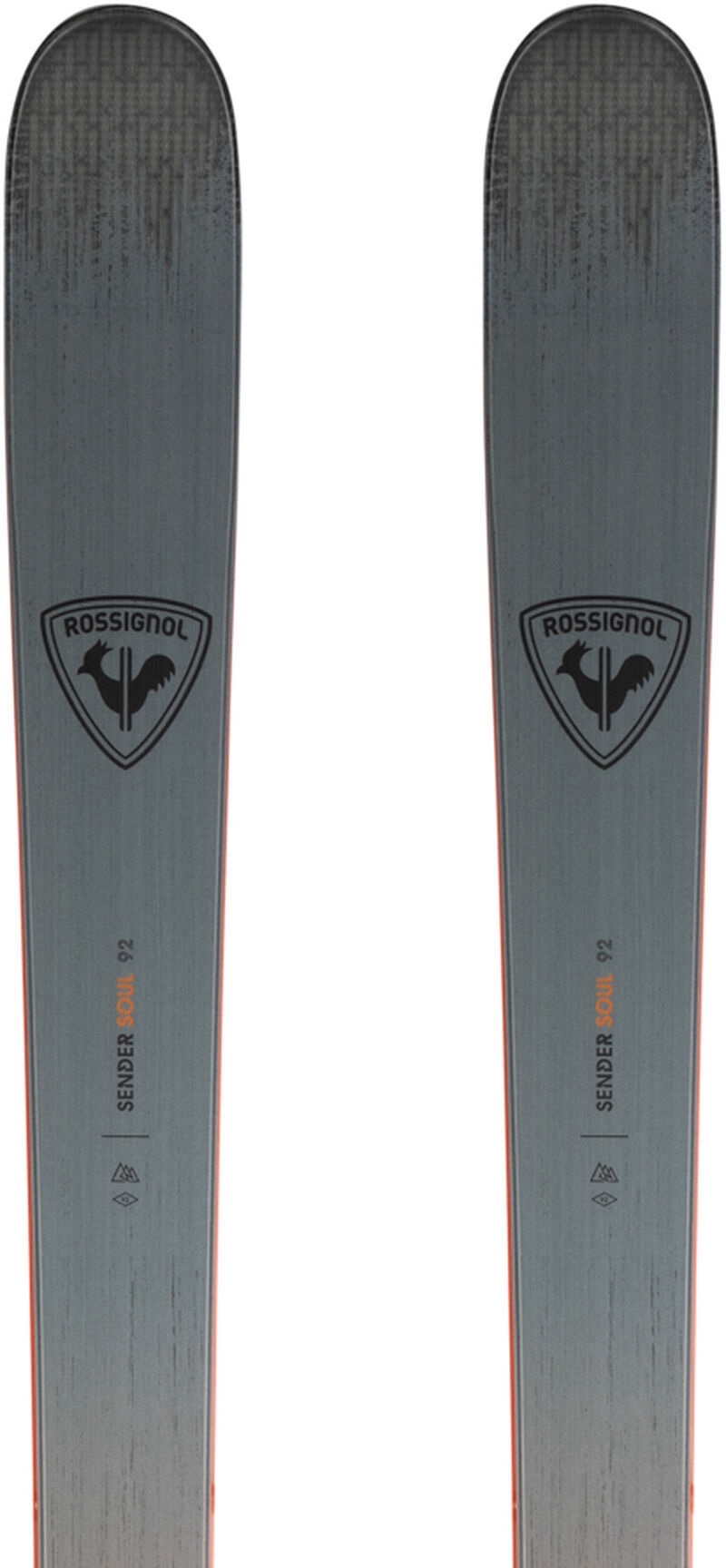
Dimensions: 122-92-112mm
Turn radius: 16m
Ability level: Beginner to intermediate
What we like: Well built and plenty capable for beginners up to solid intermediates.
What we don’t: May be too wide for certain conditions.
A beginner design that you’ll grow out of in a season isn’t a great buy, which is why our top pick is the well-rounded Rossignol Sender Soul 92. This ski has the build and versatility to handle groomed runs, off-piste terrain, hardpack, or powder. The wide turning radius will help beginners learn to initiate turns and drive the ski, while the gentle rocker camber in the tips is ideal for chewing up variable snow types, as you learn to get forward in your boots. The included Look Xpress 11 bindings are an ideal entry-level option, with a DIN range from 3.5-11, which allows you to make the bindings less prone to eject as your skiing skill set grows and you become more aggressive.
Since the Sender Soul 92 is a bit of a jack-of-all-trades ski, it doesn’t quite stand out for any one particular use. It’s decent in powder, but it isn’t quite wide enough to be our go-to on a true powder day. The turning radius is great for all-mountain, but a deeper sidecut with a skinnier waist is more helpful for learning to carve. The paulownia wood core is light and agile, but if you’re charging hard, a beefier ski is ideal. All of that said, the Sender Soul 92 is a great all-around ski for learning and deciding which direction you’d like to take your skiing in the future.
See the Rossignol Sender Soul 92
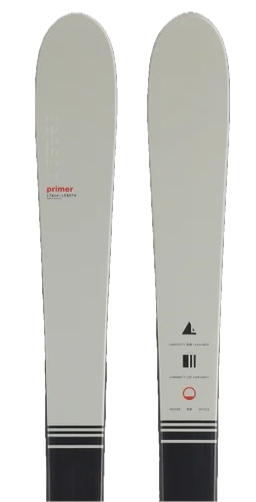
Dimensions: 126-87-120.5mm
Turn radius: 14.5m
Ability level: Beginner to intermediate
What we like: Soft, friendly, affordable, and free wax jobs.
What we don’t: Lacks stiffness for advanced terrain.
A relative newcomer to the ski industry, Season has been thoughtful enough to include beginners in their lineup—a move we rarely see from industry newbies. Their entry-level model, the Primer, is soft and playful with a poplar core. The triple radius sidecut takes a larger radius at the tip and tail and blends it with a smaller one at the waist, which means the skis don’t want to catch or hook when you’re making mellower turns, but as you begin to learn how to carve, they’re capable of laying perfect trenches as a trained ski racer could. On top of their low price point, they are available with bindings if you'd like to do a package, and if you’re near an Evo, you become a member of Season’s lifetime service pass, where you get free mounting, unlimited free waxes, and an annual tune-up for the life of the skis.
The biggest drawback of the Primer is that your skills may outgrow the performance of the ski fairly quickly. We’d say they’re perfectly fine for people who are new to the sport and most intermediate skiers, but if you’ve recently moved to a ski town and are hell-bent on conquering double black diamonds by the end of the season, it would be wise to go with a burlier set of planks. And like most entry-level skis, the Primers aren’t built for floating in powder. With a slim waist, there is substantially less surface area than skis that are even 5mm or 10mm wider, so even on the green runs, these skis are going to be a lot of work in fresh snow.
See the Season Primer

Dimensions: 117-85-109mm
Turn radius: 14.5m
Ability level: Beginner to intermediate
What we like: Good price for a fun and playful setup; eye-catching topsheet design.
What we don’t: A little more freestyle-oriented than the typical beginner ski.
As prices have increased at the middle and high end of the all-mountain ski market, a growing number of “entry-level” variations have been released. These designs follow a basic formula: simplified core constructions, softer flexes, and narrower dimensions for frontside use. Atomic’s Bent 85 here checks all of those boxes but with a twist: It's based on the legendary Bent Chetler 120, which is our current favorite powder ski. Trimmed down to an 85-millimeter waist, this ski retains its high-end sibling’s playful feel and willingness to turn in just about all conditions. While many beginner and intermediate skis are designed for skiing in one direction, this model features tails as well-defined as its tips, allowing you to take off, land, or simply go down the mountain backwards. And with the most fun and vibrant topsheet design on this list, the Atomic is a treat to look at, too.
Who is the Bent 85 best for? If you’re a beginner, the ski's rocker profile makes it easy to pivot and control at low to moderate speeds. But we think its ideal pairing is someone who plans to get out a lot and will be exploring more of the mountain right away, including the terrain park where its twin-tip layout allows you to ride switch. Keep in mind that the more affordable price does come with some downsides. In particular, we don’t love the hybrid wood/synthetic core that sacrifices a little of the natural flex and longevity of an all-wood design. But for the price, it’s hard to nitpick too much, and we fully expect this creative design to be a top choice among beginner and intermediate riders.
See the Atomic Bent 85
 Dimensions: 128-85-116mm
Turn radius: 11.9m
Ability level: Beginner to advanced
What we like: Great option for those who live in areas with consistently good snow.
What we don’t: Not great hardpack performance.
K2’s Mindbender all-mountain ski line goes as wide as 116 millimeters, but we love the narrowest 85 as an introduction to soft snow. Compared to our top pick, the Mindbender’s wider shape and increased rocker in the tip give it more flotation and a comfortable platform on groomers. It’s a little less willing to change direction quickly, however, which can be a detriment to those just starting out. But for cruising green and blue runs, the K2 is buttery smooth and relatively effortless.
At $500 without bindings, the Mindbender 85 offers decent value and is also available with Quikclik bindings for not that much more. A downside, though, is that the ski is a little soft for our tastes as a frontside carver, so it’s best for those who live in areas with consistently good snow or who plan to explore the untracked parts of the mountain as they progress. And for those with big-time powder ambitions, it’s worth considering investing in an even wider ski like the Line Pandora (99mm at the waist) below.
See the K2 Mindbender 85 See the Women's K2 Mindbender 85
 Dimensions: 125-78-104mm
Turn radius: 14.6m
Ability level: Beginner to intermediate
What we like: A great on-trail performer that grips well while turning.
What we don’t: The carving-friendly profile is not ideal for off-piste snow and terrain.
Elan flies a little under the radar in the U.S. market, but they consistently impress with a quality lineup of playful and quick-reacting skis. At the entry-level end of their on-trail-focused Wingman collection is the 78 C, which includes a couple of the brand's signature design elements. One is their asymmetrical setup—there are dedicated right and left skis—that allows them to tailor the rocker/camber profile. On the outside, there’s more rocker for easy turning, and on the inside, you get a bit more camber for improved precision and grip while on edge. The net result is one of the best groomed run performers in this entry-level sector.
There are several key differences that distinguish a ski designed for carving from models geared toward all-mountain or freestyle use. They tend to have an hourglass shape with very slim waists or, in the case of the Wingman 78 C, the sidecut is tapered to create a tail that’s skinnier than the tips. While this is ideal for carving corduroy, the width can leave you wanting more ski in variable terrain, especially if you’re leaning back in the powder. And while the asymmetrical profile is helpful for carving, if you accidentally step into them on the wrong foot, you might have a pretty funky run. This particular ski also doesn’t have the burliest construction—it features some carbon reinforcements, but the core is a combination of wood and foam. We’ve come to prefer cores that are primarily made of wood, as they tend to last longer and outperform skis with synthetic fillers.
See the Elan Wingman 78 C
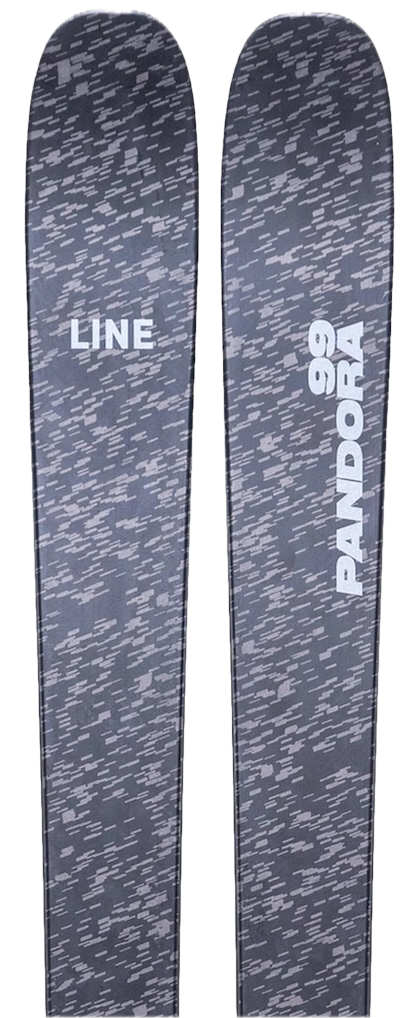
Dimensions: 130-99-120mm
Turn radius: 14.5m
Ability level: Advanced beginner/intermediate to expert
What we like: Light, playful, and forgiving; enough pop to keep advanced riders smiling.
What we don’t: Pricier than many alternatives and no bindings included; less beginner-friendly than most options here.
As we touched on above, the term "beginner" can mean different things to different riders. For skiers who already have some experience under their belt but are still building their confidence, the Line Pandora 99 strikes a really nice middle ground. Previously a popular women's-specific ski, Line transitioned their Pandora line to unisex for the 2024 season. Known for its playful, soft, and forgiving feel, this ski excels in a wide range of conditions, both on- and off-piste, while remaining light enough for beginners to maneuver. And it's reasonably priced for a design that will last many seasons (unlike true beginner models, which will likely require upgrading sooner as you progress).
That said, the Line Pandora 99 lands at the bottom of our rankings for a couple of reasons. First, the skis come flat, which means you'll need to research, purchase, and mount a pair of ski bindings before hitting the slopes—an added cost and complexity that can be avoided with an integrated setup. It's also less beginner-friendly than most alternatives here—we'd recommend a narrower and easier-to-manage design, such as the Season Primer or Elan Wingman 78, to brand-new riders. To be fair, the Pandora is stable and easy to command for a 99-millimeter-wide ski, and the double-rocker shape (with some camber underfoot) allows for quick pivoting and easy maneuverability in tight terrain. But overall, the Pandora is a little more specialized than most designs here—great for those with a solid foundation who are looking to start exploring more of the mountain, but decidedly overkill for first-timers.
See the Line Pandora 99
| Ski | Price | Bindings | Dimensions | Radius | Ability Level |
|---|---|---|---|---|---|
| Rossignol Sender Soul 92 | $750 | Included (11 DIN) | 122-92-112mm | 16m | Beginner - intermediate |
| Season Primer | $450 | Not included | 126-87-120.5mm | 14.5m | Beginner - intermediate |
| Atomic Bent 85 | $550 | Included (10 DIN) | 117-85-109mm | 14.5m | Beginner - intermediate |
| K2 Mindbender 85 | $500 | Not included | 128-85-116mm | 11.9m | Beginner - advanced |
| Elan Wingman 78 C | $650 | Included (10 DIN) | 125-78-104mm | 14.6m | Beginner - intermediate |
| Line Pandora 99 | $650 | Not included | 130-99-120mm | 14.5m | Intermediate - expert |
Skiing is a favorite pastime among most of the editors at Switchback Travel. And while many have come a long way since our humble beginnings, we’re acutely aware of what goes into making a beginner-friendly ski. Former members of our team kicked off this guide back in 2015 with a selection of 10 options for those just starting out. Editor Ross Patton currently manages the guide, with input from other team members and key contributors. Ross started skiing as soon as he could stand up and began ski racing at the age of seven. After winning the Colorado State Championship as a teen, he set his eyes on freeriding and backcountry rather than the race course. With more than 25 years of experience in the snowsports industry, he’s watched the evolution of skis from the long, stiff, straight planks of the '90s to the wide, parabolic all-mountain machines of the modern day.
Our current lineup of six beginner-friendly skis above is the result of ongoing testing, feedback from our contributors, and extensive research. Given the ambiguity of the term “beginner,” we’ve included a relatively wide variety of options, from narrow and easy-to-manage designs for first-timers to wider and more capable models for fast learners who want to start exploring more of the mountain. To make our list, each ski had to stand out in one or more areas, with many striking an effective balance between price and overall performance. And to complete your setup, we took a similar approach with our lineup of the best beginner ski boots.
.jpg)
Beginner skis are defined by a few shared characteristics: a softer flex for easier turn initiation, a lower price point that typically denotes value-oriented materials in the construction, and narrower dimensions because most skiing will be done on groomed runs. In addition, you often get an integrated binding. Skis, almost more than any other gear type, can be broken into simple categories purely by price, and for beginner skis, the ski packages (which include both skis and bindings) should run about $550 to $750 or close to it.
The best option for you, however, is more nuanced and can reach well into what’s considered an intermediate-level model. If you’re brand new to the sport and know that you're going to be sticking to the green circles for a while, a slender, soft model such as the Season Primer is not only capable, but also affordable. If you want an all-around ski that can handle all types of conditions and terrain, the Rossignol Sender Soul 92 is ideal. For those starting out who are athletic or will be spending a lot of time on the mountain, it’s often worth foregoing the true beginner category altogether. The more capable skis that made our list, including the K2 Mindbender 85 and Line Pandora 99, have forgiving characteristics that make them relatively easy to learn on but are also plenty capable at speed and for all-mountain use. The more advanced construction will cost you more, and you often don’t get integrated bindings, but you’ll save money in the long run because you won’t have to replace your skis as quickly. For more intermediate to advanced ski options, check out our articles on the best intermediate skis and best all-mountain skis.
.jpg)
Ski width measurements are given in a set of three numbers, listed in order of the tip (top), waist (middle), and tail (bottom) of the ski. For an indication of performance in varying snow conditions, identifying the waist width of a ski is quite helpful. While all beginner skis are designed for groomed runs, not all groomed runs are created equal. Some areas are prone to icy conditions, where a narrow ski is a great match, while others receive so much snow that powder inevitably accumulates throughout the day. And should you test your developing skills in the trees, a model like the Atomic Bent 85 with a little more waist width can be helpful.
There is not as large a range in waist widths for beginner skis as what you’ll find in more advanced all-mountain or powder ski categories, but here is a good guideline to use:
The profile of a ski can be broken into three main categories: camber, rocker, and mixed rocker/camber. There are others, including skis with a flat bottom shape, but these three are the most popular—and for good reason. Each has its own strengths and weaknesses for skier and snow type, and we detail these below.
Camber
Camber is the traditional groomer ski design. The profile has a half-moon-like shape that peaks right underneath your boot and contacts the ground towards the tip and tail of the ski. While skiing, your weight presses the ski into the snow, and when you lift coming out of the turn, you get a satisfying pop that propels you into the next turn. The design has been popular for many years because it provides even contact with the snow and superior edge control when carving down a groomed slope. As a result, camber is a common choice for beginner skis. However, the benefits of rocker technology are changing the market landscape.
.jpg)
Rocker
Also known as reverse camber, rocker is when the tips of the skis are raised on either end, creating a sort of banana shape to the ski profile. This design originated for its benefits in deep powder, but it has become popular on beginner skis because the raised tip makes it much easier to initiate a turn—something that is often a challenge for beginners. We do not suggest getting a full rocker ski, however, as it doesn’t hold an edge like traditional camber, which is especially notable if you plan to spend a lot of time on groomers refining your technique. Instead, the ultimate beginner ski puts the two designs together with a mixed rocker/camber.
Mixed Rocker/Camber
The most popular ski profile nowadays is the mixed camber/rocker. This is another area where entry-level skis have benefited from earlier advances in technology, with adaptations that suit casual cruising. There are variations in exactly how manufacturers utilize this mix, and for beginners, our favorite is a modest tip and tail rocker with a traditional camber underfoot. This allows a ski like the Rossignol Sender Soul 92 to turn easily but also retain good edge hold and natural flex underfoot. The Line Pandora 99 takes this one step further, featuring a lot of rocker at the tip and tail, while still maintaining some camber underfoot.
.jpg)
Traditional, Racing, or Freestyle
Depending on the intended purpose of the ski, bindings are mounted at different distances between the tips and tails. For ski racing, bindings are mounted closer to the tails because racers need their body weight as far forward as possible to quickly initiate turns, which gives the skis more leverage to flex and turn. These skis are never intended to be skied backwards, and will either have completely flat or gently curved up tails. On the other end of the spectrum, the best freestyle skiers mount their bindings directly in the middle of the ski because they are hitting jumps, rails, and the halfpipe backwards as often as they are forward. These skis, such as the Atomic Bent 85, are often referred to as “twin tips,” which means that the tails are curved up as much as the tips. Most skis fall somewhere in the middle–the bindings are mounted slightly behind the middle of the ski, and they have gently curved tails in case you ever end up going backwards.
As your skills advance and you transition your weight into a turn, you’ll feel the skis naturally rotate at a certain angle. And depending on the ski turn radius (also known as sidecut), this can be either a long, sweeping turn or something a little tighter. Turn radius is measured in meters, and the lower the number, the tighter the turn. The number itself is based on the shape of the ski, moving from the tip to the tail. Most modern skis have an hourglass arc to them, and you get a lower sidecut number with a more dramatic shape (much wider at the tip and tail compared with the waist). For most beginners, a lower turn radius is a good idea because you likely will not be all the way out on your edges in a turn. When you have a lower turn radius, even a more tentative turn can be reasonably tight. Below are some parameters for beginner skis:
Keep in mind that a longer version of the same ski will often increase the turn radius, so if you’re weighing two ski lengths, know that the shorter option will probably be more inclined to turn a little sharper (at the sacrifice of some top-end speed and flotation). For example, a 180-centimeter ski will typically have a longer turn radius than a 150-centimeter length of the same ski. In order to provide a consistent point of comparison between skis, we noted the turning radius for the length closest to 165 centimeters for our comparison table and list of picks above.
.jpg)
In line with their relatively low price tags, beginner-friendly skis focus on the basics in their construction. Options for core material fall into two general camps: foam and wood. Starting with foam (also referred to as composite), these designs are often associated with the inexpensive models you can find at the rental counter. They’re typically very flexible, offer decent vibration control, and are best at low speeds. Stepping up to a wood core provides significantly better energy and pop as you connect turns, greater stability at speed, and a boost in lifespan. As such, almost all of the skis that made our list feature wood in their cores. We think if you’re making the investment in new skis, it’s worth getting a set that can last more than a season or two.
.jpg)
Picking your ski size used to be a pretty simple process, and could be done simply by knowing your height (the center of the forehead was a common match for a ski). Those days are long gone, replaced by a more scientific process. Now, ski manufacturers are basing their recommendations on height and weight. This allows you to maximize the ski’s potential with proper amounts of flex and power transfer. Other considerations include skiing style and ability. Shorter skis are easier to handle for beginners, as they turn faster, while longer skis float better and are more stable at high speeds. In the end, the right skis might only come to your chin, or they may reach past the top of your head, so all your height should do is give you a good ballpark. We’ve found the ski sizing guide from Evo to be helpful for baseline information. For the best match, we recommend visiting your local ski shop to consult with a knowledgeable technician.
As we touched on above, many entry-level skis come as an integrated system of skis and bindings. And while they’ll still need to be mounted and tuned at a ski shop or at the resort before your first run, you don’t have to worry about binding-to-ski compatibility issues (although boot and binding compatibility will be a consideration). What about the quality of these bindings? Most have a plastic-heavy construction as a result of being focused on a price point. For casual use, the more basic designs are completely fine and should still offer multiple seasons of good use, and a properly tuned binding should release safely. You will miss out on a longer-lasting metal construction and advanced technology that rotates the bindings prior to releasing your boot in a fall, which can help reduce knee injuries. Beyond that, an entry-level binding remains a reliable option for resort use.
Should you choose a ski that does not include a binding, check out our article on the best ski bindings for our list of recommendations.
.jpg)
You will see a DIN setting provided for all integrated ski systems, which refers to the amount of force required for a binding to release a boot that is locked in. The numbers can range from roughly 1 to 18, and the higher the number, the higher the forces at which the binding will hold on prior to letting go. Understandably, beginner bindings are designed to release at a lower force to avoid injury, and intermediates will have a higher DIN rating. Skier weight also plays an important role in the binding release, and a higher setting will correspond with a larger skier.
For DIN recommendations, let us start by clarifying that even the charts compiled by respected retailers are not a substitute for visiting a ski shop. Our take is that if you’re not qualified and it’s a safety item, let the pros take care of it for you. Snowsports retailer Evo has put together a helpful chart that breaks down DIN settings by weight and ability, and when shopping for the right setup, it’s a great idea to use this to ballpark your necessary DIN range. And as mentioned in this article by Evo, it’s best to choose a binding that doesn’t put you at the maximum DIN setting right off the bat (i.e., don’t get a 10-DIN binding if you’re planning on setting it at 10). It’s better to have a little wiggle room to make adjustments once you've spent some time with your new setup.
.jpg)
Skis are expensive even at the beginner end of the spectrum, but there are deals to be found. The good news is that changes in technologies aren’t typically groundbreaking from year to year, so if you’re willing to forego the latest colors, you can sometimes save a bundle. For online searching, we’ve found Evo’s Ski Sale selection to typically be the best, including prior-season models and even lightly used gear. The House, Backcountry, and REI also have their fair share of discounted skis and ski packages. It’s important to know that things get picked out rather quickly as the winter progresses, so you’ll have the best luck purchasing early, but we think it’s always worth checking the sale section to avoid paying full MSRP.
.jpg)
As a final note, it's important to carefully consider the boots you buy. Just because you're a new skier doesn't mean that any old boot will do. Trust us, having a nicely fitting and comfortable boot can be the difference between making this a lifelong sport and hucking the whole setup into a dumpster. A beginner boot has a more forgiving feel that flexes rather than a rigid boot that transmits every slight input to your skis. And much like a beginner ski and binding, the softer setup does dull performance, which is why we don’t advise a beginner boot for skilled skiers. To help put together a suitable beginner ski package, we have an article covering our favorite beginner ski boots with the best options for men and women. Have fun out there!
Back to Our Top Beginner Ski Picks Back to Our Beginner Ski Comparison Table

bcdc.jpg?h=fbc67360&itok=wmPMXiEZ)
7114.jpg?h=fbc67360&itok=4SMmCVQE)
%20(s)cbbd.jpg?h=fbc67360&itok=CXKwGr6b)
0ec1.jpg?h=fbc67360&itok=oGaifWVw)
_07271.jpg?h=fbc67360&itok=JN5sRDFr)
_01074.jpg?h=fbc67360&itok=LZfjph4c)
c149.jpg?h=fbc67360&itok=vcIod759)
14ab.jpg?h=fbc67360&itok=1n06ZZey)
