Photo Credit
It’s that time of year! Time to find the perfect present for our adventurous loved ones. For that person in your life who loves all things cold weather, check out our gift guide for skiers and snowboarders. For ideas tailored to other pursuits, we also have more editor-recommended gift guides to explore. Happy gift giving!
Whether you're new to backcountry skiing or have been earning your turns for decades, selecting an alpine touring binding can be a particularly intimidating task. For the 2025/26 season, the market is absolutely flooded with options, ranging from ultralight tech bindings for the uphill-focused crowd to capable designs that can pull double duty at the resort and in the backcountry. No two models are the same, and there’s something for everyone, so the main task is matching your style, boot flex, and objectives with the right binding. For most people, our top recommendation is the Atomic Backland Summit 12 BR because of its all-around versatility and good uphill versus downhill performance. To help you choose the model that is best for you, we've compiled a thorough breakdown of the best touring bindings on the market, including a comparison table and detailed buying advice below the picks. To complete your setup, be sure to check out our articles on the best backcountry skis and best backcountry boots.
Editor's note: We updated this guide on December 23, 2025, to revamp our list for the 2025-2026 season. We have also added a new 'tested and dismissed' section, which highlights models that we’ve reviewed but chose not to include in our top recommendations, along with the reasons why.
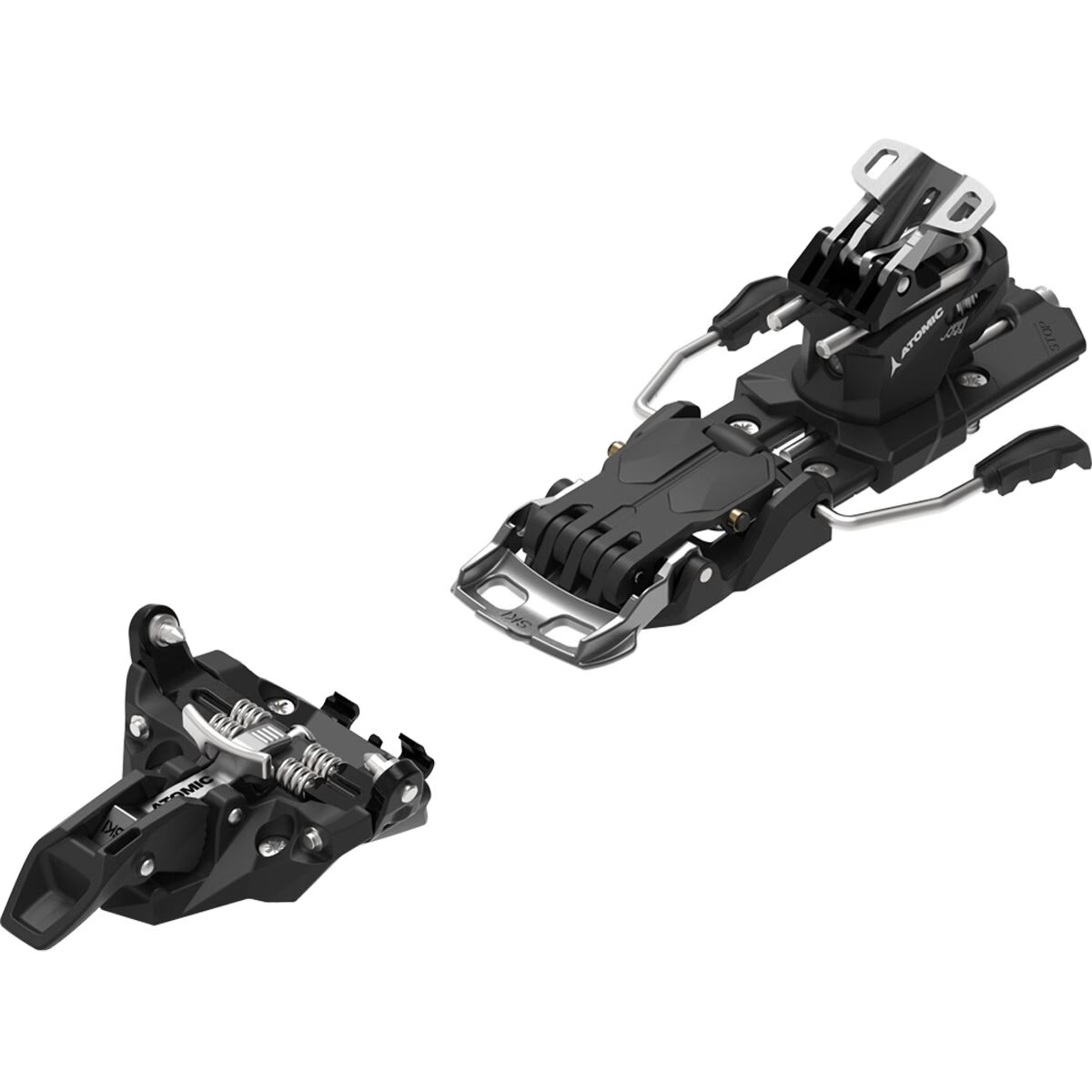
Type: Tech
Weight: 1 lb. 13 oz. (with brakes)
Release value: 6-12
What we like: Dependable, simple, wide release setting range, AutoFlex heel mechanism.
What we don’t: Brake device can ice up, trades metal construction for composite.
At the top of our list is the Atomic Backland Summit 12 BR because of its overall performance and innovative design. The Backland series has been a go-to choice for many backcountry enthusiasts due to its reliable toe piece that's easy to step into, handy heel elevators that can be flipped with a pole basket or handle, and a slimmed-down weight. Where the Summit 12 BR stands out is its widely adjustable release settings and AutoFlex system, which provides elasticity in the heel, allowing the ski to flex naturally while also enhancing safety.
While this model certainly earns its accolades, we uncovered a few quirks that may be deal-breakers for some. If you don’t want any angle assist while touring, you have to bend down and turn the heel piece to truly set the elevators to 0 degrees. We also found that the mechanism that holds the brake lever down while touring tends to ice up, and can even pop open, which may require you to pop your ski off and get it situated so that you aren’t ascending with your brake arms down. Lastly, there are some plastic composite components that may prove to be less durable than metal, although we have not experienced any breakage or malfunctions so far.
See the Atomic Backland Summit 12 BR


Type: Frame
Weight: 4 lb. 5.1 oz.
DIN: 3-10
What we like: Affordable, solid downhill performance, and compatible with a wide range of boots.
What we don’t: Heavy, clunky, and less efficient than most tech bindings.
We'll cut straight to the chase: Backcountry bindings are expensive. In fact, the average model here is about twice as much as a standard alpine binding, which—along with boots and skis—can make putting together your initial touring setup rather daunting. One of the best ways to save is by opting for a frame binding, which offers versatility (they pair with a wide range of boots, including alpine models) and downhill performance in an affordable package. Of course, the most obvious downside to frame bindings is weight: The Tyrolia Ambition 10 here clocks in at a whopping 4 pounds 5.1 ounces, which is more than three times the heft of many of our favorite all-around tech bindings.
For uphill-focused skiers, weight is a major factor that can significantly impact your efficiency. If you prefer to stay in the tech category, the Marker Alpinist 12 (below) or Dynafit Radical (not featured here) are two of the best budget options. But for casual weekenders, new skiers, or those who plan to split their days between the resort and backcountry, a strong case can be made for an affordable and versatile binding like the Ambition here. However, expect a sizable performance drop: In addition to its added heft, the Tyrolia's walkability suffers due to a pivot point located in front of the toe. Additionally, at 10 on the DIN scale, aggressive riders will be better off with an alternative like the Salomon Shift2 below or the 12-DIN Ambition. Still, the Ambition 10 is an affordable choice for beginners, budget-conscious skiers, or riders who don’t want to invest in a tech-compatible boot.
See the Tyrolia Ambition 10
 Type: Hybrid
Weight: 4 lb. 0.9 oz.
DIN: 6-13
What we like: Full downhill performance in a touring binding; compatible with a variety of boots.
What we don’t: Heavy compared to simple tech bindings.
Immediately after its release, Salomon's Shift changed the backcountry ski binding landscape. Simply put, it was one of the first tech bindings that provided legitimate performance and safety while hitting big lines or bombing laps at the resort. Now in its second iteration, the magic formula here is a fairly standard alpine-style heel piece paired with a wildly innovative toe piece, which functions as a pin-ready setup for uphill travel and converts into a traditional downhill toe clamp in ski mode. The net result is impressive versatility in terms of performance and boot-sole compatibility: You can wear your downhill boots and put down the power in hardpack and crud, or go lightweight with your touring setup on a backcountry adventure.
What are the downsides of the Shift? The binding’s two-mode toe piece and beefy heel add considerable weight, so those who like to go far or fast will want to stick with a design like Salomon’s MTN Pure above or the Marker Alpinist below. Additionally, the Shift is not compatible with alpine touring boots that don’t have full toe and heel lugs. Finally, in testing, we found that the heel’s locking lever occasionally pops out while in tour mode (also releasing the brakes) if snow and ice aren't carefully cleared out, and all the Shift’s moving parts can be a bit tricky to operate. As a result, this wouldn’t be our top choice for those skiing exclusively in the backcountry. But these gripes are fairly minor for a game-changing product that still stands out as the best hybrid binding on the market. Of note: The Salomon S/Lab Shift is also sold under the Armada and Atomic brand names, with the only difference being colors.
Read more: Salomon S/Lab Shift review (prior version)
See the Salomon S/Lab Shift2 MNC 13

 Type: Tech
Weight: 10.6 oz.
DIN: 4-13
What we like: Great performance and feature set in an ultralight build.
What we don’t: Non-adjustable heel piece requires numerous rotations depending on riser height.
While the majority of backcountry riders will opt for an all-rounder like the Atomic Backland Summit 12 BR above, decidedly uphill-focused skiers can shed grams and streamline their kit even further with a design like the Dynafit Superlite 150. The Superlite is inspired by the lightest skimo race bindings on the market, but with more versatility for everyday touring and ski mountaineering. As a result, it’s one of the best ultralight yet highly durable options for ski mountaineers and endurance enthusiasts. For the ascent, you get a 10.6-ounce build with two riser heights (plus flat) and the option for brakes. And on the downhill, the Superlite truly stands out in its weight class, with a nice balance of retention and release safety paired with a wide 4-13 DIN range, as well as an all-metal heel (minimizing the chance of breakable parts).
As with any ultralight gear, there are some trade-offs inherent in the Superlite’s design. The most glaring is that there’s zero room for boot sole length adjustment, making it difficult to share skis or swap out boots (you can purchase a heel adjustment plate separately for an extra $110). Second, the 150’s minimum forward release is 7, which is a bit high for lighter or less aggressive skiers (the lateral release value is still 4-13). And finally, you’ll have to reach down to manually spin the heel piece rather than using your pole, and the tallest riser is just 51 millimeters (some risers extend up to 85mm or more). Despite these compromises, the Superlite 150 is in a league of its own as a fully featured ultralight binding with great downhill performance. Another Dynafit binding worth considering is the even lighter-weight Mezzalama (8.8 oz.), which has a lower vertical release value (5-10) and only one riser.
See the Dynafit Superlite 150
 Type: Tech
Weight: 6.8 oz.
DIN: Fixed
What we like: Super reliable and easy to use in a race setting.
What we don’t: A very expensive niche binding.
Skimo is a rapidly growing sport and one of the newest additions to the winter Olympics, debuting in 2026. And while most local races are welcoming to all levels of skiers and splitboarders, you'll need an extraordinarily lightweight setup to be competitive. This is where skimo race bindings come into play, and the Dynafit DNA is our top pick. Using a mix of aluminum, carbon, stainless steel, and synthetic materials, the binding’s toe piece is a pared-down version of the typical pin design—and it’s been tweaked for better retention. Further, the tiny, compact heel piece is particularly unique: It transitions from tour to ski mode with the simple flip of a riser, saving racers precious seconds during competition. Finally, although the binding is small and weighs only ounces, it’s designed to withstand speedy off-piste skiing in all manner of conditions.
Of course, the DNA is a specialty binding that's intended for racing or training on ultra-lightweight skimo race skis. It is not suitable for driving beefier skis or for ski mountaineering or everyday touring settings—if you want a weight-conscious setup for these disciplines, we recommend Dynafit’s race-inspired but more versatile Superlite 150 above. Further, a skimo race setup is an expensive investment when you tally up the bindings, ultralight skis, and racing boots (not to mention a Lycra suit). Before throwing down for the whole setup, we recommend trying a race or two and making sure it’s something you enjoy.
See the Dynafit DNA

Type: Tech
Weight: 1 lb. 4.8 oz.
Release value: “women,” “men,” and “expert”
What we like: Reliable, easy to use, and great all-around performance.
What we don’t: Only three predetermined release settings.
For the majority of skiers, the best backcountry ski binding is a tech design that deftly balances uphill and downhill performance, weight, ease of use, and durability. With these metrics in mind, the Salomon MTN Pure is a great option for those who prioritize user-friendliness and well-rounded performance. Tech bindings can come with a steep learning curve, but the MTN is easy to step into and a breeze to transition between ski and tour modes. The binding showcases its simplistic nature with just three release value settings, and you can also opt for the brakeless version (with included leash). Finally, Salomon nailed the build quality with metal-heavy heel and toe pieces that have held up impressively well throughout our testing.
All that said, the MTN Pure isn’t ideal for everyone, and expert skiers in particular might not like the inability to customize the release settings. The Marker Alpinist 12, shown below, performs even better on the descent with a gapless heel piece that lends a smooth feel and consistent release, although it’s not as easy to transition as the Salomon. Alternatively, if you’re looking for a burlier binding that prioritizes power and stability on the downhill (at the cost of added weight), it’s worth stepping up to a tech design with an alpine heel like the Fritschi Tecton below, or choosing a resort-capable model like the popular Salomon Shift2. However, whether you’re a recent backcountry convert, an experienced powder hound, or somewhere in between, the MTN Pure puts it all together better than most.
Read more: Salomon MTN Pure review (prior version)
See the Salomon MTN Pure
 Type: Tech
Weight: 1 lb. 10.1 oz.
Release value: 5-13
What we like: High-quality build that’s been updated with an automatic brake and adjustable release value in the toe piece.
What we don’t: Expensive and on the heavier side for a lightweight tech binding.
ATK’s reputation in the U.S. for producing high-quality and reliable tech bindings has only grown in recent years. A couple of design features make the Raider Evo noteworthy, and the first is the automatic ski brake. While other Raider models require pressing a button on the heel piece to raise the brake, the Evo line has a system that raises and locks the brake when you stomp on the heel plate (in tour mode), and it then automatically releases the brake when you rotate the binding to downhill mode. In short, now you don’t have to think about the brake at all. Next, the binding’s toe piece has an adjustable lateral release value (like its heel piece), which means that the binding as a whole can be better-tuned for release, unlike many tech bindings that have an adjustable heel piece and fixed toe.
Aside from these standout features, the Raider 13 Evo offers a traditional tech design that goes head-to-head with models like the MTN Pure above. ATK’s durability is best-in-class, featuring CNC-machined pieces, aircraft-grade aluminum, and a blend of carbon throughout the components. It’s a big investment and among the priciest pin bindings here, which is its biggest knock and makes it a little less viable for casual or budget-oriented users. Additionally, weight goes up slightly with the emphasis on metal in the construction. But the latest Raider Evo is undeniably premium and built to last.
See the ATK Raider 13 Evo
 Type: Tech
Weight: 1 lb. 3.0 oz. (w/ brakes: 1 lb. 9.4 oz.)
DIN: 6-12
What we like: Gapless design offers impressive downhill capabilities.
What we don’t: More plastic parts than the Salomon MTN Pure and trickier to transition.
Marker’s Alpinist 12 goes head-to-head with the Salomon MTN Pure for the best lightweight tech binding here. The two bindings are very similar in terms of both price and weight (note that the brakeless version is listed here), but the Alpinist 12 adds a bit of extra tech with its "gapless" (also known as a “kiss gap”) heel piece design. This allows the heel to move along a track to compensate for ski flex, rather than the buffer more common in tech bindings, which translates to better downhill performance, including a smoother ride and more consistent release, compared to a model like the MTN Pure. And the real kicker is that the Marker accomplished this at a truly impressive weight: At just 1 pound 9.4 ounces with brakes, the Alpinist undercuts much of its direct competition by a huge margin.
With all that praise, why do we have the Marker ranked here? In short, the Salomon is the more approachable option for the majority of skiers: It's easier to step into and transition with a 90-degree heel piece rotation (the Alpinist’s is a full 180 degrees) and provides a bit more assurance in terms of durability with more metal parts (the Marker uses a lot of carbon-reinforced plastic). It’s also a bit lighter when you factor in brakes (sold separately, they'll add about $60 and 7 oz. for the pair). But for the more experienced skier who’s familiar with tech bindings and doesn’t need a gentle learning curve, the Alpinist’s combination of downhill performance and value is truly hard to beat, and Marker even updated their toe piece a couple of seasons back with a rubber “stop pad” and wider platform to make stepping into it easier. Finally, unlike the MTN Pure, which offers only three release settings, you can also tweak the Alpinist’s DIN anywhere between 6 and 12.
See the Marker Alpinist 12
 Type: Tech
Weight: 3 lb. 2.4 oz.
DIN: 6-13
What we like: Impressive combination of power, safety, and usability.
What we don’t: More expensive and not as versatile as the Salomon Shift2.
Like the Fritschi Tecton above, the Kingpin is a freetouring binding designed for skiers who don’t like to hold back. It’s also one of the only setups here that earns a TÜV certification for DIN, giving the Kingpin the credentials to stamp its mark in a crowded and highly competitive market. For the descent, you get the safety and secure feeling of a quality 13-DIN alpine binding that releases both vertically and laterally at the heel. On the uphill, the reasonable 3-pound weight easily undercuts most other hybrid models. It’s true that the Kingpin is overkill for all but the most expert-level skiers, but if you’re dropping big lines, it’s one of the most capable tech bindings money can buy.
The Kingpin earns its stripes with its official DIN cert, but it’s not the binding for everyone. For one, they’re really pricey unless you can find a stellar deal, and they are more than double the weight of the lightest bindings in our lineup. Comparing the Kingpin side-by-side with the Shift, you give up alpine boot compatibility and the true alpine toe, which are great features for those who dabble both in and out of bounds. However, these are all fairly minor nitpicks for such a highly capable design, and there's a reason it has garnered so much attention over the years. Importantly, Marker recently expanded the line to include the Kingpin M-Werks, which combines the trimmed-down toe piece of the Alpinist, the heel of the standard Kingpin, and a host of other upgrades. The result: a drop in weight (2 lb. 14.2 oz.) but a steep $880 price tag.
See the Marker Kingpin 13
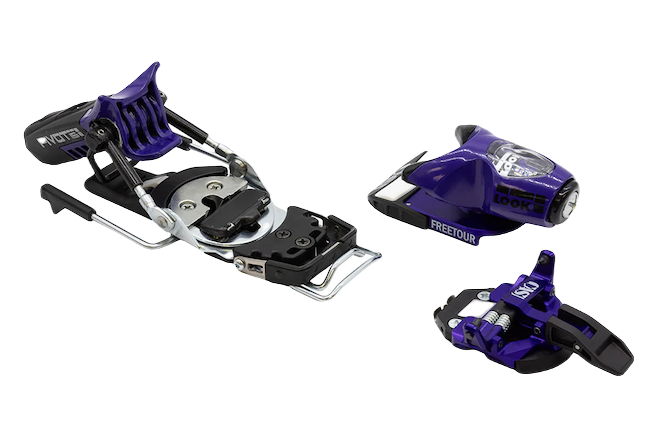 Type: Hybrid
Weight: 5 lb. 14.5 oz. (4 lb. 6.5 oz. in tour mode)
Release value: 6-15
What we like: No-holds-barred downhill performance.
What we don’t: Lots of moving parts and overkill for all but the most aggressive riders.
The Salomon Shift dominates the hybrid binding market, but for truly unmatched downhill performance, Cast's Freetour 2.0 Pivot is worth a look. The unique setup takes Look’s popular Pivot alpine binding—modified so that the toe piece can be removed—and adds Cast's pin-tech touring toe for swapping in on the ascent. In other words, you’re getting one of the most capable and powerful alpine bindings on the market (available in 15- and 18-DIN variations) along with all of the uphill benefits of a tech binding. For the small group of expert skiers for whom the Shift and Marker Duke fall short, the Freetour 2.0 Pivot is a functional and highly capable solution.
A few elements of the Cast Freetour 2.0 Pivot may be dealbreakers for some. The swappable toe system has a lot of moving parts (don’t lose your spare toe piece) and requires additional time and tweaking at each transition. It also adds considerable weight and heft, checking in at 4 pounds 6.5 ounces in tour mode and nearly 6 pounds with the alpine toe. Further, you’re paying a sizable premium at $830, and a DIN of 15 or 18 is overkill for most riders, especially in the backcountry. Note: If you already own a Pivot binding, the Cast Freetour Upgrade Kit ($365) includes all the necessary parts for conversion.
See the Cast Freetour 2.0 Pivot 15
With several decades of combined experience in the backcountry, our team has tested a lot of equipment. As a result, we’ve become beyond critical and choose to only recommend the absolute top-performing products or models that have a niche use case. Still, we want to mention the products that didn’t quite make the list and why we feel the way we do about them.
There are many fans of the Ski Trab Titan Vario.2 7-9 because of their downhill and safety performance wrapped up in a reasonably lightweight package. However, the brake width maxes out at 94mm, and skis at that width can be driven by an even lighter binding. Also, the release tension is not adjustable, and they aren’t an easy binding to find for sale.
Dynafit is one of the top touring brands in the game, but our team didn’t find anything about the ST Rotation 14 that is especially noteworthy, and it falls in the middle of the pack in terms of price versus performance.
The Marker Duke PT 16 is a resort/backcountry hybrid that utilizes a convertible toe system and has an impressive DIN range of 6-16, but our favorite hybrid, the Salomon S/Lab Shift2 MNC 13, is lighter, more affordable, and edges the Duke out in terms of overall performance.

| Binding | Price | Type | Weight | Release Values | TÜV | Boots |
|---|---|---|---|---|---|---|
| Atomic Backland Summit 12 BR | $630 | Tech | 1 lb. 13 oz. | 6-12 | No | Tech |
| Tyrolia Ambition 10 | $475 | Frame | 4 lb. 5.1 oz. | 3-10 | Yes | Alpine, touring |
| Salomon S/Lab Shift2 MNC 13 | $680 | Hybrid | 4 lb. 0.9 oz. | 6-13 | Yes | Alpine, touring, tech |
| Dynafit Superlite 150 | $550 | Tech | 10.6 oz. | 4-13 | No | Tech |
| Dynafit DNA Binding | $600 | Tech | 6.8 oz. | Fixed | No | Tech |
| Salomon MTN Pure | $680 | Tech | 1 lb. 4.8 oz. | women, men, expert | No | Tech |
| ATK Raider 13 Evo | $750 | Tech | 1 lb. 10.1 oz. | 5-13 | No | Tech |
| Marker Alpinist 12 | $600 | Tech | 1 lb. 3.0 oz. | 6-12 | No | Tech |
| Marker Kingpin 13 | $770 | Tech | 3 lb. 2.4 oz. | 6-13 | Yes | Tech |
| Cast Freetour 2.0 Pivot 15 | $830 | Hybrid | 5 lb. 14.5 oz. | 6-15 | Yes | Alpine, touring, tech |
The Switchback Travel team loves geeking out on gear, especially when it means spending long days in the backcountry in search of untracked powder. Whether you're trudging miles into the wilderness or embarking on a short after-work tour, having a pair of bindings that you can trust is key to a safe and enjoyable outing. Former members of our team launched this guide in 2021 with 15 carefully considered designs, and our current snowsports editor, Ross Patton, took over managing the guide in 2025. His first backcountry experience was on three-pin bindings decades ago, and he’s watched the evolution of touring technology ever since. A few of our longtime freelancers—Brian McCurdy, Sasha Brown, and Alli Hartz—have also played a leading role in this guide's evolution. Brian and Sasha are based on Vancouver Island and are no strangers to long slogs in the mountains, while Alli splits her time between ski guiding and avalanche education in the winter months.
Our current lineup of 10 touring bindings is the result of considerable hands-on testing, targeted feedback from trusted contributors, and extensive market research. When we put backcountry bindings to the test, we look closely at overall construction and build quality, scrutinize each binding's weight and bulk, and pay close attention to functionality and ease of use. We get out in all manner of conditions throughout the season, both to gauge performance and to evaluate long-term durability. As the market continues to evolve, our list above will change from time to time to reflect our current favorites and any notable innovations.
.jpg)
Backcountry ski bindings, otherwise known as AT (alpine touring) bindings, are designed specifically for use when skiing in areas with no chairlift access. They differ from standard downhill (alpine) models in a few ways, the most notable of which is uphill capability. Whereas a downhill ski binding is only built to function with both your toe and heel locked in, a backcountry binding operates in both uphill mode (toe on a hinge) and downhill mode (toe and heel fully locked in). Additionally, they’re designed with an emphasis on weight savings—essential for uphill travel—and many are only compatible with backcountry-specific boots with tech fittings at the toe (there are a few exceptions to this rule).

Before we go any further, we want to make one thing clear: There is no one-size-fits-all backcountry binding. In other words, there is no one ideal binding for every skier—but there is an ideal binding for each skier. Your choice will come down to a number of factors, including uphill and downhill performance, weight, price, durability, ease of use, retention, safety, and compatibility with your current ski or ski boot. Read below to find out more, and be sure to also check out our top picks above, which line up with many popular backcountry skiing styles.
When shopping for a backcountry binding, one of the first questions you’ll want to ask yourself is: Where do I want this to perform best? Given the opposing demands of backcountry travel, bindings will usually excel on either the ascent or the descent, but rarely both. If you’re motivated by long ski traverses, endurance missions, and fast-and-light travel, you’ll want to look for a lightweight tech binding with an efficient pivot point under the toe. There are a few other factors to also keep in mind, including riser heights, ease of transition, and durability for remote environments. Bindings like the Atomic Backland Summit 12 BR, Salomon MTN Pure, and Dynafit Superlite 150 are some of our favorites in this category.

On the other hand, for skiers who endure the uphill for rowdy freeride descents (including those who typically access terrain via sled, snocat, or helicopter), the ideal binding will have an alpine heel and prioritize safety features like lateral toe release and official TÜV certification for DIN. A few tech designs fall into this category—namely the Marker Kingpin—but hybrid bindings like the Salomon S/Lab Shift2 MNC 13 and Cast Freetour 2.0 Pivot 15 really shine, with toe pieces that lock down to mimic the connection of an alpine binding. Keep in mind, however, that weight typically matters less for those who prioritize downhill performance, and many of these bindings are notably heavier as a result.
Tech Bindings
Also referred to as pin bindings, tech bindings are the most common form of backcountry ski binding and are characterized by their skillful combination of uphill and downhill performance. These designs are the lightest of the bunch (most versions range from 1 to 3 lb. for the pair), feature separate heel and toe pieces, and are compatible with tech boots only. Some even swap in an alpine heel (similar to a binding used for resort skiing) for the standard pin heel, which adds significant downhill capability without detracting from walkability or adding too much weight (the Marker Kingpin 13, for example, weighs 3 lb. 2.4 oz.). Tech bindings are generally offered with either a brake or a leash, and the majority have adjustable boot-sole lengths and customizable release values.
.jpg)
Due to their lightweight builds and pivot point near the ball of the foot that allows for a natural stride, tech bindings are our first choice for skiers who spend most of their time in the backcountry, and especially those who want to move efficiently uphill. Downhill performance ranges from serviceable to very good, with the highest-performing models incorporating design features such as a kiss-gap/gapless heel, a laterally releasing toe piece, or even an alpine heel. You can expect to see an increase in both weight and price with these options, which are primarily designed for particularly heavy or aggressive skiers.
All that said, we’d be remiss not to mention the downsides associated with tech bindings. Given their unique design and intention, they do not have the same release attributes as alpine-style bindings, including frame bindings and hybrid designs. In fact, most tech bindings do not earn a TÜV certification for DIN (the Cast Freetour 2.0 Pivot 15 and Marker Kingpin are two exceptions). The biggest reason for this is their fixed toe (alpine bindings have a toe that releases with lateral force), which offers no elasticity in the event of a fall and has been implicated in many leg injuries (specifically, spiral tib/fib fractures). For more on the topic, see our section on Release Values and TÜV-Certified DIN below.
%20copy.jpg)
Frame Bindings
Frame bindings are a crossover category that merges the design of an alpine (downhill) binding with the intention of a tech binding. As a result, you get many features standard to alpine bindings, such as official DIN certification, good downhill performance, and compatibility with most boots (including tech, touring, and alpine styles), along with the ability to detach the heel piece and head uphill. But the biggest selling point here is affordability, with price tags that amount to hundreds of dollars less than tech or hybrid designs.
The most notable compromise with frame bindings is uphill performance: They are very heavy (clocking in anywhere from 3.5 to almost 7 lb.), and the placement of their pivot point in front of your toe results in an unnatural stride and reduced efficiency on the skin track. With more capable tech and hybrid designs on the market than ever before, frame bindings are at risk of becoming obsolete and aren’t our first choice for most skiers. That said, if you’re on a strict budget or ski mostly inbounds, a frame binding could be the best option.
.jpg)
Hybrid Bindings
Hybrid backcountry bindings are a relatively new category and are defined by two key designs: the Salomon Shift and Marker Duke PT. Along with an alpine heel, these bindings feature an evolved toe piece that functions like a tech toe on the uphill but converts into a traditional downhill design in ski mode. This means a few things: For one, you get incredible downhill performance and safety with a fully locked-in toe, on par with a standard alpine binding (both the Salomon and Marker are TÜV-certified for DIN). Second, hybrid bindings are incredibly versatile in terms of boot sole compatibility: You can wear your tech boots to seek out remote powder stashes (a pin toe is required for uphill travel) or strap in your alpine boots for a day in the resort. They’re heavier than tech bindings (the Shift exceeds 4 lb. per pair, while the Duke PT clocks in close to 6 lb.), but are the least compromised option for hard chargers or skiers who split their time between the front and backcountry and want to use the same setup in both environments.
If you’re a particularly large person and/or an aggressive skier, there’s one final option: the Cast Freetour 2.0 Pivot. Available in 15- and 18-DIN variations, this binding takes the Look Pivot (a popular alpine binding) and adds a swappable tech toe piece for uphill travel. In other words, you get the security and power of a full-on alpine binding along with uphill touring capabilities. The Cast is largely overkill in weight, price, and overall construction for most riders, and the swappable toe pieces can take some time to get used to, but if you already own the Look Pivot or are looking for no-holds-barred security, it’s an intriguing and innovative solution.

A wildly popular activity in Europe, skimo has recently gained momentum in the U.S., thanks in part to its inclusion in the 2026 winter Olympics. In short, the sport includes both uphill and downhill racing on skis, with an emphasis on quick transitions between the two. Importantly, skimo and ski mountaineering are incredibly different activities—the former takes place in a controlled environment and generally implies racing; the latter involves traveling unsupported in big mountains, often for multiple days at a time. To illustrate the point, we know some skimo racers who don’t ski in the backcountry at all—rather, they use uphill resort travel as a way to maintain fitness and log vert during winter months.
The most important thing to note about skimo race bindings is that they’re designed specifically for competition and are not recommended for everyday ski touring or ski mountaineering. Skimo race bindings rarely have adjustable release values, and often include just one riser height (and often no flat setting). Historically, they have not included brakes or attachments for ski crampons, though that’s changing with a few models like Dynafit’s DNA (our top pick for skimo) and Low Tech Race 105, as well as Ski Trab’s Gara Titan (another popular race binding). Finally, most skimo bindings should only be used in conjunction with skimo race skis and boots—they’re simply not strong enough to drive wide skis or be driven by stiff boots.
.jpg)
All backcountry skiers will benefit from a lightweight setup, but ski mountaineers, skimo racers, and fast-and-light enthusiasts in particular will want to minimize weight. Tech bindings are our preferred choice for this group because of their minimalist build: The picks here range from a scant 6.8 ounces for the Dynafit DNA skimo race binding to 3 pounds 2.4 ounces for the Marker Kingpin 13. Within this category, expect the heavier models to have better retention and release features, higher performance on the downhill, and ease of use. On the other end of the spectrum, frame and hybrid types like the Cast Freetour 2.0 Pivot 15 (5 lb. 14.5 oz.) are among the heaviest options, but they also offer the best downhill performance, are versatile with a range of ski boots, and excel for skiers who spend most of their time inbounds. In the end, deciding how much weight you're willing to shuttle underfoot will depend on a variety of factors, including your ski objectives, how much durability you need, what boots you plan to wear with your bindings, and more.
_0.jpg)
Each binding on our list comes with a manufacturer-specified release value (usually a range of values), which provides an idea of the amount of force that must be exerted on the binding before it releases your boot. The numbers generally range from 1 to 18, and the higher you go, the longer the binding will keep you locked in. Lighter and less aggressive skiers typically set lower release values, while heavier and powerful skiers will dial it in higher. Understandably, this is a very important number to get right, as a binding that releases either prematurely or too late can have pretty serious safety ramifications—not to mention impact performance.
.jpg)
Within the alpine skiing world, release value is referred to as DIN (short for Deutsches Institut für Normung) and is measured via a standardized test administered by the TÜV (an international testing group based in Europe). When a binding meets all the requirements laid out by the DIN ISO 13992 specification, it is often referred to as TÜV certified.
While all the hybrid and frame bindings here are TÜV-certified, tech styles are essentially the Wild West with just a few exceptions (for one, the Marker Kingpin). The reason for this is their unique toe and heel pieces, which prioritize durability, lightness, and strength over safety features like elasticity and release mechanisms. While alpine bindings release laterally at the toe, most tech bindings feature a fixed toe and release at the heel instead, which has been attributed to an increase in the risk of leg injuries. In other words, if safety is a priority, it’s not a bad idea to opt for a TÜV-certified binding like the aforementioned Kingpin or bump up to a hybrid binding like the Salomon Shift.
.jpg)
Whether you’re skiing at a resort or in the backcountry, it’s a good idea to use either a brake or a leash to keep your skis from going too far if they detach from your boot. Most hybrid and frame styles come with built-in brakes, but tech styles often give you the option for leashes instead. On one hand, leashes are lighter and keep your skis much closer to you (brakes don’t always bite on icy terrain). On the other hand, brakes make it easier to step into your ski boot by holding your ski in place and don’t require you to bend over and attach them like a leash does. In our opinion, brakes are the most user-friendly solution for the majority of skiers, but we understand the appeal of leashes, especially for those focused on minimizing weight. If you opt for the latter, the B&D Ski Leash is our favorite: It features a coiled cord that stretches so that you can transition without unclipping and breaks under a certain force (you choose between 40 and 60 lb.), which is a nice safety measure in the event of a serious fall.
.jpg)
Brake Width
If you opt for brakes, you’ll likely have your pick between a variety of widths. It’s a good idea to get a width that closely matches the waist width of your touring skis—part of the reason it’s always a good idea to select your skis prior to picking a binding. The typical recommendation is to choose a width that is no more than 10 to 15 millimeters wider than your ski's waist, and not slimmer than a few millimeters (a ski shop can bend the bars ever so slightly). Be sure to avoid buying a brake that is too wide, as it can drag when you’re carving on hardpack.
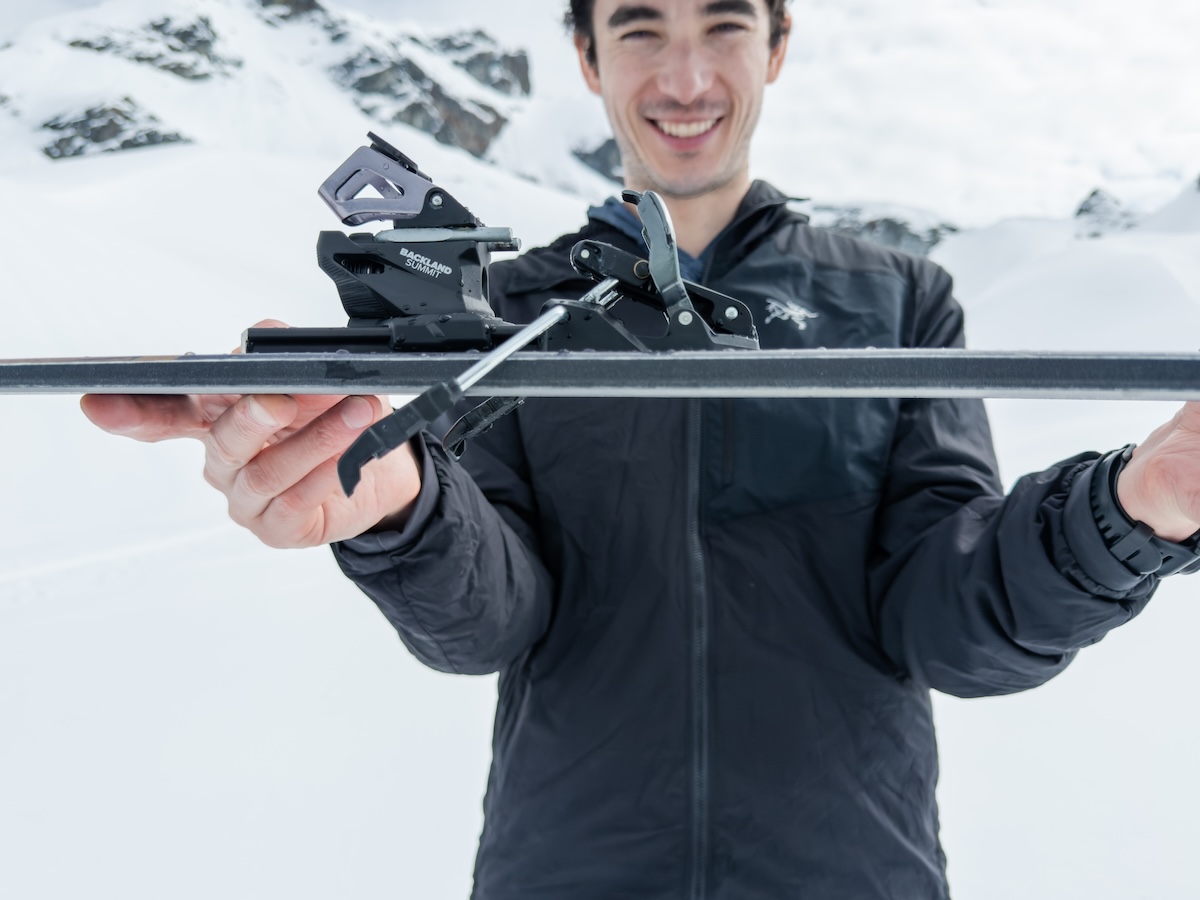
Heel risers—also known as heel lifts—help reduce strain on your calf muscles and Achilles tendon on steep terrain by elevating your heel and decreasing the range of motion required from your foot and ankle. They can also make it easier to break trail in deep powder by keeping the tips of your skis up. Designs vary between brands and models, but most risers comprise small metal tabs on the binding's heel piece that you can flip into place with a ski pole. On average, the majority of touring bindings have three riser levels: flat (no lift engaged), mid-rise, and high rise.
.jpg)
When you’re skinning across a flat meadow, ideally you’ll be in “flat” mode (not using a riser at all), and your movement will look very similar to classic cross-country skiing. By gliding across flat surfaces, you’re able to cover more distance with fewer steps and minimal effort. However, a big part of backcountry skiing is going uphill. As you ascend moderately steep terrain, engaging the lowest heel riser will lessen the strain on your lower legs and help you maintain an upright and efficient body position (i.e., not leaning forward at the waist). As you get into very steep terrain, using the high-rise position on your heel riser will accomplish the same goal. Importantly, using risers when you don’t need them will shorten your stride and tip your balance forward (like walking in high heels), so a good rule of thumb is to adjust your risers to what feels most natural given the slope angle—and reassess as that changes.
.jpg)
Ski Crampons
Another common climbing tool is the ski crampon. Almost all backcountry ski and splitboard bindings have a small tubular slot on the toe piece for attaching a ski crampon. Ski crampons have sharp edges that bite into firm snow as you step down with the ball of your foot. They’re an essential piece of gear for ski mountaineering and springtime volcano skiing in the Pacific Northwest, when you’re likely to start the day on very hard, frozen snow and descend on sun-softened corn. Note: If you’re using ski crampons, you can’t use your binding’s heel riser(s), as you’ll need to be able to flatten your foot against the ski in order to push the crampon into the icy snow surface.
Backcountry bindings are fairly complex pieces of gear, and you’re bound to face some sort of learning curve no matter which design you choose. In general, we’ve found that frame bindings are the easiest to use, while tech and hybrid styles have more moving parts, especially during transitions. For us, a user-friendly binding is one that rotates quickly (ideally, with just the twist of our ski pole), offers a convenient transition from tour to ski mode without detaching from the boot, and uses risers to alternate between climbing modes (rather than rotations). And some subtler features can go a long way toward increasing efficiency, including easy-to-grab heel pieces that only require 90-degree rotation (we like taller and more rectangular shapes), climbing risers that toggle with your pole’s basket or grip, and components like the toe lever.
.jpg)
More than most gear, backcountry bindings truly take a beating, especially if you like to ski hard or venture deep into the mountains. We ask a lot from these devices, and most of the time, they hold up impressively well (although if you’re a ski mountaineer, it’s likely you have a story of your binding breaking at the least optimal time). Most tech bindings are made with predominantly metal parts, including aircraft-grade aluminum, titanium, and carbon, but we also see a lot of high-tech synthetic materials, especially in the hybrid and frame categories. While an all-metal design is certainly robust and confidence-inspiring (ATK prides itself on this), we’ve found the durability of bindings with plastic components to be almost equally as impressive (and plastic can help shave weight and cost, too).
.jpg)
More than the quality and type of materials (metal vs. synthetics), it’s important to consider the quantity—that is, the weight of your binding. In other words, you’ll want to ski your binding well within its limits in order to maximize its lifespan (and importantly, take care to match it with an appropriate ski). We dive deeper into this in the next two sections below.
Ski boot compatibility is a big topic in the alpine binding world, and it's arguably even more consequential for backcountry bindings. However, the good news is that it's fairly easy to break down. Starting with tech bindings, which comprise the majority of the options on our list, you get compatibility only with boots with tech fittings at the toe, which come standard on most modern touring boots. In terms of the boot sole, tech bindings typically work with designs that have ISO 9523 soles or non-compliant soles (often found on streamlined, lightweight models).
.jpg)
Frame bindings and multi-norm hybrid bindings like the Salomon Shift2 or Cast Freetour 2.0 Pivot 15 are a different story: With these styles, you can ski a very wide range of boot types. These include most tech boots, crossover downhill/backcountry designs that have GripWalk and Walk to Ride soles, and standard alpine boots that do not have tech fittings (ISO 5355 Alpine). The benefit to this versatility is huge for skiers who want to ski one pair of skis with two separate boots—you can throw down on groomers in your stiff resort boots and strap on your light and flexy backcountry boots for the skin track. Of course, you’ll want to check the details for each binding before you commit to purchasing, as there are always exceptions to the rule (for example, the Salomon Shift does not accommodate tech boots with shortened heel and toe lugs). For a deeper dive on the topic, check out our Ski Boot and Binding Compatibility Guide.
.jpg)
Ski gear works best as an integrated system, so it's a good idea to research your skis, boots, and bindings all at once. Outside of the basic compatibility issues between boots and bindings that we touched on above, it’s important to ensure all parts complement one another. Put another way, don’t throw an ultralight tech binding on a heavy powder ski—it’s just a waste of a lot of cool technology (and cash). And the same goes with some of the heavier and more downhill-capable bindings here: We recommend avoiding an ultralight touring ski that isn't powerful or stable enough for carving. To help in the process, see our top picks for backcountry skis.

When ordering skis and bindings online, it’s important to know that the bindings will not arrive mounted (unless you specifically buy them mounted together). If you have a local ski shop or order from a retailer like REI, it’s as simple as paying to get the bindings mounted on the skis (you'll need to bring your boots along, too). The typical cost is around $50 to $1000, but REI will do the work for cheaper if you purchase from them (the price varies by store). It's worth noting that there are some pretty good DIY mounting tutorials online, but given the safety element and risk (you'll be drilling into your own pricey skis), we think it's well worth having a professional technician do the job.
Back to Our Top Backcountry Binding Picks Back to Our Backcountry Binding Comparison Table

90ed.jpg?h=fbc67360&itok=5fkKemHt)

c6b1.jpg?h=fbc67360&itok=_TaYDqd-)
ec55.jpg?h=fbc67360&itok=0_jtrRCF)
389b.jpg?h=fbc67360&itok=S5cY6s4R)
6754.jpg?h=fbc67360&itok=XJLgXTM5)
9d09.jpg?h=fbc67360&itok=krYHMzB9)
a981.jpg?h=fbc67360&itok=V_kmw90n)