.jpg)
-m.jpg)
Photo Credit
It’s that time of year! Time to find the perfect present for our adventurous loved ones. For that person in your life who loves all things cold weather, check out our gift guide for skiers and snowboarders. For ideas tailored to other pursuits, we also have more editor-recommended gift guides to explore. Happy gift giving!
Few pieces of gear are as versatile and essential as a quality down jacket. Whether you're layering up for a chilly commute or bundling up while deep in the backcountry, down offers unmatched warmth for its weight and compresses small for easy stashing. Over the years, we've tested dozens of these cozy layers, everywhere from the frosty peaks of the Himalayas to the soggy forests of the Pacific Northwest. After countless hours in the field, we’ve honed in on the best down jackets of 2025, ranging from lightweight down sweaters to minimalist ultralight layers and burly winter-ready puffies. The Patagonia Down Sweater reigns supreme for us once again, thanks to its versatility, style, and excellent warmth-to-weight ratio. For more background information, see our comparison table and buying advice below the picks, along with details about our testing process. Note: This article includes models for both men and women, but our team has also written a dedicated round-up of the best women’s down jackets.
Editor's note: We updated this guide on November 23, 2025, to add the Norrøna Falketind Down750, Montbell Plasma 1000, Mountain Equipment Paiyu Jacket, Simond MT100 Hooded Down Jacket, and the Katabatic Tincup. We also removed several models, added a tested and dismissed section, updated our comparison table, and ensured that all prices, links, and colorways were current at the time of publishing.

Category: Lightweight
Weight: 13.0 oz. (men's), 10.3 oz. (women's)
Fill: 5.0 oz. (men's) / 3.5 oz. (women's) of 800-fill down
What we like: Extremely versatile, stylish, and warm for the weight.
What we don't: A bit heavy for technical backcountry use.
From backcountry layering to around-town warmth, few jackets are as versatile as the Patagonia Down Sweater. With 5 ounces of high-quality 800-fill down (3.5 oz. in the women's version), it hits a sweet spot between performance and everyday use—light and compressible enough for backpacking and travel, yet warm enough to serve as a midlayer for resort skiing or chilly nights at camp. Patagonia also nails the style factor better than most, with a clean design that works just as well on city streets as it does in the mountains. And when it comes to long-term durability, Patagonia continues to stand out—our testers consistently find their jackets last season after season with little sign of wear.
The Down Sweater features a NetPlus shell made from recycled fishing nets, 100% RDS down (down that is certified by Control Union to be responsibly sourced), and handy internal drop-in pockets for stashing gloves or snacks. That said, while this jacket weighs a respectable 13 ounces (10.3 oz. for the women's version), it’s not the lightest option out there for true ounce-counters. Lastly, the fit is a little more relaxed than some of the trim, technical pieces on our list, but that does make it more versatile for layering over a baselayer or under a shell. If you'd prefer to have a hood, the Down Sweater Hoody is $50 more and just a bit heavier at 14.8 ounces (12.1 oz. for the women's version).
Read more: Patagonia Down Sweater review (men's hooded version)
See the Men's Patagonia Down Sweater See the Women's Patagonia Down Sweater
.jpg)

Category: Lightweight
Weight: 10.9 oz. (men's), 10.2 oz. (women's)
Fill: 3.5 oz. (men's) / 3.3 oz. (women's) of 650-fill down
What we like: Fantastic price for a well-rounded, lightweight design.
What we don’t: Not particularly compressible and the women's version isn't currently available as a hoodie.
REI’s popular 650 Down Jacket has been a go-to budget pick of ours for years, and the latest version stays true to that winning formula. It’s lightweight, decently warm with 3.3-3.5 ounces of 650-fill-power down, and built with a windproof, water-resistant shell that holds its own in light weather. REI also refined the design the last time they updated the 650, adding a drawcord hem, swapping to a tougher ripstop nylon shell, and returning to classic horizontal baffles (the previous version had boxy ones). This is one of the best values out there—undercutting many competitors by $150 or more.
Of course, budget gear usually comes with trade-offs, and the REI 650 Down Jacket is no exception. The lower-fill down isn’t as lofty or packable as higher-end models like the Patagonia Down Sweater, and the jacket doesn't stuff into its own pocket or come with a stuff sack as many higher-end models do. The fit is also on the boxier side, which is great for layering over a sweater but less ideal under trim shells. That said, for casual wear, travel, resort days, and even the occasional overnight trip, this jacket delivers excellent warmth and durability for the price. We also appreciate REI’s commitment to inclusive sizing—the men’s jacket comes in 10 sizes, including Tall options, and the women’s version spans from XS to 3X. If you like having a hood on your down jacket, the men's 650 Down Hoodie is only $20 more and less than an ounce heavier. Oddly and unfortunately, the women's version isn't currently available in a hoodie version, though we've seen it in the past, so expect it will likely return.
Read more: REI Co-op 650 Down Jacket review (men's version)
See the Men's REI 650 Down Jacket See the Women's REI 650 Down Jacket
/REI%20Co-op%20650%20Down%20Jacket%20(walking%20through%20tall%20grass).jpg)
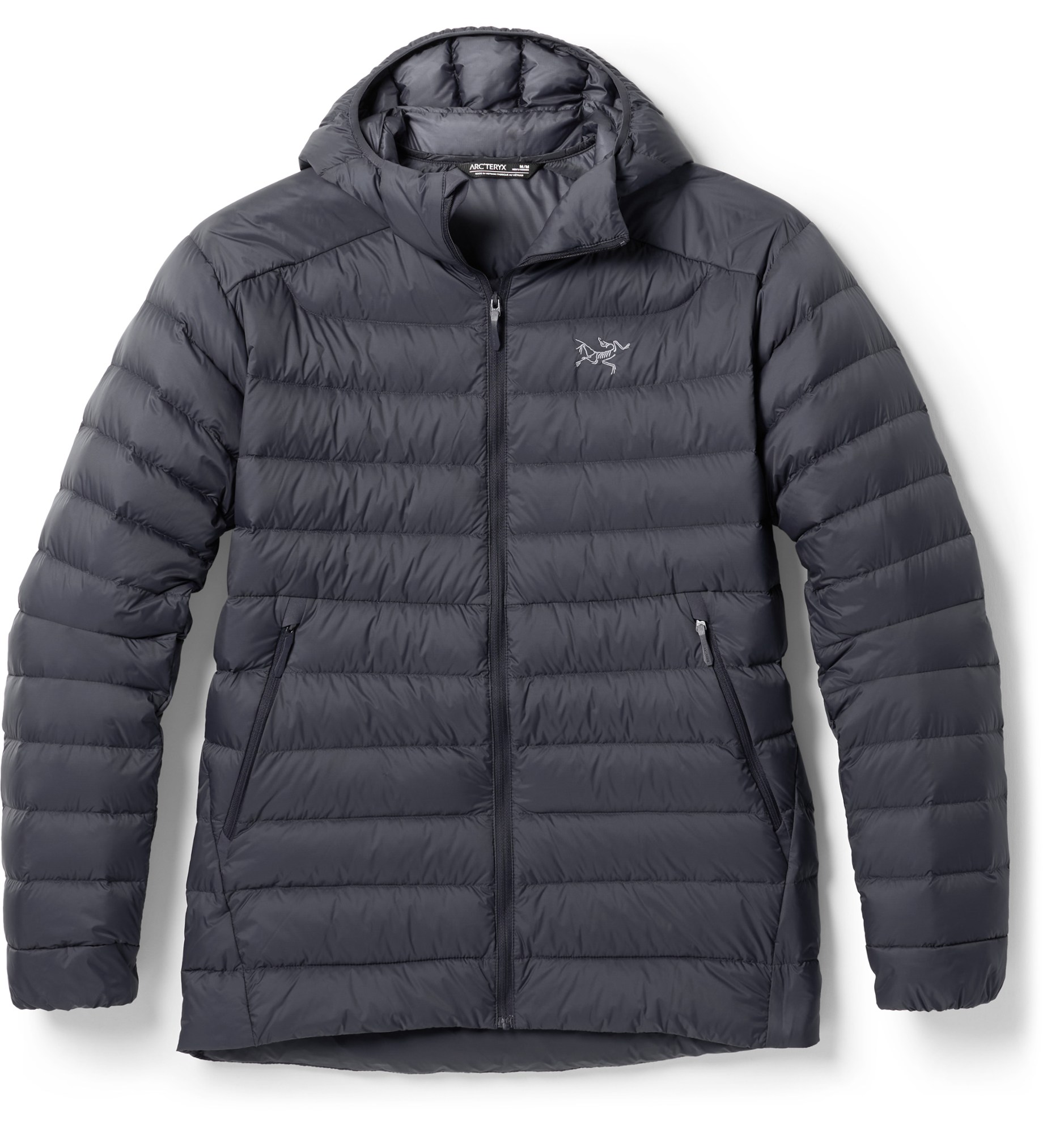 Category: Lightweight
Weight: 11.9 oz. (men's), 10.2 oz. (women's)
Fill: 4.0 oz. of 850-fill down; 80g Coreloft
What we like: Serious performance chops; premium look and feel.
What we don’t: Expensive; not as light as previous versions.
Arc’teryx gear has quite the reputation: it’s expensive, undeniably sleek, and built for serious use—and the Cerium Hoody fits that mold to a T. This is the brand’s flagship lightweight down jacket, and it delivers in all the ways you’d expect. At just 11.9 ounces (10.2 oz. for the women's version), it’s impressively light yet still feature-rich, with a buttery-soft shell and liner, streamlined design, and Arc’teryx’s signature Down Composite Mapping, which places synthetic fill in moisture-prone zones to retain warmth when conditions turn wet. The icing on the cake? This is one of the few jackets in this weight class that manages to look as good around town as it performs in the backcountry.
That premium polish does come with a steep price—$400 to be exact, which is $120 more than Patagonia’s Down Sweater. That said, the Cerium is well-tailored (typical of Arc'teryx pieces), offering a fit that's trim enough for strategic layering without being too tight. The reverse-coil zipper, paired with a TPU pull, also contributes to the jacket’s clean, refined aesthetic, and the internal pocket is zippered for added security. We are also big fans of the Arc'teryx StormHood, which is helmet compatible and easy to adjust. All in all, if you're willing to spend up, the Cerium is a lightweight powerhouse that blends warmth, style, and performance better than just about anything else out there. Other notable options in the Cerium line include the non-hooded jacket version, which is $20 less, and the Cerium SV, which features 1,000-fill down and is the warmest and most durable Cerium option—but it doesn't come cheap.
Read more: Arc'teryx Cerium Hoody review (men's version)
See the Men's Arc'teryx Cerium Hoody See the Women's Arc'teryx Cerium Hoody
_0.jpg)

Category: Heavyweight
Weight: 1 lb. 3.9 oz. (men's), 1 lb. 2.3 oz. (women's)
Fill: 7.5 oz. (men's) / 7.0 oz. (women's) of 800-fill down
What we like: Tons of premium down at a reasonable price point.
What we don’t: Heavy and bulky; not versatile for year-round use.
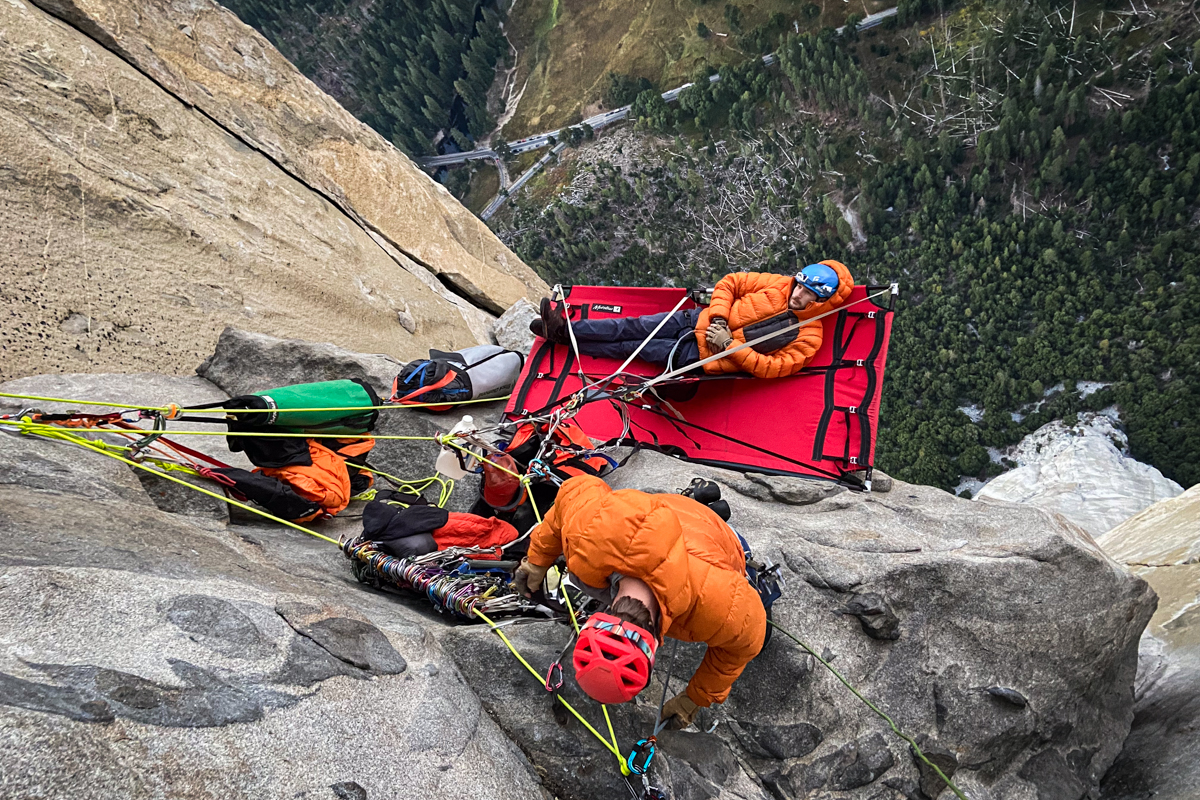
When temps really dip, and you need serious insulation—whether for winter camping, belaying on an icy wall, or tossing on during ski transitions—a heavyweight down jacket is hard to beat. These lofty puffies are built for warmth above all, with generous cuts, burly collars, and a sleeping bag-like puff that seals in heat. You’ll also get beefed-up shells for wind and water resistance, as well as handy features like large internal dump pockets for stashing climbing skins or warming up gear. And in our book, the Rab Neutrino Pro stands out as the best of the bunch. This has been our steed of choice for countless cold-weather adventures, including multiple late-fall ascents of El Cap in Yosemite National Park.
What really sets the Neutrino Pro apart is its Pertex Quantum Pro shell—it’s impressively tough and weather-resistant, considering its lightweight feel, making this jacket a great match for icy belays or cold alpine transitions. The 800-fill-power down provides outstanding warmth—nearly double what you get from most lightweight puffies—at a still-reasonable price. One of our editors has relied on the Neutrino for big-wall climbs in Yosemite, where it’s proven its worth in whipping wind and on freezing ledges. Another one of our editors always grabs this jacket for high-altitude camping trips where the nighttime temps drop dramatically—it's the perfect comfort layer to have on hand. The Neutrino Pro is definitely not light or packable enough for summer missions, but if maximum warmth is the goal, this is a reliable, cold-crushing powerhouse.
Read more: Rab Neutrino Pro review (previous men's version)
See the Men's Rab Neutrino Pro See the Women's Rab Neutrino Pro

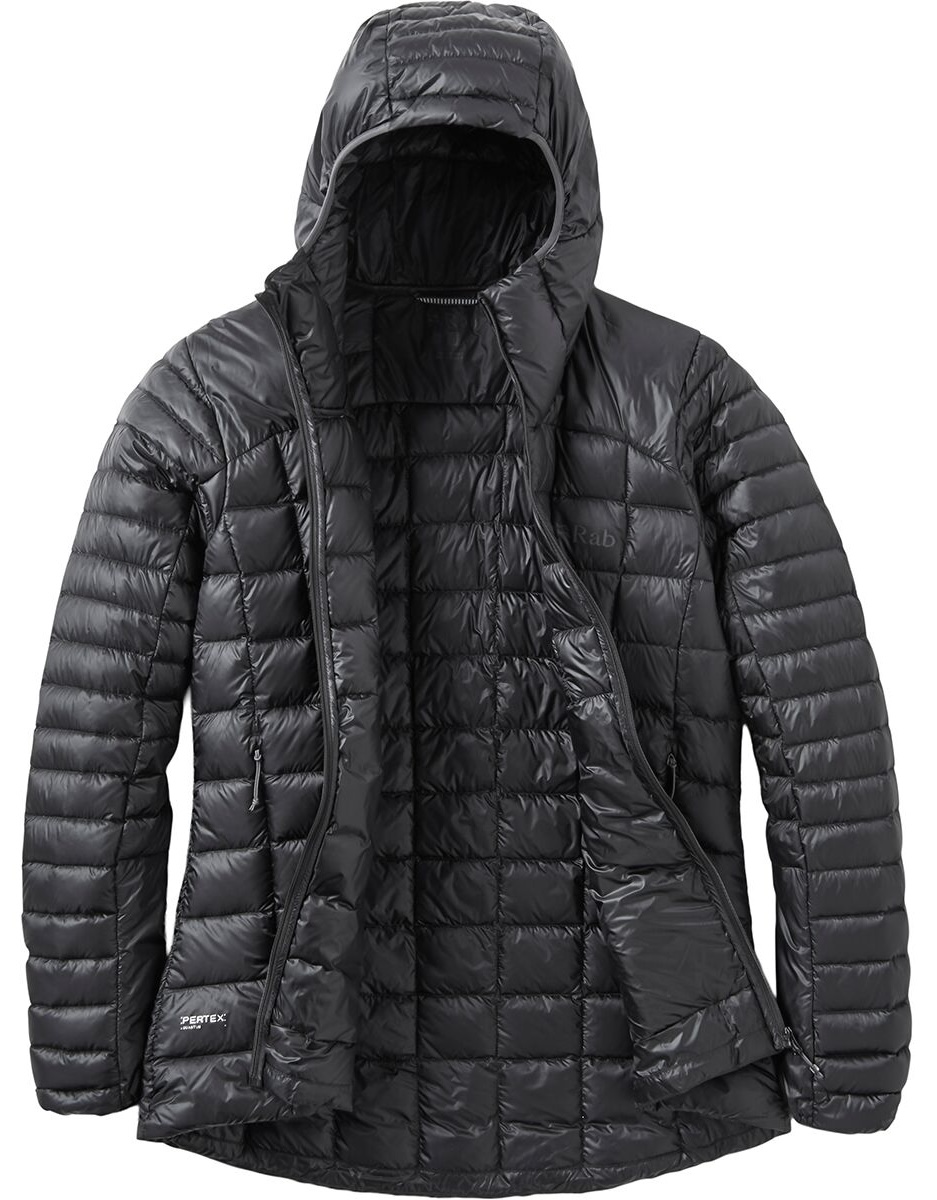
Category: Ultralight
Weight: 8.8 oz. (men's), 8.0 oz. (women's)
Fill: 2.8 oz. (men's) / 2.1 oz. (women's) of 900-fill down & PrimaLoft Gold
What we like: Great price for a very premium ultralight jacket.
What we don’t: Thin shell is too fragile for everyday use.
Rab’s Mythic Alpine Light secured its spot as our favorite ultralight down jacket. Season after season, we’ve been blown away by its performance: It’s impressively lightweight at just 8.8 ounces (8 oz. for the women's version), packs serious warmth with 900-fill-power down and PrimaLoft Gold insulation, and uses a tough and weather-resistant Pertex Quantum shell. Additionally, it looks great, featuring sleek boxed baffles, premium materials, and a flattering cut that provides just a bit more coverage at the hem.
If you’re eyeing the Arc’teryx Cerium Hoody above, the Mythic Alpine Light is a worthy alternative. It’s lighter by a few ounces, uses higher-fill down (900 vs. 850), and saves you $70—no small feat. On the flip side, the Cerium’s thicker 15D shell (versus 10D) and slightly beefier build do give it a bit more durability and warmth, and the Rab’s longer cut can hang below your shell jacket depending on the pairing. But if you're after a trim, ultralight insulator for shoulder-season missions or as a backcountry midlayer, the Mythic Alpine Light punches well above its weight. If you need even more warmth, Rab also offers the standard Mythic Alpine with almost double the down (read our full, in-depth review of the men's Mythic Alpine here), or the high-end Mythic G—an ultra-premium piece stuffed with 1,000-fill down for serious alpine pursuits.
See the Men's Rab Mythic Alpine Light See the Women's Rab Mythic Alpine Light


Category: Ultralight
Weight: 5.2 oz. (men's), 4.9 oz. (women's)
Fill: 1000-fill down
What we like: Absurdly ultralight and packable, with just enough features for the outdoor athlete.
What we don’t: Very fragile, no pockets, boxy fit, extremely pricey.
Black Diamond isn’t quite exaggerating when they call the Deploy Down Jacket “the lightest down jacket in the world”—at just 5.3 ounces (4.9 oz. on the women's side), it practically disappears in your pack (and, aside from the Montbell Plasma below, we don't know of a lighter option out there—and the Plasma doesn't have a hood). We were skeptical at first (it feels more like a prop than a piece of gear when you unbox it), but after putting it through its paces on shoulder-season rock climbs, ultralight treks through Wyoming’s Wind River Range, and snowy day hikes, we’ve been thoroughly impressed. The Deploy is incredibly compact and streamlined to just the essentials, yet still offers enough warmth for active missions in mild conditions.
Of course, all that weight savings comes at a cost. To hit that ultralight mark, Black Diamond had to make some big trade-offs in durability, comfort, and features. The nearly translucent 4-denier shell fabric is incredibly thin and prone to tearing—we picked up a few snags just from brushing against granite and tree branches. There’s also no hem adjustment to seal out drafts, no handwarmer pockets (a real bummer on chilly belays), and the half-zip pullover design can be tricky to get on over bulkier midlayers (though a full-zip version is available for $50 more). Lastly, at $499, you’re dropping a premium on a jacket that’s intentionally minimalist and not particularly versatile. That said, for ounce-counters heading into the alpine or tackling long routes with unpredictable conditions, the Deploy is a brilliantly executed tool. It’s certainly not your everyday insulator, but for athletes focused on fast-and-light mountain missions, it earns a spot in the pack.
See the Men's Black Diamond Deploy Down 0.5 Pullover See the Women's BD Deploy Down 0.5

 Category: Lightweight
Weight: 12.2 oz.
Fill: 4.0 oz. of 850-fill down
What we like: A competitive alternative to the Cerium above for less cash, stellar fit and style.
What we don’t: Relatively delicate shell fabric; attached stuff sack gets in the way.
Himali first caught our attention while planning a climbing expedition to Nepal, and the brand’s roots run deep in the region, with strong ties to the Sherpa community and a growing focus on sustainable manufacturing. Their story is compelling, but what really impressed us was how their gear performed in the field. We took a range of Himali pieces, including the Accelerator Down Jacket here, into the heart of the Himalayas and came away seriously impressed. This jacket, in particular, quickly earned a top spot in our kit thanks to its dialed-in athletic fit, streamlined look, and no-fuss functionality that worked equally well both in alpine terrain and around town.
Sitting solidly in the lightweight category, the Accelerator offers standout warmth for its weight, a clean silhouette that layers well, and a great price considering its performance. It mirrors the hybrid insulation layout found in higher-end jackets like the Arc’teryx Cerium—using synthetic fill in moisture-prone zones to boost its versatility for cold, fast-moving days in the mountains. That said, the thin face fabric showed some wear after a few rugged missions, and the integrated stuff sack inside the pocket felt more like an annoyance than a convenience. Still, for a jacket that looks great, moves with you, and competes with top-tier designs at a lower price, the Accelerator Down Jacket is a home run—and an exciting sign of what’s to come from Himali. Our female editors have also really enjoyed the Women's Accelerator Down, after it accompanied our team on a rugged trip to Chilean Patagonia.
See the Men's Himali Accelerator See the Women's Himali Accelerator

 Category: Midweight
Weight: 2 lb. 5.0 oz.
Fill: 8.3 oz. of 600-fill down
What we like: Great styling and a major boost in warmth over shorter down jackets.
What we don’t: Not everyone will like the length and subsequent bulky packed size.
While high-fill down jackets often take center stage for alpine pursuits, they also shine for everyday wear, offering unbeatable coziness and a great warmth-to-weight ratio for city life. For women seeking a blend of performance and polish, Patagonia’s Down With It Parka is our top pick. It’s packed with 8.3 ounces of 600-fill down for reliable insulation, treated with a PFAS-free DWR coating to shed light moisture, and lined with soft fleece in the collar and hand pockets for added comfort. Style-wise, it’s a standout too: Chevron baffles, princess seams, a detachable hood, and clever side snaps (a lifesaver when sitting down or driving) give it a tailored yet practical edge that many parkas lack.
The main thing that sets the Down With It apart from other jackets on this list is its length. At 35 inches down the back, it provides true knee-length coverage—perfect for blustery winters in places like Chicago or Boston, though it might feel a bit bulky for milder conditions or locations. That added coverage makes a big difference in truly frigid temps, even if the jacket doesn’t pack down particularly well. And while 600-fill down doesn’t have the lofty compressibility of higher-end insulations, the hefty 8.3-ounce fill weight translates to serious warmth. For those who prefer something shorter and easier to stash in a bag, the hip-length version trims both the coverage and cost while still offering a generous 7.1 ounces of down. Either way, this is a winter-ready piece that doesn’t ask you to choose between warmth and everyday style.
Read More: Patagonia Down With It Parka (women's version)
See the Women's Patagonia Down With It Parka
.jpg)
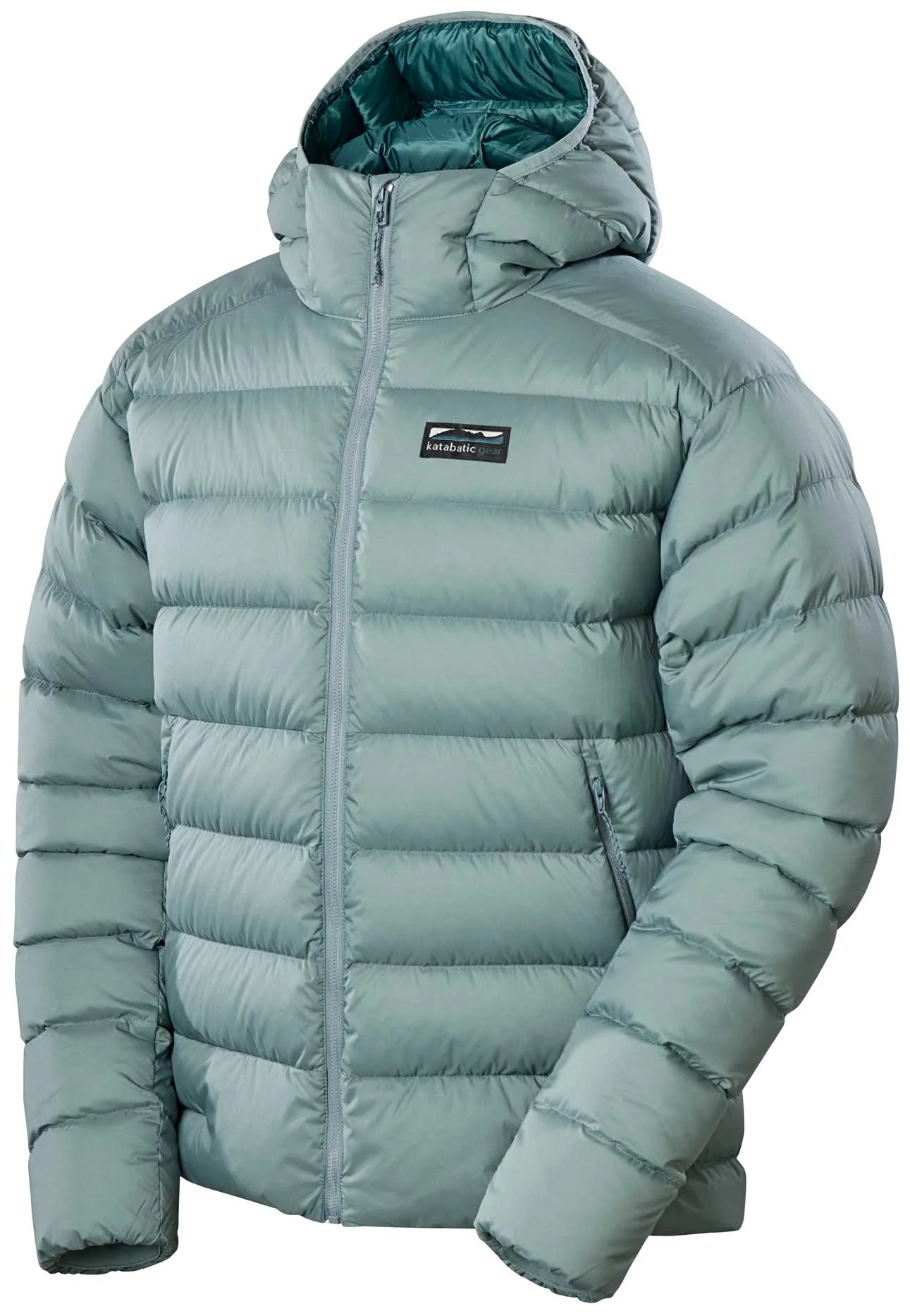
Category: Light/midweight
Weight: 12.7 oz. (men's), 11.7 oz. (women's)
Fill: 5.6 oz. (men's) / 5.0 oz. (women's) of 850-fill down
What we like: Excellent warmth for the weight; great materials, construction, and fit; reasonable price for the quality and performance.
What we don’t: Limited colors; only available to purchase directly from the manufacturer.
The Katabatic Gear Tincup offers excellent warmth with a surprisingly light weight and reasonable price, making it one of the highest-performing and best-value down jackets on the market. Weighing in a 12.7 ounces in a men's size medium, the Tincup is insulated with 5.6 ounces of 850-fill-power hydrophobic down (5.0 oz. for a women's medium), and is wrapped in a soft 20-Denier Pertex Quantum Eco ripstop nylon with a DWR finish. Combined with a pleasant fit that is not too tight nor too loose, the Tincup provides comparable warmth to its closest competitors from Patagonia, Arc'teryx, and Rab at a more competitive price. This jacket is lightweight, packable, and warm enough for technical adventures, yet it also has a casual appeal that makes it ideal for daily wear around town.
It's hard to find any notable flaws with the Katabatic Gear Tincup Down Jacket. It checks all the boxes that we'd look for in a high-quality down puffy and also has one of the easiest-operating zippers we've used. Being manufactured by a boutique brand, the Tincup is only available directly from Katabatic Gear, so you won't be able to use your REI dividends on this one, though we love supporting smaller brands wherever we can. Currently, this jacket is available in only a few colors, but the offerings are attractive nonetheless, and Katabatic makes up for this with its competitive pricing and performance. If you'd like to step away from the big brands and want something new and fresh, the Tincup is worth a serious look.
See the Men's Katabatic Tincup See the Women's Katabatic Tincup

 Category: Midweight
Weight: 1 lb. 4.7 oz. (men's), 1 lb. 5.2 oz. (women's)
Fill: 6.7 oz. (men's) / 5.6 oz. (women's) of 700-fill down & 150g VerticalX Eco
What we like: Comfy, classy, and well-priced for what you get.
What we don’t: Doesn’t pack down nearly as small as more premium options.
Outdoor Research jackets may not be the most premium or technically advanced options on the market, but they consistently strike a sweet spot between price and performance. The Coldfront Down Hoodie is a standout example: At just $279, it undercuts many high-end alternatives while still delivering impressive warmth and weather protection. With 6.7 ounces of 700-fill down (5.6 oz. in the women's) paired with VerticalX Eco synthetic insulation in moisture-prone areas like the shoulders and cuffs, the Coldfront holds its own in chilly, wet conditions. We’re also big fans of the soft yet tough shell fabric, cozy fleece-lined hand pockets, and thoughtful extras like snug cuff gaiters with thumb loops and clean branding on the sleeve. For daily wear or casual winter outings, this is a dependable and well-rounded option that doesn’t break the bank.
That said, there are some clear trade-offs at this price point. With mid-range down fill, a beefy dose of synthetic insulation, and a burly 30-denier shell, the Coldfront isn’t particularly lightweight or compact. At 1 pound 4.7 ounces (1 lb. 5.2 oz. for the slighter longer women's version), it’s almost three times heavier than true ultralight pieces like the Rab Mythic Alpine Light above. All in all, the Coldfront collection is better suited for everyday wear and shoulder-season hikes than fast-and-light backcountry missions. But if you’re after warmth, comfort, and durability at a solid price, this is one of the best values around.
See the Men's Outdoor Research Coldfront See the Women's Outdoor Research Coldfront

Category: Heavyweight
Weight: 1 lb. 9.7 oz. (men's), 1 lb. 2.7 oz. (women's)
Fill: 9.5 oz. of 700-fill down
What we like: Incredible value for impressive warmth, durability, and features.
What we don’t: On the heavy and bulky side; women's version only has one chest pocket.
Mountain Equipment may be little known in North America, but the European brand has quietly built a reputation for premium, expedition-ready outerwear—and the Paiyu Jacket is a standout example. This jacket packs 9.5 ounces of 700-fill down, making it an extremely warm midweight jacket and a true furnace for winter pursuits. What sets the Paiyu apart is its clever construction: dual-layer offset baffles eliminate cold spots, while an internal reflective layer boosts thermal efficiency beyond what the specs might suggest. Combined with a fully insulated hood, tall collar, and 40-denier Drilite Loft shell that shrugs off snow and wind, it delivers near-parka-level warmth that’s suitable for everything from frigid ski tours to high-altitude expeditions.
The robust build does come with compromises. At 1 pound 9.7 ounces (1 lb. 2.7 oz. for the women's), the Paiyu isn’t as light or compressible as other technical pieces, and it lacks hydrophobic-treated down. But the tradeoff is excellent durability, weather resistance, and an unusually generous feature set—including a two-way zipper, helmet-compatible hood, bi-directional hem adjustments, and seven (six for women) total pockets (including large mesh drop-ins for drying gloves or stashing water bottles). For serious cold-weather use, the Paiyu's versatility and workhorse performance are hard to beat at this price. All told, if you’re shopping for maximum warmth, ruggedness, and value—not just the lowest weight—this is a compelling option. The men's and women's iterations feature a slightly different design, with the women's version having only one chest pocket (and a lighter weight), whereas the men's has two.
See the Men's Mountain Equipment Paiyu Jacket See the Women's Mountain Equipment Paiyu Jacket

Category: Lightweight
Weight: 11.3 oz. (men's), 10.2 oz. (women's)
Fill: 800-fill down
What we like: Streamlined, durable, and surprisingly well built for the price.
What we don’t: Not as warm or lofty as expected; better for mild temps or layering.
The Simond MT100 has earned cult status for good reason: it's one of the best values in the lightweight down jacket category. At just $119 and a feathery 11.3 ounces (10.2 oz. for the women's), it punches far above its price with an athletic yet comfortable cut, durable-feeling shell, and excellent packability for travel or shoulder-season adventures. Unlike many budget down jackets, the Simond MT100 doesn't feel flimsy or overly delicate, and the streamlined build layers nicely under a shell or over a fleece. The fit runs slim (Decathlon is upfront about this), but sizing up solves the issue for most and preserves mobility for hiking or climbing. For hikers, travelers, and budget-conscious adventurers wanting dependable warmth without the stress—or cost—of babying high-end gear, this is a standout.
That said, despite using 800-fill-power down, the MT100 isn’t as lofty or warm as more premium jackets, and it’s best suited for mild conditions, active use, or as a midlayer in colder temps. If you regularly venture into true winter weather, it’s worth stepping up to the warmer MT500 or MT900 models—both still excellent values but better equipped for sustained cold. But for shoulder-season hikes, travel, everyday wear, or tossing into your pack “just in case,” the MT100 remains one of the more versatile and impressively built budget down jackets on the market. The women's iteration is decidedly more contoured than the men's (and lighter), with extra stitching along the back to achieve a better fit for the ladies.
See the Men's Decathlon Simond MT100 Jacket See the Women's Decathlon Simond MT100 Jacket

Category: Lightweight
Weight: 1 lb. 0.2 oz. (men's), 15.4 oz. (women's)
Fill: 3.9 oz. of 800-fill down
What we like: Waterproof fabric on the hood and shoulders; highly abrasion-resistant.
What we don’t: Shell is fairly crinkly; heavy for a performance-oriented jacket.
For all their inherent strengths, down jackets aren’t perfect: Namely, they perform poorly in wet weather, and their thin fabrics are often lacking in durability. But with the Helium Down Hoodie, Outdoor Research addresses both of these concerns in one fell swoop. The Helium uses Pertex’s Diamond Fuse technology throughout the shell, which improves abrasion resistance without adding weight. On top of that, you get waterproof Pertex Shield on the hood and shoulders for protection from rain and melting snow. The result is a respectably lightweight down jacket that is both impressively durable and relatively capable in wet weather.
But while the Helium Down’s partially waterproof shell is a nice touch, you won’t find us relying on it for much more than light rain or snow. In terms of the competition, the Cerium Hoody above is significantly lighter, and the use of synthetic Coreloft in the hood and shoulders (which insulates even when wet) lends similar wet-weather assurance. In addition, we’ve found the crinkly Diamond Fuse shell makes the Helium a little less cozy than an alternative like the Cerium, and the jacket is known to run small for its size. Nitpicks aside, the Helium’s solid weatherproofing and durability make it an intriguing standalone piece, earning it a spot on our list. The men's and women's iterations are extremely similar, but the reinforced fabric along the shoulders of the men's jacket does reach further down the arm than the women's.
See the Men's Outdoor Research Helium Down See the Women's Outdoor Research Helium Down
 Category: Lightweight
Weight: 11.8 oz. (men's), 11.1 oz. (women's)
Fill: 4.0 oz. (men's) / 3.7 oz. (women's) of 900-fill down
What we like: Superb build quality and warmth-to-weight ratio.
What we don’t: Expensive and not our favorite fit.
Feathered Friends might not be a household name outside of hardcore alpine circles, but among seasoned mountaineers and gear nerds, they’re practically royalty. You won’t find splashy ad campaigns or influencer collabs here—just top-notch construction, responsibly sourced materials, and a hyper-focus on performance. Their jackets are built in small batches in Seattle and Vancouver and sold directly to consumers, which helps keep costs relatively competitive despite the premium build. The Eos is their most approachable offering, striking a sweet balance between weight, warmth, and packability. With a whopping 4 ounces of ultra-premium 900-fill down (3.7 oz. for women) packed into an 11.8-ounce shell (11.1 oz. for women), it boasts one of the better warmth-to-weight ratios in this entire guide.
So why isn’t it ranked higher? Well, while the Eos is an absolute performer in the mountains, it’s not exactly a looker. The fit is boxy and utilitarian, which makes it less appealing for daily wear compared to sleeker offerings like the Arc’teryx Cerium or Patagonia Down Sweater. It’s also expensive at $409—landing it in the same ballpark as burlier, expedition-ready pieces like the Rab Neutrino Pro—and it doesn’t come with the benefit of widespread availability. Unless you’re in Seattle and can swing by their shop (just across the street from REI’s flagship), you’re buying sight unseen. But if warmth-to-weight is your top priority and you want a jacket that delivers true alpine-grade performance, the Eos is hard to beat.
Read more: Feathered Friends Eos review (women's version)
See the Men's Feathered Friends Eos See the Women's Feathered Friends Eos
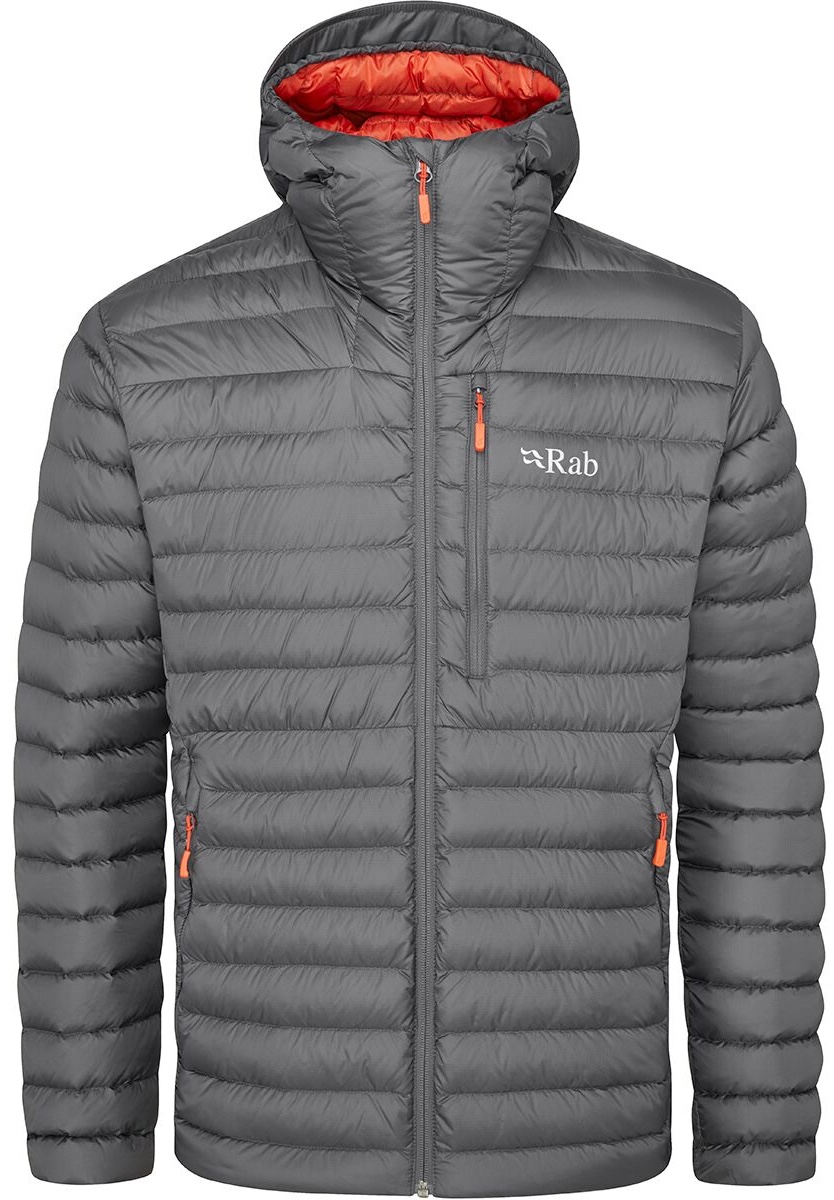
Category: Light/midweight
Weight: 1 lb. 0.5 oz. (men's), 14.6 oz. (women's)
Fill: 5.4 oz. (men's) / 5.1 oz. (women's) of 700-fill down
What we like: A nice level of warmth with a water-resistant build.
What we don’t: A tad heavy for the backcountry.
Rab’s popular Microlight Alpine Jacket is a true nod to the brand’s climbing roots, offering a thoughtful blend of technical performance and everyday usability. With its tough Pertex Quantum shell, DWR coating, and hydrophobic down, it’s built to fend off wind and light moisture far better than your average puffy. One of our favorite features is the wire-brimmed hood, which adds structure and coverage reminiscent of a hardshell—ideal for battening down the hatches when conditions turn. While you’ll still want a true rain jacket for sustained precipitation, the Microlight Alpine remains one of the most weather-ready down jackets we’ve tested.
That well-rounded design has made the Rab a go-to for both casual wearers and alpine climbers, but it’s not without worthy challengers. Outdoor Research’s Helium Down, for instance, steps it up with waterproof fabric on the hood and shoulders, while Patagonia’s Down Sweater beats it in both fill quality and overall weight. Still, the Microlight Alpine strikes an excellent balance of warmth, weather protection, and durability—especially at its approachable price point. For mountain missions where weight and packability matter but durability and protection can’t be compromised, it remains a stellar choice.
Read more: Rab Microlight Alpine Jacket review (women's version)
See the Men's Rab Microlight Alpine See the Women's Rab Microlight Alpine
 Category: Lightweight
Weight: 15.7 oz. (men's), 13.5 oz. (women's)
Fill: 3.5 oz. of 750-fill down; synthetic
What we like: Thoughtful design boosts weather resistance and durability.
What we don’t: A little heavy for backcountry use, limited storage.
Norrøna might not be on everyone’s radar, but the Norwegian company has a serious lineup of outerwear built for performance use. Their Falketind Down750 is a lightweight down jacket that has served us well both as a cold-weather midlayer (worn underneath a hardshell) and a standalone piece in milder conditions. A number of features set it apart from other jackets here, including body-mapped insulation (the down fill is centered largely around the core, while synthetic fill is used in exposed areas for added durability and weather protection), and fabric reinforcements (45D) at the shoulders and lower arms for enhanced abrasion resistance. We wore the Falketind Down750 for a winter of travel (including a 16-day trek in Nepal and backcountry skiing in BC), and it proved itself a capable companion in fall and winter conditions.
That said, we do have a few minor gripes with the Falketind Down750’s design. First off, both of our handwarmer pockets have stitching on the inside that reduces the usable area by a sizable margin (we undid the stitches in one pocket, but our handiwork resulted in a damaged zipper). Second, the jacket lacks interior storage (we like having dump pockets for storing skins or climbing shoes), and the hand pockets’ low placement makes them inaccessible under our backpack’s hip belt. Finally, the Norrøna is heavier than much of the lightweight competition, although many will consider this a fair trade for the added water resistance and durability. Added up, the Falketind Down750 is a hardwearing and thoughtfully designed down jacket with the top-notch build quality we’ve come to expect from Norrøna. Aside from a slightly lighter weight and a bit of different branding, the women's doesn't have any noticeable differences from the men's.
Read More: Norrøna Falketind Down750 Hood review
See the Men's Norrøna Falketind Down750 See the Women's Norrøna Falketind Down750
 Category: Ultralight
Weight: 4.9 oz. (men's), 4.2 oz. (women's)
Fill: 1.6 oz. of 1,000-fill down
What we like: Incredible warmth-to-weight ratio—the best on the market.
What we don't: Super thin shell fabric is lacking in durability.
Among serious alpinists, you won’t find an outdoor brand with more street cred than Montbell. This Japan-based company makes gear for those who depend on it, and they don't spend much on paid athletes or splashy marketing campaigns. But the proof is in the pudding: Montbell makes some of the most well-respected ultralight insulation on the market, and their most unique offering is the Plasma 1000. With ultra-premium 1,000-fill-power down (that is not a misprint) along with a paper-thin 7-denier shell, it’s by far the lightest down jacket on this list at an incredible 4.9 ounces all-in (just 4.2 oz. for women).
Why isn’t the Montbell Plasma 1000 ranked higher in our lineup? First, the 1.6 ounces of down fill is pretty meager—it might work for warm-weather backpacking on a route like the Appalachian Trail, but on its own, may not provide enough insulation even for summer nights in the mountains. Second, the 7-denier shell is extremely thin and requires extra care to prevent holes and snags. Last but not least, the fit of the jacket felt quite short on us. It’s listed as having a 27-inch length down the center back, but it certainly didn’t feel that way in person (the medium was way too short, while the large was too baggy). Nevertheless, the Plasma is an impressive technological feat, and for the right person, a fun addition to have in your quiver. The women's version has a slightly different baffle pattern (but is the same "skip-stitch" quilting pattern that reduces cold spots and heat loss), but other than that boasts the same impressive specs, low weight (slightly lighter than the men's), and tiny packed size.
See the Men's Montbell Plasma 1000 See the Women's Montbell Plasma 1000
Beyond the models featured above, we’ve tested a wide range of excellent down jackets that didn’t quite earn a spot in our round-up. Our goal is to highlight true standouts—pieces that offer exceptional value, performance, and durability over the long haul. Each jacket we recommend has been vetted across multiple seasons, so you can trust its quality. That said, we also like to pull back the curtain and share the other contenders we’ve tested to give you a fuller picture of what’s out there.
The Stone Glacier Grumman Down Jacket is one we've been wearing for a few months now, but decided not to include. It is a stout jacket with impressive durability, but compared to the competition, we just don't feel like it stands out in any specific category.
We've rocked our cherished La Sportiva Supercouloir Down Jacket for a couple of years now, and it has accompanied us all over the world—from high-alpine ascents in Nepal to winter romps in the Rockies. It's a worthy active-use jacket for wild adventures in the far-flung corners of the world. We left it out this round due to its overly specialized nature and high price point, but if you've got a mountaineering trip on your calendar, it's not to be missed.
The Stio Pinion is another notable jacket we excluded from our list. While it is a stellar jacket from a reputable brand, we just don't feel like it offers anything our current round-up doesn't, and it delivers below-average warmth for its weight.
The Black Diamond Mission 4000m Parka also didn't make the cut this round—but not because it didn't impress us. We only recently started testing this impressive cocoon of warmth, and in the end, just haven't been able to gauge it well enough on real-world adventures at high altitudes to deliver an authoritative review. After we get a bit more time in it—and test it on some proper mountains—we will be sure to re-evaluate.
A couple of other jackets we removed this round were the Cotopaxi Fuego Hooded Jacket and the Fjallraven Expedition Pack Down Hoodie. While these are worthy picks, they just can't stack up to the lineup of stellar layers above, and don't hold much appeal for us in light of the current competition. That said, if you want something with unique and fun colors, the Fuego is a classic.

| Jacket (men's / women's) | Price (M/W) | Weight (M/W) | Category | Insulation (M/W) | Fabric Denier |
|---|---|---|---|---|---|
| Men's Patagonia Sweater Women's Patagonia Sweater | $279 | 13.0 oz./ 10.3 oz. | Lightweight | 5.0 oz. / 3.5 oz. of 800-fill | 20D |
| Men's REI Down Jacket Women's REI Down Jacket | $129 | 10.9 oz./ 10.2 oz. | Lightweight | 3.5 oz. / 3.3 oz. of 650-fill | 20D |
| Men's Arc'teryx Cerium Women's Arc'teryx Cerium | $400 | 11.9 oz./ 10.2 oz. | Lightweight | 4.0 oz. 850-fill & 80g Coreloft | 15D |
| Men's Rab Neutrino Pro Women's Rab Neutrino Pro | $425 | 1 lb. 3.9 oz./ 1 lb. 2.3 oz. | Heavyweight | 7.5 oz. / 7.0 oz. of 800-fill | 20D |
| Men's Rab Mythic Alpine Light Women's Mythic Alpine Light | $330 | 8.8 oz./ 8.0 oz. | Ultralight | 2.8 oz. / 2.1 oz. of 900-fill | 10D |
| Men's BD Deploy 0.5 Women's BD Deploy 0.5 | $499 | 5.2 oz./ 4.9 oz. | Ultralight | 1000 fill power | 4D |
| Men's Himali Accelerator Women's Himali Accelerator | $330 | 12.2 oz./ 11.0 oz. | Lightweight | 4.0 oz. of 850-fill | Unavail. |
| Patagonia Down With It Parka | $349 | 2 lb. 5.0 oz. | Midweight | 8.3 oz. of 600-fill | 50D |
| Men's Katabatic Tincup Women's Katabatic Tincup | $309 | 12.7 oz./ 11.7 oz. | Light/midweight | 5.6 oz. / 5.0 oz. of 850-fill | 20D |
| Men's OR Coldfront Down Women's OR Coldfront Down | $279 | 1 lb. 4.7 oz./ 1 lb. 5.2 oz. | Midweight | 6.7 oz. / 5.6 oz of 700-fill | 30D |
| Men's ME Paiyu Women's ME Paiyu | $350 | 1 lb. 9.7 oz./ 1 lb. 2.7 oz. | Heavyweight | 9.5 oz. of 700-fill | 40D |
| Men's Decathlon MT100 Women's Decathlon MT100 | $119 | 11.3 oz./ 10.2 oz. | Lightweight | 800 fill power | 15D |
| Men's OR Helium Down Women's OR Helium Down | $299 | 1 lb. 0.2 oz./ 15.4 oz. | Lightweight | 3.9 oz. of 800-fill | 15Dx30D |
| Men's FF Eos Women's FF Eos | $409 | 11.8 oz./ 11.1 oz. | Lightweight | 4.0 oz. / 3.7 oz. of 900-fill | 12Dx20D |
| Men's Rab Microlight Alpine Women's Microlight Alpine | $295 | 1 lb. 0.5 oz./ 14.6 oz. | Light/midweight | 5.4 oz. / 5.1 oz. of 700-fill | 30D |
| Men's Falketind Down750 Women's Falketind Down750 | $369 | 15.7 oz./ 13.5 oz. | Lightweight | 3.5 oz. of 750-fill | 20Dx45D |
| Men's Montbell Plasma Women's Montbell Plasma | $299/ $295 | 4.9 oz./ 4.2 oz. | Ultralight | 1.6 oz. of 1000-fill | 7D |
Whether we’re jamming cracks, skinning up powdery slopes, or grabbing a quick bite on the trail, cozy down jackets are staples in our kits—and we rarely leave home without one. Former editor-in-chief John Ellings drew from his experience on endless local romps in the Pacific Northwest and far-flung international expeditions to hone in on our initial list of 11 jackets back in 2015. Down jacket testing was taken over in early 2024 by senior editor Chris Carter and editor-in-chief Penney Garrett, with help from other key members on our team. Chris is a diehard thru-hiker, climber, and globetrotter who’s tackled the Triple Crown of long-distance hiking in the U.S. (AT, PCT, and CDT). Penney is a veteran outdoorswoman across many disciplines and currently lives in Lake Tahoe, a mecca for any and every sport you could want to dabble in. Together, they bring a wealth of experience to this review and can fully stand behind the jackets in our lineup.
We’ve logged serious miles in all the jackets listed above, across just about every terrain and climate imaginable, to bring you our list of 17 top performers. From icy alpine starts and windy desert belays to long-haul thru-hikes and quick town errands, each piece was tested in the environments it was designed for. Every jacket had to earn its spot through rigorous real-world testing and prove its mettle in multiple categories. We evaluated warmth-to-weight ratio, packability, weather protection, comfort, and long-term durability—making sure each contender could take a beating and still deliver. Only the true standouts made the cut, and we continue to retest and refine our list as new models hit the market and old favorites get updated. Rest assured, the jackets above aren’t just warm—they’re the best of the best.

Lightweight
The lightweight down jacket category is by far the most popular, appealing to those seeking versatile warmth for everyday use. These jackets prioritize comfort and functionality, though you won’t find features like helmet-compatible hoods or slim, athletic fits. They excel in casual wear, travel, light outdoor activities, and as layers for winter sports. In terms of temperature range, lightweight jackets generally perform best in the 35-50°F range, depending on layering and your level of activity (more on this in "Our Estimated Temperature Scale" below). Top models include the Patagonia Down Sweater, Norrøna Falketind Down750, and the budget Decathlon Simond MT100 Jacket.

Ultralight
Ultralight down jackets, such as the 4.9-ounce Montbell Plasma, are highly specialized pieces built for activities like backpacking, climbing, and backcountry skiing, where every ounce counts. While their fill weights are often similar to lightweight down jackets, they stand out for their use of high-quality down (fill power), lightweight shell fabrics (denier), and minimalist features like zippers and pockets. A true standout in this category is Black Diamond's impossibly light 5.3-ounce Deploy Pullover. Interestingly, many of these jackets, such as the Rab Mythic Alpine Light, are also worn as everyday layers in urban environments. These jackets deliver a great balance of warmth for their weight, and with a little extra care to protect the delicate shell, they provide an athletic fit that’s perfect for layering.

Midweight and Heavyweight
Mid- and heavyweight down jackets offer a significant leap in warmth compared to their lightweight and ultralight counterparts, making them ideal for demanding winter conditions like alpine climbing and mountaineering. These jackets typically feature fill weights that range from 7.5 ounces (such as the Rab Neutrino Pro) to even higher amounts (like the 9.5 ounces of down in the chunky Mountain Equipment Paiyu Down Jacket), a major step up from the 3- to 4-ounce range of lighter models. As a result, they tend to be much bulkier and take up more room in your pack, which is why we reserve them for situations where extra warmth is crucial. To maintain a good warmth-to-weight ratio, many of these jackets utilize top-tier down insulation. We've highlighted several of our favorite mid- and heavyweight options in this guide—one of our current favorites is the Katabatic Tincup—but for a more detailed look, check out our round-up of the best winter jackets.

There’s nothing quite like the plush, premium warmth that down insulation provides. The reason down works so well is that the loose clusters of feathers are exceptional at trapping body heat. However, unlike down sleeping bags, which have an official EN rating system to measure and quantify warmth, down jackets lack a standardized scale. Keep reading for the information that can help you navigate this uncharted territory.
Fill Power
Fill power (600-fill, 700-fill, 800-fill, and so on) measures the quality of down, with higher fill numbers indicating better down. The number is determined by how much space one ounce of down clusters occupies in a cylindrical tube, known as loft. The greater the loft, the more heat the down traps, making the jacket warmer. In simpler terms, to achieve the same level of warmth with a lower fill power, more down is needed, which increases weight and bulk while remaining at the same comfort level.

For jackets, you'll typically find 550 to 650-fill down in most entry-level and mid-range models. While this is perfectly fine for everyday wear, it doesn't quite cut it for high-performance use. Premium down starts at 800-fill and above, which is used by brands like Arc'teryx, Patagonia, and Mountain Hardwear in their top-tier jackets. At this level, you get the well-known benefits of down insulation: lightweight warmth that's also highly compressible. Some high-end climbing brands, such as Feathered Friends and Montbell, even use 900-fill down, though that's quite rare, with 800-fill generally being the benchmark for premium quality.
.jpg)
In 2013, Patagonia introduced the Encapsil, a 1,000-fill down jacket, but it hasn't returned to the market since. Currently, Montbell offers the 1,000-fill Plasma Down Jacket above and the Plasma 1000 Alpine Down Parka, which feature lightweight 7D shells. These are ideal for ultralight adventurers, but with a very limited amount of fill, they aren't suitable for extreme conditions.
Fill Weight
While fill power often gets the spotlight, fill weight is arguably the more crucial factor in determining a down jacket’s warmth. Fill weight refers to the actual amount of down in a jacket, measured in ounces. For instance, if Jacket A contains 6 ounces of 800-fill down and Jacket B has only 3 ounces of the same fill power, Jacket A will be much warmer (we estimate it could boost comfort in low-output activities by roughly 10-20 degrees). Lower fill power down provides less warmth per ounce, so to make a fair comparison, it's best to look at jackets with similar fill powers.

It’s interesting that fill weight tends to be less emphasized than fill power, which can create confusion for shoppers who assume higher fill power always equates to more warmth. Fill power numbers certainly have more appeal, and as a result, we often find ourselves reaching out to manufacturers to get the fill weight, as it’s often not listed (for more details, check out our article: Down Fill and Insulation Explained).
Our Estimated Temperature Scale
Pinpointing an exact temperature range for comfort in a down jacket is tricky (which is why no standardized rating system exists). Factors such as fit, layering, activity level, circulation, and wind all impact how warm you’ll feel.
.jpg)
Generally, down sweaters and ultralights, which typically have between 2 to 4 ounces of fill, provide solid warmth in conditions ranging from 35 to 60°F (2 to 15°C) with light activity, such as hanging around a campsite. More fill will bring you closer to the lower end of that range, while less fill will move you toward the middle. Adding a cozy baselayer can extend that range by 5 to 15 degrees, depending on thickness and quality. These jackets are a go-to for three-season alpine adventures and everyday use in cities, except during the coldest winter months.

When temperatures dip below freezing, a midweight or heavyweight down jacket will keep you much more comfortable for winter conditions. These jackets typically have a minimum fill weight of 4 ounces, with most ranging from 5 to 6 ounces or more (for example, the Rab Neutrino Pro packs 7.5 ounces of down). For extreme cold or high-altitude climbs, you might want to opt for an even thicker down parka to ensure warmth.
For activities like backpacking, climbing, mountaineering, or ski touring—where you're carrying your own gear—the total weight of your down jacket should be a key consideration. Jackets like the Rab Mythic Alpine Light and Black Diamond Deploy offer excellent warmth with minimal weight and compress down to a very small size in your pack. However, the advanced tech that makes these jackets so lightweight and packable comes at a premium price. On the other hand, if you just need a jacket for casual use and occasional outdoor activities like downhill skiing, a heavier and more affordable option like the 1-pound-4.7-ounce Outdoor Research Coldfront will do the trick. For true winter conditions, expect to need a heavier option, such as Rab's 1-pound-5.3-ounce Neutrino Pro.
.jpg)
“Ultralight” is a term you’ll often encounter while shopping for a down jacket, but it’s important to remember that there’s no strict definition of what qualifies as ultralight. We pay attention to the ratio of fill weight to total weight to gauge how much effort the manufacturer put into minimizing weight (the shell denier is also a good indicator, which we’ll cover below). On the extreme end, Montbell's Plasma 1000 packs just 1.6 ounces of down into an incredibly light 4.9-ounce jacket. To shed weight, gear brands often make changes to zippers, opt for a trim fit, and eliminate pockets. Some even go for a pullover style to remove half the zipper, such as with the Black Diamond Deploy. Regardless of the label a jacket carries, it’s always best to check both the fill weight and total weight to assess whether it truly qualifies as ultralight for your needs.

Denier (D) refers to the thickness of the threads used in a fabric, and the lower the number, the lighter—and typically less durable—the material. Jackets with low-denier shells are more prone to snags and tears, which is something to keep in mind if you’re tough on gear. That said, one of the main ways manufacturers cut weight on ultralight down jackets is by using lower-denier fabrics for the shell. While high-fill-power down and ultralight zippers also help shave ounces, the shell material plays the biggest role in keeping overall weight down.

Most of the jackets we recommend use fairly lightweight shell materials, but there’s still a wide range in durability and feel. On the ultra-thin end is the Montbell Plasma 1000 (not featured here) with its super delicate 7-denier fabric, while more robust options can reach 30D or higher. For reference, 10D is common among ultralight designs, while 20D is typical for standard down sweaters. That jump from 10D to 20D may not seem huge, but it can have a real impact on both a jacket’s weight and its long-term durability. If you’re counting ounces and heading into the backcountry, go ultralight. But if your jacket will mostly see action around town, a burlier down sweater will likely last longer and cost you less.
/REI%20Co-op%20650%20Down%20Jacket%20(closeup%20from%20front).jpg)
Denier plays a big role in a jacket’s toughness, but it’s not the only factor to consider when assessing durability. One key element is the shell fabric technology. Pertex’s Quantum Pro—used in jackets like the Rab Neutrino Pro—is one of our favorites, offering excellent abrasion resistance even in thin constructions (we’ve tested 10D Quantum Pro shells that held up impressively well). Another standout is Pertex’s Diamond Fuse, featured on the OR Helium Down, which boosts durability with a unique yarn structure. Lastly, stretch-woven fabrics are becoming increasingly common, offering a nice blend of flexibility, comfort, and enhanced tear resistance.

One of the biggest perks of down insulation—especially for ounce counters—is how well it compresses. Featherweight jackets like the Black Diamond Deploy can stuff into their own pocket and shrink down to smaller than a Nalgene bottle, making them incredibly easy to toss in a daypack or backpacking pack without thinking twice. Additionally, the higher the fill power, the better the compressibility. Premium down (800-fill and above) can squash down impressively small and spring back to full loft quickly, as long as it hasn’t been stored tightly packed for too long. Shell fabric plays a role too: thinner denier materials pack smaller than beefier shells. This is one of the key reasons down still holds a clear edge over synthetic insulation when space and packability matter most.

Down’s biggest weakness is its vulnerability to moisture—get it wet, and those lofty feathers clump up, losing their insulating power fast. That’s why in damp climates or during high-output activities where sweat is a factor, many folks turn to a synthetic jacket, which continues to insulate even when soaked. That said, hydrophobic down has changed the game. Many brands now treat their down with a water-resistant polymer that helps it repel moisture and stay lofted longer in light rain or snow. It’s not quite on par with synthetics in truly wet conditions, but it’s a big step forward. If you’re adventuring in rainy zones like the Pacific Northwest or New Zealand, a jacket like the Rab Microlight Alpine—with hydrophobic down and a solid shell—can give you the best of both worlds.
.jpg)
Another common defense against moisture is a DWR (durable water repellent) finish applied to the jacket’s outer fabric. This treatment causes water to bead up and roll off rather than soak into the material, giving you a buffer against light rain or snow. While DWR alone won’t make a jacket waterproof—and neither will hydrophobic down—it’s a solid first line of defense. Together, these technologies can go a long way in keeping you dry during short bouts of precipitation or in damp, drizzly conditions.
Fit will always depend on the specific jacket, but there are a couple key themes to keep in mind. For one, casual down sweaters tend to have more generous cuts—think boxier torsos, wider arms, and roomier hoods (when included)—compared to sleeker, performance-oriented pieces. Brand differences also stand out. Arc’teryx jackets, for example, are famously slim-fitting (like the Cerium Hoody)—a style we often refer to as the “Arc’teryx fit.” They are designed with guides and high-output users in mind, which explains the trim profile.
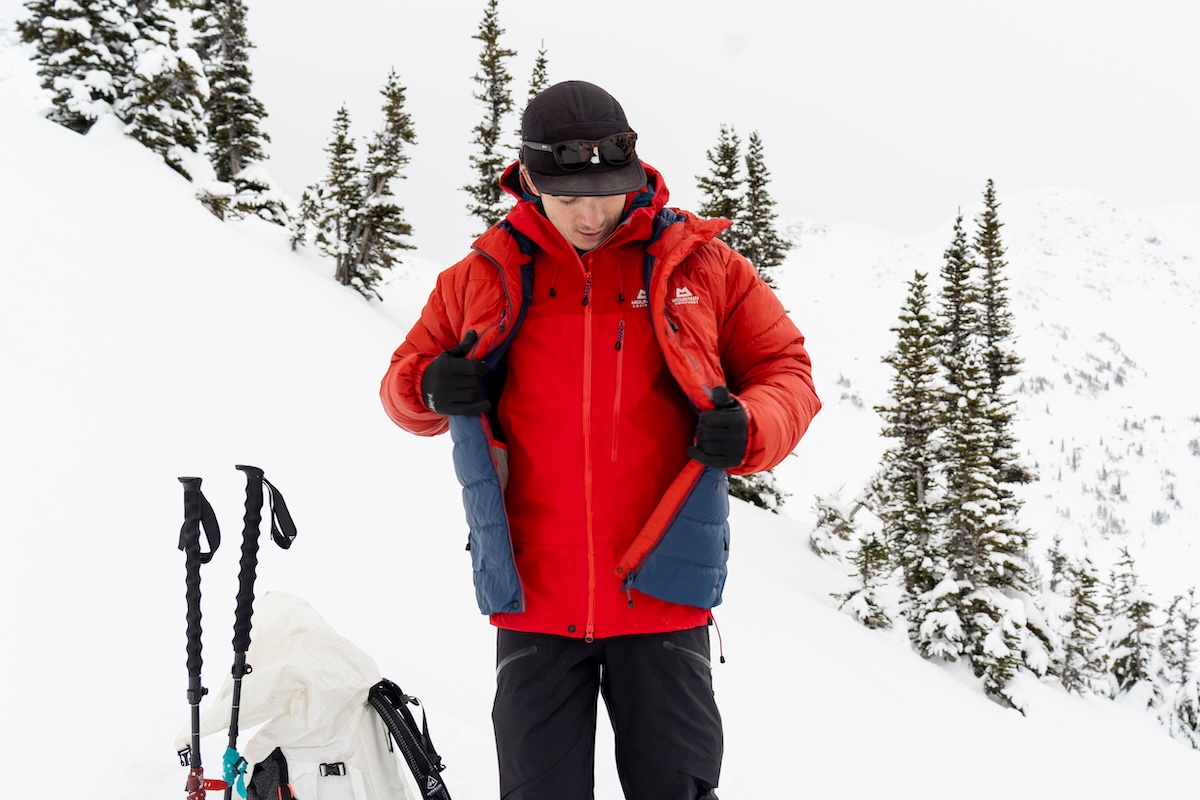
Rab and Himali also lean athletic in their cuts, while Patagonia, Outdoor Research, and Mountain Hardwear strike a nice middle ground between casual comfort and technical performance. On the roomier side, REI Co-op and Marmot tend to offer more generous sizing, and we’ve found ourselves sizing down at times (including with our REI 650 Down Jacket).

Most of the down jackets we’ve featured come in both hooded and non-hooded styles. Going without the hood usually shaves a little weight and cost, which can be appealing if you’re trying to keep things streamlined. That said, a hood adds noticeable warmth and comfort, especially in cold or windy conditions. For casual wear or as a midlayer under a ski shell, many folks skip the hood (or opt for a down vest) and just pack a beanie. But for backcountry pursuits like climbing or backpacking, a hooded jacket is often worth the extra ounces. In our round-up, we’ve highlighted non-hooded versions when available, since they tend to be the more popular pick for casual use, and listed the ultralight models with hoods, which are often preferred for more technical applications. If you’re still on the fence, we cover the pros and cons more in-depth in our article: Does Your Down Jacket Need a Hood?
.jpg)
This article is unisex in nature, featuring both male and female gear testers who get outdoors in all seasons and types of conditions. In addition, we have created a round-up of the best women’s-specific down jackets covering that category in particular. Many of the models are the same, but the names and colorways sometimes vary. On occasion, a specific design feature may differ, and women's down jackets often have slightly less downfill than their male counterparts, as shown in the tables and specs above. And there are, of course, products that are only available for women or vice versa. In general, women's jackets will have more curve built into the shape, but if that design feature doesn't work for your body, opting for a men's jacket is a perfectly reasonable approach.
.jpg)
With environmental impact front and center these days, it’s encouraging to see more outdoor brands stepping up their sustainability efforts. One of the biggest changes we’ve noticed is the widespread use of responsibly sourced down—keep an eye out for an RDS (Responsible Down Standard) certification. This ensures the insulation was sourced ethically, with safeguards in place to protect birds from practices like force-feeding or live-plucking. In addition, recycled shell and lining fabrics are becoming increasingly common. Brands like Patagonia, REI Co-op, and Mountain Hardwear are leading the charge here, building high-quality jackets while reducing their environmental footprint.
.jpg)
One final sustainability trend worth highlighting is the shift toward PFAS-free durable water repellent (DWR) finishes. As mentioned above, DWR helps keep moisture from soaking into your jacket, but traditional versions rely on per- or polyfluorinated chemicals—commonly called “forever chemicals” for their persistence in the environment. With growing awareness around their environmental and health impacts, and new regulations restricting their use in several states, outdoor brands are being pushed to find safer alternatives (for more, you can read about Patagonia’s take on the issue). Thankfully, the industry is responding. Companies like Stio, Black Diamond, and Patagonia have already begun phasing in PFAS-free DWR finishes, offering similar performance while being much gentler on the planet.
.jpg)
There’s a strong case to be made for synthetic insulated jackets—they hold up far better than down when wet, tend to be more breathable, and are usually easier on the wallet. That said, down remains the gold standard for pure warmth-to-weight performance. Nothing else matches its combination of loft, packability, and overall comfort. We’ve tested popular synthetics like the Arc’teryx Atom and Patagonia Micro Puff and found them to be impressively cozy and fairly lightweight, but they just can’t match the insulating power of quality down. Synthetics are great for shoulder-season outings and everyday use, but when you’re heading deep into the backcountry or facing real winter conditions, down’s superior warmth and compressibility make it the better choice. In a perfect world, you’d own both—but if you’re picking just one, down is still the undisputed champ. For a deeper comparison, check out our full breakdown of down vs. synthetic insulation.
Back to Our Top Down Jacket Picks Back to Our Down Jacket Comparison Table

0c92.jpg?h=fbc67360&itok=PYHlfPFz)
_0f523.jpg?h=fbc67360&itok=Y_CF_sgL)
e13b.jpg?h=fbc67360&itok=roLTspKI)
678e.jpg?h=fbc67360&itok=Fjr9waXE)
_0441c.jpg?h=fbc67360&itok=SPWEpzYe)
Sfbfb.jpg?h=fbc67360&itok=-57tipaI)


