.jpg)
.jpg)
Photo Credit
It’s that time of year! Time to find the perfect present for our adventurous loved ones. For that person in your life who loves all things cold weather, check out our gift guide for skiers and snowboarders. For ideas tailored to other pursuits, we also have more editor-recommended gift guides to explore. Happy gift giving!
We can’t overstate the importance of choosing the right boots for your feet, whether you're just starting out or have been skiing for years. And while there has been progress in the development of women's ski gear, it's important to note that some women's-specific designs don't reach the same performance standard as unisex boots. We'd like to acknowledge that for hard-charging women, sometimes the best option will be a unisex or men's boot. That said, the industry has come a long way, and there are now some great options built specifically for the ladies, including our top pick, the Tecnica Mach1 MV 105 W. Below are all of our top choices for the best women’s-specific ski boots for the 2025-2026 season. For more background information, see our comparison table and buying advice below the picks. To complete your downhill kit, check out our articles on the best women’s all-mountain skis, best ski bindings, and our ski boot and binding compatibility guide.
Editor's note: We updated this guide on November 21, 2025, to refine our list by removing ski boots that didn't stand out in testing or are no longer competitive in the space (you can see our list of dismissed ski boots below). We also added a few new boots to the list, including Scarpa's Gea RS and 4-Quattro SL, as well as the Tecnica Mach Sport HV 65 and Cochise 105 W. Finally, we swept the guide to ensure all other information was up to date at the time of publishing and refreshed the imagery with new testing photos.

Type: Alpine (resort)
Lasts: 100mm (medium width)
Flex: 105 (intermediate/advanced skiers)
Other flexes: 95, 115
What we like: A high-performance boot that’s actually comfortable.
What we don’t: Beginners will want something softer, experts will want something stiffer.
The alpine ski boot market is flush with options, but the Tecnica Mach1 series continues to impress us year after year. For intermediate and advanced skiers, we recommend the MV 105, which stands for their medium volume (100 last) 105 flex boot. In testing, we found that this boot offers nearly the ideal combination of comfort, performance, and price. This medium volume boot is a good middle ground for most skiers, but the liner is heat-moldable and the shell is punchable for most customization. The boot has a predictable power transfer and plenty of support with its four buckle design. In testing, we found it trustworthy in a range of terrain, including crud and bumps. Lastly, the boot has proven to be very well-made and durable for the price, and we have no doubts that it will last us through seasons of regular use.
While the Mach1 MV 105 is a great middle ground, beginners and experts will likely want to consider something different. For beginners, we recommend a softer boot that is more forgiving on mellow terrain (beginner boots are also generally cheaper). Expert riders will likely want something stiffer, like the Lange Shadow below. But if you like the Mach1’s design, you can also get it in a stiffer 115 flex. It’s also worth noting that the Mach1 is available in low volume (98mm) and high volume (103mm) versions that might be better for those with narrower or wider feet, respectively. In our opinion, these options are just another feather in the Mach1’s cap: There’s a lot of versatility within the line, making it easy to find your right size and flex.
See the Tecnica Mach1 MV 105 W


Type: Alpine (resort)
Last: 103mm (wide width)
Flex: 65 (beginner/intermediate skiers)
Other flex: 75, 85
What we like: A thoughtfully built, beginner-friendly design at a great price.
What we don’t: Progressing intermediates will quickly outgrow this boot.
Learning to ski is challenging enough without uncomfortable boots and achy toes thrown in the mix, which is why we recommend Tecnica’s Mach Sport HV 65 to new skiers. This soft and forgiving boot prioritizes comfort with a 103-millimeter last and high-volume shape that will accommodate most feet with minimal break-in required. The cozy liner is warm and well cushioned for full days of lessons and laps, and the shell can be customized by a bootfitter. To top it off, the boots' grippy soles will help new skiers stay upright while learning to navigate icy parking lots and slippery ski lodge staircases.
While the Mach Sport HV 65 is an excellent choice for beginners building their skills, the boot’s soft flex and plush comfort mean that progressing intermediate riders will outgrow it sooner rather than later. Skiers who can confidently link turns on green runs but still want a comfortable all-day boot will be better off with a slightly stiffer option, such as the Nordica Sportmachine 3 75 or the stiffer options in the Mach Sport line, including the 75 and 85 flexes. Although both alternatives come with a higher price tag, quickly advancing riders will appreciate the efficient power transfer and responsiveness they get with very little trade-off in overall comfort. On the other hand, it’s hard to beat the value of the Mach Sport HV 65, making it an approachable but capable pick for riders graduating from their first turns to the bunny slopes and beyond. For more beginner ski boot picks, be sure to check out our beginner ski boot round-up.
See the Tecnica Mach Sport HV 65

Type: Alpine (resort)
Last: 97mm (narrow width)
Flex: 115 (advanced/expert skiers)
Other flexes: 85, 95
What we like: An intriguing design that takes boot flex and efficient power transfer to a new level.
What we don’t: Pricey, and we have some long-term durability concerns.
Lange brought a unique and innovative approach to ski boot design with its Shadow line, most notably their Suspension Blade and Dual Pivot concepts. For context, traditional ski boots are built with two overlapping pieces (the cuff and the shell), which are attached via a spine along the back of the boot. The Shadow's “Suspension Blade” shakes this concept up by connecting the cuff to the lower shell via two pivot points on either side of the heel. This allows the skier to transfer power more efficiently to their skis, which in turn saves energy and maintains power and control. In testing, this made turn initiation very easy, and we were surprised by how quickly we got used to the new tech.
Aside from the intriguing innovations, the women’s Lange Shadow 115 is a feature-packed boot that deserves a spot on any advanced or expert skier’s shortlist. With a 115 flex, it’s almost as stiff as ski boots get for ladies, and Lange didn’t skimp on comfort with a heat-moldable, single-piece liner that boasts an asymmetrical toe box to match the shape of the foot while minimizing pressure points. Additionally, the women’s-specific cuff and shell enhance comfort, making the boot easier to put on and take off. Our only real hesitation is durability. Generally, the more moving parts, the greater the risk of failure; however, we have yet to encounter any issues in testing. A final note: Beginner and intermediate riders will be better off with the softer 85- or 95-flex models, and the entire line is available in low volume (97mm), medium volume (100mm), or high volume (102mm) variations depending on your foot shape.
See the Lange Shadow 115 LV

 Type: Hybrid (resort & backcountry)
Last: 97mm (narrow width)
Flex: 115 (advanced/expert skiers)
Other flex: 95
What we like: Excellent performance all over the mountain.
What we don’t: Walk mode range of motion isn't up to par with true touring boots.
A favorite amongst ski patrollers, the Lange XT3 is a true workhorse of a ski boot. Though designated as a touring boot (which oftentimes foregoes downhill performance for uphill efficiency), it flexes with the same snappy pop as Lange's downhill offerings. Plus, the walk mode is a real benefit for long days on the mountain, bootpacking inbounds, and chilling at the lodge. The XT3 comes with a removable, dual-position highback, or "spoiler", to accommodate different calf sizes. We also appreciate the lightweight Performance Boot Board footbed, which surpasses most stock options on the market. And the boot is offered in both low volume (97mm) and medium volume options (100mm), making it appealing to a wide range of skiers.
With so many fun features, what's not to like about the Lange XT3 Free? First, while we appreciate the walk mode, we've found in testing that it's more limited compared to others on the market and in this lineup. In other words, while the XT3 thrives as an inbounds, all-mountain option, we wouldn't recommend it as a daily driver in the backcountry. Additionally, the narrower last options might be a bit too tight without punching for folks with wider feet. However, if you're going to be working at a ski hill or just average a high number of days in ski boots doing everything from making turns to hiking ridges to putzing around the parking lot, these are a great choice.
See the Lange XT3 Free 115 LV

Type: Hybrid (resort & backcountry)
Last: 100mm (medium width)
Flex: 100 (advanced skiers)
Other flex: 130 (Pro), 95 (GT)
What we like: Can keep up both in and out of bounds.
What we don’t: More experienced skiers might be left wanting more.
Those who split their time between the resort and backcountry might find a lot of value in a hybrid model. Within this category, Scarpa’s 4-Quattro SL is our favorite for women. In our experience, this boot does a great job at balancing both in-bounds downhill performance and uphill charge. As the lightest of the 4-Quattro line, the SL has a lot of skin track appeal: Unlike heftier hybrid boots, this one actually climbs like a dedicated backcountry design, and has a flexible 61 degrees of motion in the collar that promotes a natural stride. On the way down, the 4-Quattro provides a stiff and confidence-inspiring ride with its sturdy 4-buckle design and balanced 100 flex. The GripWalk sole is compatible with both downhill and touring bindings, and provides plenty of grip for both icy parking lots and backcountry approaches. And we have no gripes with Scarpa’s build quality. Despite being lightweight, the shell holds up well to regular use and abuse, and the included Intuition liner is best-in-class.
Our main gripe with the 4-Quattro SL is its flex. While we do think that it lands on the stiffer side of 100, expert skiers will likely want something a bit stiffer. Scarpa also offers the 4-Quattro Pro with a 130 flex, but that might be too stiff for some users. In a perfect world, Scarpa would have some version of the 4-Quattro series with a 115 or 120 flex. Another option to consider is Atomic’s Hawx XTD 115 BOA W GW, which has a beefy construction and plenty of stiffness for more experienced skiers. We still prefer the 4-Quattro SL for its lightweight design and lower price tag, but the Hawx is a stellar alternative for those who value downhill performance a bit more than uphill. For the best of both worlds, however, the answer is easy for us: Scarpa’s 4-Quattro series continues to impress us year after year.
See the Scarpa 4-Quattro SL

Type: Backcountry
Last: 102mm (wide width)
Flex: 120 (advanced/expert skiers)
Other flex: 100 (non-RS version)
What we like: Balances downhill and uphill performance better than most.
What we don’t: Doesn’t translate as well into resort use.
We turn again to Scarpa for our top backcountry boot, the brand’s venerable Gea RS. Like the 4-Quattro above, the Gea deftly balances uphill and downhill performance, but in a more powerful package. Don’t get us wrong, the Gea is still a great boot for the skin track—it’s lightweight and has 61 degrees of cuff rotation—but its 120 flex is better for hard-charging backcountry skiers. In our testing, we found that it has excellent response and power transfer for advanced and expert skiers, and it maintains its performance across a range of terrain and snow conditions. We’re also big fans of the buckle system, which transfers pressure evenly over the top of the foot, and the 102-millimeter last, which specifically accommodates the pinky toe, a common hotspot for backcountry skiers. Put together, the Gea is a stellar all-around boot for backcountry skiers, and it can keep up with a little bit of everything from casual yo-yo laps to more technical mountaineering ascents.
To be sure, the Gea is a fully-fledged backcountry boot. Its sole isn’t compatible with alpine bindings, which means you’ll have to stick to your backcountry setup even if you want to ski inbounds. If you’re dedicated to earning your turns, however, that shouldn’t be an issue. It’s worth pointing out another compelling design here: Tecnica’s Zero G Tour Pro W. The Zero G is the other model you’re likely to see most often on the skin track, and for good reason. With a 125 flex, lightweight build, and high range of motion (65 degrees), the Zero G is a beast for women who like to ski a little harder. Still, we keep coming back to the Gea RS for its build quality and more comfortable fit (not to mention, slightly lower price tag). On the other hand, another alternative is the standard Gea, which has a softer flex (100) but saves you a bit of cash and weight. For more options, see our guide on the best backcountry ski boots.
See the Scarpa Gea RS

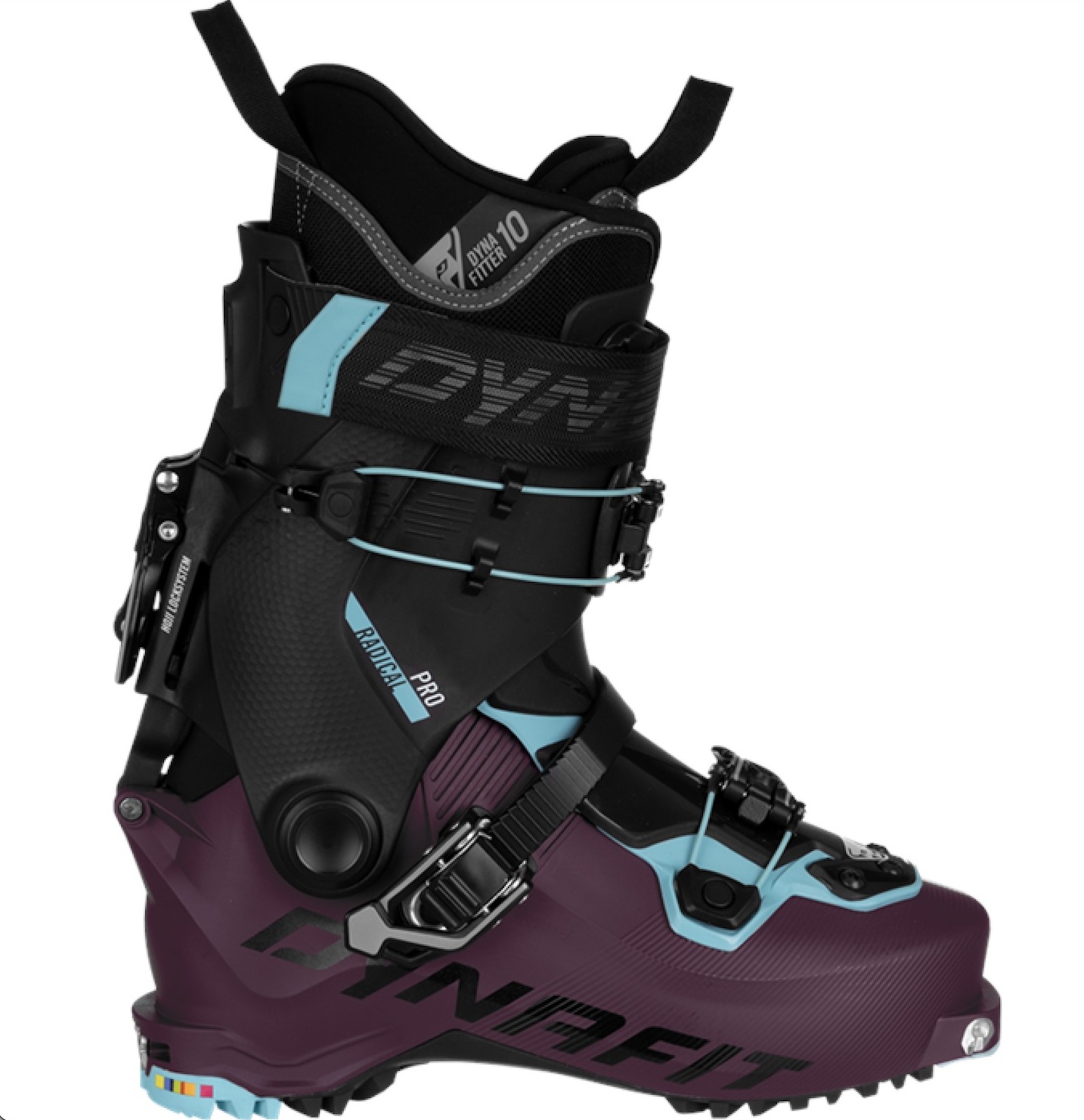
Type: Backcountry
Last: 103.5mm (wide width)
Flex: 110 (advanced/expert skiers)
Other flex: 100 (non-Pro version)
What we like: Hard-charging on the down without compromising much on the uphill.
What we don’t: Stock liners aren't great, very wide, and Hoji Lock System can be finicky.
Could it be?! A true backcountry freeride boot for women? Yes, that's right; Dynafit stepped up its game by creating a women's version of their popular Radical Pro a few years back, and they just keep getting better. A favorite among guides and mountain professionals who want all-day comfort and downhill performance without compromise, the Radical Pro shines as a touring boot. The magic lies in the boot’s 60-degree range of motion, stiff 110 flex, and the innovative Hoji Lock system that makes transitions a breeze. The concept is simple: When put into walk mode, the back lever simultaneously releases the top buckle and disconnects the cuff from the shell, allowing for freedom of movement on the skin track. And when it’s time to go down, the lever tightens the top buckle and secures the cuff and shell securely together.
No boot is perfect, however, and we have our gripes with the Radical Pro. To start, the 103.5 last is very wide, which can lead to a sloppy ride for those with narrow feet. It also lands on the heavier end for a backcountry boot, which can make it a slog to drag up the skin track. Finally, the stock liner proved quick to pack out, and we experienced some issues with the Hoji Lock System in testing: We found it easier to lock the heel by first undoing the top buckle, then tightening it once the heel is in place. But in our opinion, these aren’t deal-breaker downsides. For folks who really care about the downhill as much as the up—and are willing to manage a bit of heft to achieve that—the Radical Pro is worth considering.
See the Dynafit Radical Pro

Type: Alpine (resort)
Last: 100mm (medium width)
Flex: 105 (intermediate/advanced skiers)
Other flexes: 85, 95, 115, 125
What we like: Great balance of performance and comfort.
What we don’t: Expensive and we wish it had a walk mode function.
Lightweight and snappy, K2’s Anthem 105 is a responsive all-mountain boot that’s ideal for women who like to charge hard both on- and off-piste. With a moderately stiff 105 flex, it edges more toward precision than playfulness, but thankfully, K2 didn’t skimp on comfort: both the liner and shell can be heat-molded, the Boa closure provides a more precise fit, and the rear cuff can be adjusted to accommodate different calf shapes. Despite the boot’s moderate stiffness, the K2 Anthem 105 is easy to take on and off thanks to softer material at the instep and oversized buckles that are easy to manipulate with gloved hands.
Despite the middle-of-the-road 105 flex, we found that the Anthem felt more lively and powerful on the slopes than the flex would suggest. That said, expert skiers who are blasting all over the mountain at top speed will likely want to step up to the stiffer Anthem 115 or 125. On the other hand, intermediate and beginner skiers can find more forgiveness in the Anthem 85 or 95. Flex aside, we do have some gripes with the Anthem. First, we wish that K2 had included a walk lever to enhance the boot’s all-mountain versatility—a logical fit in our minds, given its lightweight construction. And we’re also bummed to see the price go up so much with the addition of a Boa this year, which now makes the Anthem pricier than our top downhill boot. We hope that K2 brings back the traditional buckles in a less expensive design in the future. Nitpicks aside, the Anthem 105 has proven itself a very comfortable yet high-performing boot that works well for most advanced resort skiers.
See the K2 Anthem 105 Boa

Type: Hybrid (resort & backcountry)
Last: 99mm (narrow width)
Flex: 105 (intermediate/advanced skiers)
Other flexes: 95, 115
What we like: Great price for a high-performing hybrid boot.
What we don’t: Too heavy for dedicated backcountry use.
If you’re just beginning to dip your toes into backcountry skiing and don’t want yet want to invest in one of the premium backcountry or hybrid designs above, you can save a lot by opting for Tecnica’s Cochise 105 here. But don’t be fooled: The Cochise doesn’t sacrifice much in performance to achieve its more budget-friendly status. It has a decent 50 degrees of cuff rotation and an easy-to-use hike lever for efficient and smooth skinning. And the 105 flex is no slouch on the downhill, either. The 99 millimeter last is a nice balance of comfort and precision, and we found the liner quite warm and comfortable on chilly days. Put together, the Cochise is a great boot for the price, and will have no problem keeping up on mild day tours and out-of-bounds laps.
To be sure, dedicated backcountry skiers will want something lighter weight and slightly more flexible on the skin track. As you improve your backcountry confidence, keep in mind that you might have to upgrade in the future. But we have no complaints regarding its downhill performance. If you want something a bit stiffer, you can spend up for the 115 flex, but the 105 here has proven plenty for driving skinnier touring skis. For the best results, we recommend pairing the boots with hybrid bindings, such as Salomon’s Shift or Marker’s Duke PT, to maximize the versatility of your kit.
See the Tecnica Cochise 105 W
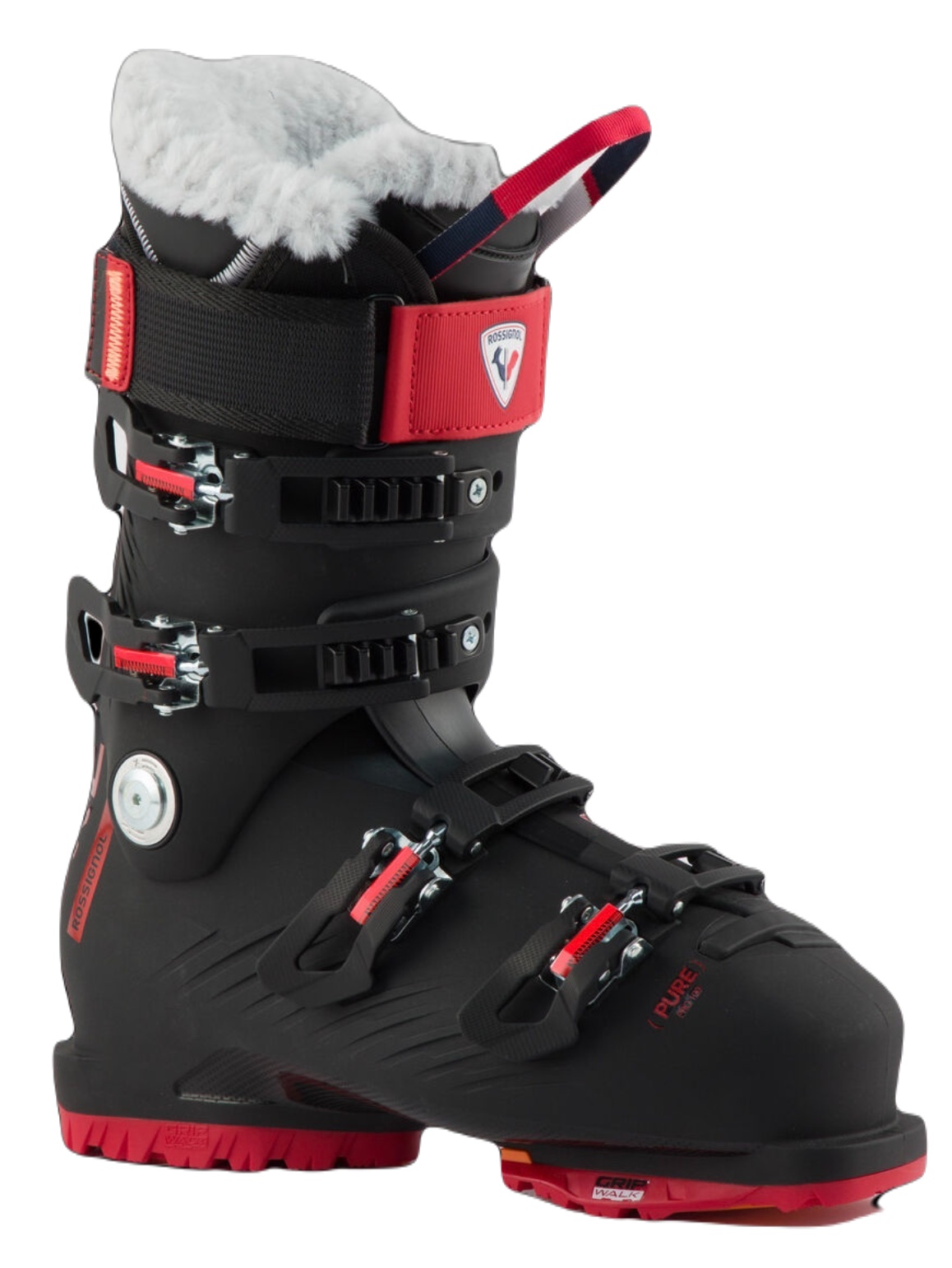
Type: Alpine (resort)
Last: 100mm
Flex: 100 (intermediate/advanced skiers)
Other flexes: 80, 90
Weight (per boot): 1670g
What we like: It’ll keep your feet warm from the first chair to the last.
What we don’t: Relatively pricey and overbuilt for mild conditions.
The Rossi Pure Pro is the perfect companion for an upscale ski vacation to Aspen's slopes: plush, fancily warm, and delivering all the goods. It’s rare that a boot actually outperforms its marketing copy, but that’s exactly what we found with the Pure Pro 100 GW. Not only is this boot ski stiffer than its 100 flex would suggest, but its “on piste” designation sells its capabilities short—we found off-trail performance to be competitive with most of the all-mountain competition. Part of this can be attributed to the boot’s unique adjustable flex, which allows you to soften or stiffen the feel to customize power and overall performance (you can adjust by a rating of 5). The rest of the design is equally well thought out, including a fully customizable liner and an asymmetric cuff made from a mix of soft and hard plastics to maximize support while keeping weight in check. For skiers who really like to geek out on their setup, this level of customization is a real boon.
In addition to its innovative adjustable flex, another feature unique to the Rossignol Pure Pro 100 is its thick merino wool insulation. Along with giving the boot a noticeably soft and plush feel, it also adds a sizable dose of warmth on frigid resort days. Rossignol also sells an upgraded Pure Pro Heat model (out of stock at the time of publishing) with a built-in heated liner for an additional cost, although both boots will likely be overkill for those who run warm, like to push their limits, or frequently venture into the sidecountry. Given the thick wool lining, the Pure Pro is also less year-round-friendly than many of its competitors, which is certainly worth considering if you like to get out into late spring. Finally, the Rossignol is fairly pricey given the lack of versatility, but there’s no denying the boots’ premium warmth and impressive customization.
See the Rossignol Pure Pro 100 GW
The ski boot market is ever-evolving, and to stay ahead of the latest technology, we dedicate our winters to testing new offerings. However, not every ski boot makes the cut. We have high standards for performance, durability, and price so that we can narrow down the best of the best options for our guides. However, we understand that you might be interested in the models we tested and decided to dismiss.
First, we decided to replace Dalbello's Veloce Max 65 W with the Tecnica Mach Sport HV 65 as our best beginner boot. Our primary reason was price: The Mach Sport is a bit cheaper than the Veloce without sacrificing any performance or build quality. For a beginner who will likely outgrow their boots in a season or two, price should be a priority.
We also decided to remove the K2 BFC 95 from the list because, while comfortable, we think it makes some serious sacrifices in performance for its wide 103 millimeter last. We understand that some women need a wider boot, but many of the other boots on this list come in high-volume options. We encourage you to check out the wide version of the Tecnica Mach1 or the K2 Anthem, which has a Boa closure along the front of the foot for a precise fit.
We replaced the Tecnica Zero G Tour Pro with the Scarpa Gea RS as our favorite backcountry boot because the Gea proved to be a better all-around boot. It features a slightly softer flex and a wider last, accommodating a broader range of foot types. The Zero G Tour Pro did impress us in testing, however, and we encourage those who are looking for a harder backcountry charger to check it out.
We removed many boots from this list, not because they performed poorly in testing, but because they didn't outperform or stand out from the other boots we tested. These include the Atomic Hawx Prime 115 S BOA, Dalbello Cabrio LV 95 3D Wrap, Salomon S/Pro Supra BOA, and Fischer Ranger 115 DYN.

| Boot | Price | Type | Last | Flex | Weight (per boot) |
|---|---|---|---|---|---|
| Tecnica Mach1 MV 105 W | $750 | Alpine | 100mm | 105 (intermediate/advanced) | 1660g |
| Tecnica Mach Sport HV 65 | $330 | Alpine | 103mm | 65 (beginner/intermediate) | Unavailable |
| Lange Shadow 115 LV | $800 | Alpine | 97mm | 115 (advanced/expert) | 1795g |
| Lange XT3 Free 115 LV | $800 | Hybrid | 97mm | 115 (advanced/expert) | 1614g |
| Scarpa 4-Quattro SL | $800 | Hybrid | 100mm | 100 (advanced) | 1290g |
| Scarpa Gea RS | $900 | Backcountry | 102mm | 120 (advanced/expert) | 1310g |
| Dynafit Radical Pro | $900 | Backcountry | 103.5mm | 110 (advanced/expert) | 1270g |
| K2 Anthem 105 BOA | $800 | Alpine | 100mm | 105 (intermediate/advanced) | 1534g |
| Tecnica Cochise 105 W | $750 | Hybrid | 99mm | 105 (intermediate/advanced) | 1670g |
| Rossignol Pure Pro 100 GW | $650 | Alpine | 100mm | 100 (intermediate/advanced) | 1670g |
Skiing is a favorite pastime among most of the editors at Switchback Travel. And while many have come a long way since our humble beginnings many decades ago, we pride ourselves on providing exceptional beginner and intermediate-specific feedback. Freelance writer and gear tester Alli Hartz kicked off this guide back in 2022 with a streamlined selection of options available specifically for women. Based in Bend, Oregon, Alli shares her love for skiing through teaching avalanche courses and ski guiding in the winter months. Editor Maddie Downie currently manages this guide. Based in Bellingham, Washington, Maddie divides her winter days between skiing on groomers at Mt. Baker Ski Resort and hunting for untouched snow in the North Cascades backcountry.
Our current lineup of fifteen women's-specific boots above is the result of ongoing testing, feedback from our contributors, and extensive research. Given the rapidly growing amount of offerings for women's boots, we’ve included a relatively wide variety of options, varying in last, flex, and use case. To make our list, each boot had to stand out in one or more areas, with many striking an effective balance between performance and price. If you're looking to complete your setup for the season, know that we took a similar approach with our lineup of women's all-mountain skis and ski bindings.

Most ski boots are technically unisex, but the majority of core manufacturers also make women’s-specific models. What makes a woman’s boot different? To start, they’re usually offered in smaller sizes compared to their unisex counterparts. For example, the women’s Nordica Promachine 105 TK is offered in Mondo sizes from 22.5 to 27.5, while the men’s/unisex Promachine 100 is available in 24 to 30.5. While this is great, a number of women's specific models are simply men's boots in a smaller size without many additional changes. Those that are designed in a more thoughtful manner are often shaped to better accommodate the female anatomy, including lower or adjustable cuffs to work with shorter and wider calves.
In addition, many women's-specific boots have lower flex ratings, generally making them slightly softer. This is rooted in the very early belief that women don't need stiffer boots due to ability, size, and aggressiveness of ski style—an argument that has been well disproven at this point. While the ski industry can acknowledge women need high-performance gear at the same level as men, the products are still catching up. There are many stiffer boots still only available in a unisex shape, though more and more stiff flex options are coming out in women-specific shapes. A good example is the new Tecnica Zero G Tour Pro, which took the long-time favorite aggressive men's boot and made a women's-specific version with a comparable flex of 125.
.jpg)
No two women are built the same, however, and a final decision should come down to what fits and feels best. If you identify as female but find that the men’s or unisex version of a boot fits you better than the women’s-specific model (or vice versa), it’s likely the better option for you. In the end, what’s most important is that your boots feel snug but comfortable and line up with your riding style and objectives. And while you're probably not reading this guide if you grew up racing, if you're skiing at that level on-piste, it'd be best to look into stiff race boots, not the recreational offerings here.
The women’s ski boot market is a big one, but starting your search by choosing the proper flex will quickly narrow it down. Most women’s downhill boots have a flex rating between 60 and 125. Lower numbers are generally softer, more forgiving, and more comfortable, which makes them ideal for beginners. We include a couple of our favorite beginner boots for women above—like the Tecnica Mach Sport HV 65—but for a more complete breakdown, we’ve compiled a dedicated round-up of the best ski boots for beginners. Beginners should understand that although a softer flex in a downhill boot generally means it is for newer skiers, softer flex touring boots are not aimed at the same market. The women's Scarpa 4-Quattro SL is a great example here. With a 100 flex rating coming from a lightweight design to save weight on far-reaching backcountry pursuits, the 4-Quattro SL is not going to be a good match for a beginner to intermediate skier, while the downhill-specific Rossignol Pure Pro 100 GW (same flex) would be perfect.
.jpg)
Moving up in stiffness to intermediate, advanced, and expert models gets you a boot that isn't as cushy but transfers your energy input more efficiently to your bindings and skis. As a result, you waste less energy flexing the boot forward and get a more instantaneous response. Additionally, a preferred stiffness also correlates with your body weight, with heavier and more powerful skiers needing to go with a higher number. Here are general recommendations for flex ratings based on skier level, but know that flexes are not standardized across brands, nor are all flexes created equal as we explained above:
.jpg)
Ski boot sizing is one of the most difficult things to understand when shopping online. It’s not as simple as taking your shoe size and matching it to a Mondo size (ski boot sizing nomenclature) on a chart. The length, width, volume, and underfoot profile need to be dialed in for a boot to truly fit. As a result, we recommend going to a local shop to get sized. If this is not an option, find a reputable online retailer that allows for returns and plan to order a couple of sizes with the expectation that they probably won’t fit exactly as you may expect. For a good baseline level of knowledge, we break down the most common boot sizing terminology and considerations below.
_0.jpg)
Mondo
Both men’s and women’s ski boots are listed in unisex Mondo (or Mondopoint) sizing: the length of your foot measured in centimeters. You can measure your foot by tracing its outline on a piece of paper or marking the bottom of the heel and top of the toes. If your foot measures 23 centimeters in length, your Mondo size is 23. Getting measured in a ski shop is preferred, but this is a rough way to do it at home.
Every manufacturer or retailer provides a sizing chart that matches shoe sizes to ski boot sizes, but your actual Mondo size may be a size or two smaller than what you see on the chart. This is because a tight fit is recommended with ski boots. Ski boot liners are made of foam and will mold to your feet over time, so it’s best to start with a snug fit and wear them in.

Last
Footbed width, referred to as last, is another important specification for ski boots. This measurement is based on the width of the forefoot and is listed in millimeters. Most manufacturers make ski boots with varying lasts to accommodate those with narrow, average, and wide feet. And some models, including the Lange Shadow 115, are made with multiple last options (in this case, 97mm “LV”, 100mm “MV”, and 102mm "HV" variations). It’s important to get this part of the fit right because side-to-side motion is a given when descending a hill, and a boot that’s too loose around the sides of your feet will negatively affect performance.
.jpg)
For those with narrow feet or looking for performance boots with a more precise fit, look in the 96- to 98-millimeter range. For reference, average lasts are around 99 to 100 millimeters for women. Those with particularly wide feet may have some challenges finding the right pair of boots, although there are a growing number of high-performance designs made in wider lasts, including the K2 BFC 95 at 103 millimeters.
Replaceable Footbeds/Insoles
No matter how well you do in selecting the proper fit, you still may experience discomfort during a full day of skiing. That’s where another piece of the fit puzzle comes in: replaceable insoles. Most downhill ski boot liners have a removable insole, much like a hiking boot. Swapping these out for a quality aftermarket insole that better matches your foot profile can make a big difference. New insoles can provide better arch support, more or less volume, and a heel cup that better locks your foot in place. Good aftermarket insoles can be found from brands like Superfeet and SOLE.
.jpg)
Another related alternative is getting a custom footbed from a boot fitter (which requires getting fit in person). This is an expensive process but can be worthwhile for those with hard-to-fit feet or who ski a lot each year. Most folks won't need to do this—it's often a last-ditch effort in finding a comfortable fit—but if you're low on options, it's worth checking with your local ski shop to see if they offer the service.
Most all-mountain ski boots consist of two independent pieces: A hard plastic outer shell that provides structure and strength, and a removable liner that delivers comfort, support, and insulation. Liners are made with varying amounts of foam depending on the type of skiing the boot is intended for. Downhill racing boots, for instance, will have far less foam than beginner-friendly designs due to the focus on performance over all-day comfort. However, it’s not always as simple as choosing the plushest boot liner (beginners and comfort-oriented skiers are an exception). Softer foam won’t hold your foot and shin as well while carving, and it may not mold as well to your feet over time.
.jpg)
Supportive but comfortable is the preferred place to be for most intermediate and advanced skiers. As we mentioned above, your liner will conform to your feet, so don’t be too concerned if it feels snug at first. That said, make sure it’s not overly restricting and that your toes aren't smashed against the hard-sided shell, as painful boots and cold toes can quickly ruin a good ski day.
While picking the right boot make and model is essential, many of us will find ourselves with "hot spots" or places of irritation on our feet after a day of skiing. Sometimes these are just from general anatomy, or if you're like this author, you may have some funny bumps on your feet from years of distance trail running. Luckily, there are two ways to further customize the fit of your boots: heat-molding your liners and punching your boots.
Most ski boot liners available today are heat-moldable. While you can attempt the process at home, more than one ski bum has a story about catching their liners on fire in their oven. By heat molding at a local ski shop with a professional boot fitter (who has the required equipment), liners can be custom-fitted to your feet. This is a nice way to ensure the liner fits your feet right out of the box, although it’s not necessary for many people. You can get much of the same fitting accomplished just by wearing the liners around the house or on a few early-season ski days. But for those who don’t want to deal with a break-in period, it's a useful tool that helps dial in comfort quickly and effectively.

Some will still have painful, identifiable hot spots they can point to after a day of skiing, even with heat-molded liners. For those with some irregular bumps, making a full-service appointment with a trusted local boot fitter for some punching may be the best solution. Boot fitters work with you to identify your hot spots and "punch" your boot shells to create more room for any irregularities. To punch a ski boot shell, fitters will use a heating device (typically a heat gun) to heat the plastic until it becomes malleable. They'll press out on the shell to create move volume just where you need it, have you try on the boot again, and continue this process until you no longer have any issues. If this sounds complex, it's because it is—be sure to go to a professional to avoid damaging your shells by trying this at home.
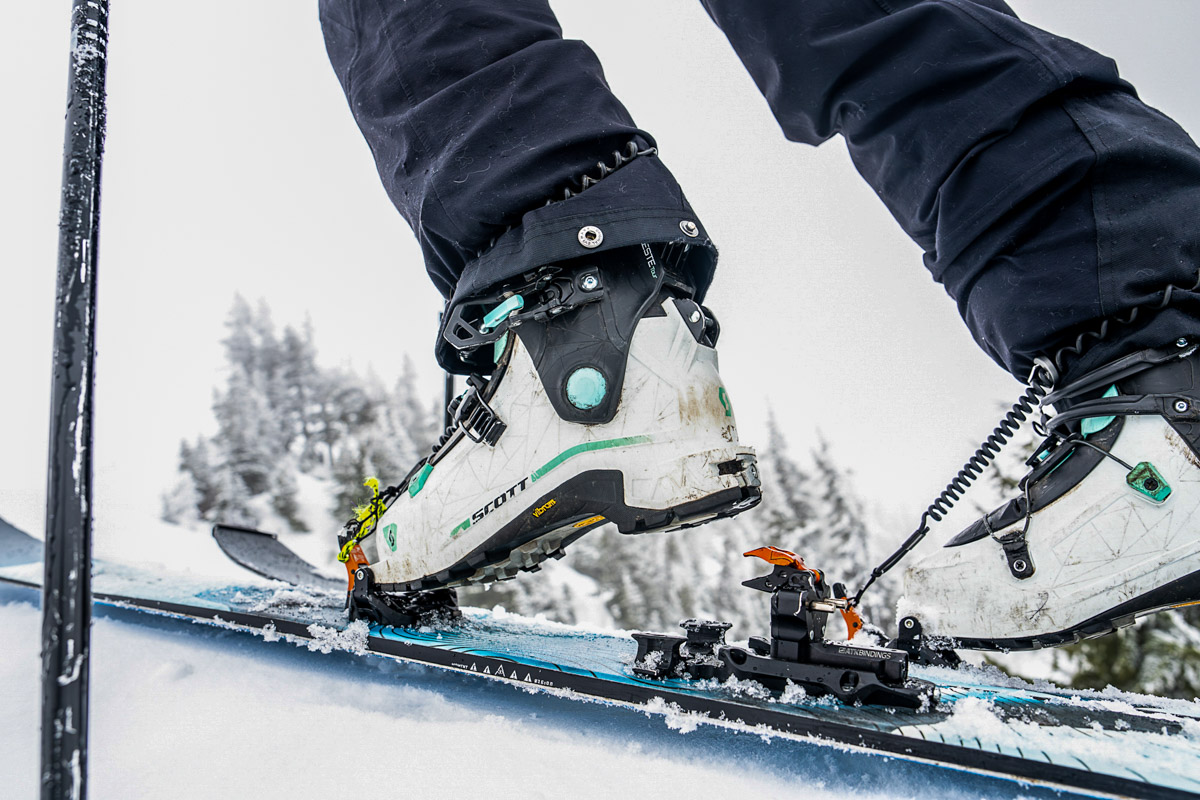
To start, it’s helpful to know that buckles and strap designs do not vary greatly between brands. The buckle systems on most downhill ski boots follow a similar methodology: two buckles across the foot, one just above the ankle, and another along the shin. Look for buckles made mostly with aluminum for greater durability (plastic is cheaper but a bit more prone to breaking, especially in very cold temperatures). Some boots try to cut some weight by removing the buckle at the ankle, but for downhill purposes, when total boot weight isn’t as important, we find it well worth having the more supportive four-aluminum-buckle design.
.jpg)
Another important piece of the design is the strap at the top of the boot near the cuff. Sometimes referred to as the "power strap," it keeps that top portion nicely locked into place to help bring out the full performance potential of your boots. Four buckles, as well as a quality power strap, help dial in your fit with macro and micro adjustments, making it easier to accommodate a variety of leg shapes and sizes.

Boa dials offer ultimate fit customization and are becoming common on outdoor footwear of all types. The concept is fairly simple: A thin cable is routed throughout the boot, and twisting the dial adjusts the tension of the cable in small increments to achieve a snug and even all-around fit (note that some designs boast two dials). When you're done, simply pull out the dial to release the tension. The Boa system’s primary advantage is that it allows you to achieve a noticeably more precise fit than traditional buckles. It’s also a clean design that keeps bulk to a minimum, which may or may not be a factor depending on your intended use(s). K2 and Vans were early adopters of the technology, but today, you’ll find Boa dials on footwear designed for cycling, golf, mountaineering, hiking, snowboarding, and, of course, skiing.

All that said, Boa dials are not without fault. First, Boa-equipped models generally cost more than comparable designs without the tech—K2’s Anthem 105 Boa, for example, costs $100 more than the standard, four-buckle Anthem 105, which is now discontinued. Second, the Boa system comprises more moving parts than standard laces or buckles, which translates to more potential failure points over time. Depending on the design, a broken cable or dial could render your shoe or boot temporarily useless. The good news is that Boa offers free repair kits, and you can purchase spare parts relatively cheaply if you’re concerned about issues in the field. In our experience, Boa dials are highly reliable and great for maximizing fit customization. However, whether the tech is worth the added cost—and potential time investment—is up to you.
Shifting to the bottom of the boots, downhill ski boot soles fall into two categories: traditional ISO 5355 models and newer, GripWalk-equipped designs. Starting with the former, ISO 5355-compatible boots are mostly flat underfoot and sized to fit and release from the toe piece on a traditional alpine binding. The main downside is that they’re uncomfortable and awkward when you’re walking around without skis on or hiking up a bootpack—their shape and simple outsoles lead to an awkward gait and can be quite slippery on anything from hardpack snow and ice to slick bathroom floors.
.jpg)
Enter the GripWalk sole, which has a rockered shape for a more natural stride and a softer plastic/rubber compound for improved traction. GripWalk soles are commonly found on higher-end boots that have an all-mountain focus (the extra grip is a big benefit on sidecountry hikes), although they’re becoming more common each year. If you go the GripWalk route, you’ll want to verify your bindings are compatible (be on the lookout for an ISO 23223 designation). The good news is that many alpine bindings are now multi-norm-ready (i.e., designed to be compatible with a variety of boots and sole types), including popular models like the Marker Griffon, Look Pivot, and versatile Salmon S/Lab Shift (which is also sold under the Atomic name). See our ski boot and binding compatibility guide for more detailed information on how to pair boots with bindings.
.jpg)
Until recently, the weight of a downhill ski boot was largely ignored (it’s still not listed as a spec on many retailer websites). But with the dramatic growth in backcountry and sidecountry skiing—and an increased spotlight on weight in general in the outdoor gear world—we’re starting to see the same lightweight focus in the downhill ski boot market. The benefits of lighter footwear for uphill travel and bootpacking are obvious: You have less weight to move with each step. With that in mind, it comes as little surprise that tech binding-compatible (read: backcountry-ready) models like the Scarpa 4-Quattro SL and Scarpa Gea RS are some of the lightest on our list. However, even for those riding the chairlift, lightweight boots can make it easier to control and maneuver your skis in tight spaces, such as bumps and trees, and reduce leg fatigue on long days.
That said, we don't expect to see ultralight boots take over the resort market anytime soon. Downhill boots are heavy for a reason: The substantial linings provide excellent insulation, the relatively thick shells are quite durable and transfer power well, and quality aluminum parts on the buckles inevitably add weight. Ultimately, unless you're a seasoned off-trail explorer, we don't recommend placing much importance on a trimmed-down design.

A growing number of downhill boots include a walk or hike lever (usually located roughly at your heel) for added flex and comfort, whether you’re trekking from the car to the resort or venturing into sidecountry terrain. In reality, these modes don’t have the necessary range of motion to be fully comfortable when walking long distances or uphill for extended stretches (select a true backcountry-ready design like the Tecnica Cochise 105 W or Dynafit Radical Pro if that's a priority). However, the walk feature will appeal to folks who primarily ski downhill but want the option to do some booting to access inbound or sidecountry terrain. Many skiers will also appreciate it when climbing the stairs to the lodge or walking across the parking lot after a long day on the hill.
.jpg)
For women who run cold or primarily ski in frigid areas like the upper Midwest of the U.S., it may be worth considering a boot with an integrated heated liner. Many reputable manufacturers offer designs that fit this bill, including K2, Rossignol, Nordica, and others. For example, Rossignol sells a heated version of their Pure Pro above called the Pure Pro Heat. The technology is fairly consistent across the industry: The boot is outfitted with the requisite heating elements and includes a control panel that allows you to adjust the temperature of the liner, which can then be recharged via USB.
In terms of downsides, keep in mind that you’ll pay for the added feature in cost, weight, and a bit of bulk, and built-in liners do add a little more complexity to the overall construction of your boot. But for those with chronically cold feet or who frequently ski in temperatures well below freezing, those drawbacks may be worth the boost in warmth and all-day comfort. As an alternative and one-time investment, it might be worthwhile to consider a pair of heated socks.
.jpg)
Backcountry skiing has exploded in popularity in recent years, and many downhillers are adding an alpine touring setup to their quiver. It's important to keep in mind that most backcountry boots won't be compatible with alpine bindings, like the Scarpa Gea RS, meaning you'll have to stick to pin bindings even if you take things in bounds. To help make things easier, there are a growing number of crossover boots that perform well on both resort days and while touring, including models like the Tecnica Cochise 105 W and Scarpa 4-Quattro SL. Both have sturdy flex ratings (up to 115 at the stiffest end) but are light enough and boast tech fittings and a walk mode with a decent range of motion for occasional uphill use.
.jpg)
That said, if you plan to use your boots primarily at the resort, there are some compromises to be aware of. The lightweight construction of a hybrid boot isn't as warm and sacrifices some precision when carving on hardpack, and they can feel harsh in choppy conditions compared to downhill-only models. Additionally, crossover boots are heavier than the vast majority of specialized backcountry designs—often by a pound or more for the pair. But if you don't like the idea of buying two sets of pricey boots or only plan on touring a few times a season, the hybrid downhill/touring concept can be a logical move.
Today's ski socks reflect the improvements made in boot liner technology. You no longer need a thick, heavy-duty sock, and the market is now full of thinner (light- to medium-weight) options. Modern boots are better insulators and far more comfortable than they were a decade or two ago, which places less importance on the thickness of your socks. The best options for skiing are either merino wool or synthetic, and if you can swing the added expense, wool is our preferred material for stink prevention and temperature regulation. For a full list of options, see our article on the best ski socks.

Boots are a great place to start in assembling your ski kit. For one, it hopefully means you get the pair that fits you best. It also should help guide the rest of your buying considerations. If you choose an advanced boot, you should pick out a correspondingly aggressive binding and ski that can help deliver the performance the boot is capable of. A stiff boot transfers power very efficiently as long as the binding and ski are capable of responding to those inputs. And as we mentioned above, don’t forget to ensure your boot’s sole (ISO 5355 or GripWalk) is compatible with your binding. To help get you properly outfitted, our picks for the best women's all-mountain skis and ski bindings are organized in a similar fashion as boots, broken down by ability level and terrain.
Back to Our Top Women's Ski Boot Picks Back to Our Women's Ski Boot Comparison Table


bcdc.jpg?h=fbc67360&itok=wmPMXiEZ)
0f2e.jpg?h=fbc67360&itok=s2_Z1uwG)
4348.jpg?h=fbc67360&itok=uD3bGueg)

4ed2.jpg?h=fbc67360&itok=SDjaYCfy)
91b6.jpg?h=fbc67360&itok=bkFxgr3u)

jpg209a.jpg?h=fbc67360&itok=rCRkeZ6s)
ca51.jpg?h=fbc67360&itok=X2rkJbjm)