

Photo Credit
It’s that time of year! Time to find the perfect present for our adventurous loved ones. For that person in your life who loves all things cold weather, check out our gift guide for skiers and snowboarders. For ideas tailored to other pursuits, we also have more editor-recommended gift guides to explore. Happy gift giving!
Ski jackets get all the glory, but a pair of quality pants is equally important for keeping you warm and dry on the slopes. Today’s designs range from waterproof and insulated resort options to full-coverage bibs and stretch-infused offerings built for the rigors of uphill travel. The Helly Hansen Sogn Shell grabs our top spot for the year, but most of the models here come fully dialed in with ski-specific features, including upper leg vents, an assortment of pockets, burly scuff guards, built-in gaiters, and more. Below is our list of the best women’s ski pants for the 2025/26 season, along with a comparison table and buying advice below the picks. For a wider look at the market, our unisex ski pants round-up covers both men's and women's styles. We also have a comprehensive review of the best ski bibs and best women's ski bibs, if you'd rather take that route.
Editor's note: We updated this guide on October 24, 2025, to refine our list of favorite ski pants down to a more carefully considered few. We took a critical look at our testing notes and the use cases of each pant, and added a few new contenders to the list, including Helly Hansen's Sogn Shell, Burton's Reserve 2L Pants, and 686's Outline Shell Pant. Lastly, we swept the guide to ensure all other information was up to date at the time of publishing.
 Best for: Resort/backcountry
Waterproofing: 3L Helly Tech Professional
Insulated: Yes (60g PrimaLoft Black)
What we like: A flattering, comfortable, and protective crossover ski pant at a relatively low price.
What we don’t: Master of none.
We have high standards when it comes to selecting our number one ski pant: We want a pant that’s comfortable and protective, yet also flattering and functional, one that can do a little bit of everything, and still comes in at a reasonable price. We know, that’s a lot to ask for, but in our testing, Helly Hansen’s Sogn Shell came pretty darn close to the bar. The Sogn immediately felt good on our bodies—not too loose, not too tight—and we’re big fans of the adjustable high waist. The 3-layer hardshell construction is backed by Helly Hansen’s proven waterproofing, as well as fully taped seams and watertight zippers, and we trusted it to tackle wet chairlift rides over a season of skiing in the Tahoe area. Gusseted thigh pockets, side vents, boot gaiters, and scuff guards round out the no-frills design, and the cherry on top? The Sogn’s price tag is far from other pants of this class.
As it goes, no ski pant is perfect. Many factors—including fit and styling—are subjective, though we think that the Sogn’s straight-leg cut looks good on most everyone. Our main concern with the Sogn is its crossover appeal: While it keeps up well on shorter day tours and sidecountry adventures, it’s not a dedicated backcountry pant—for that, we want something a bit stretchier and more breathable. But none of this is a dealbreaker for the Sogn, and those looking for a touring-specific pant can look to the Black Diamond Recon below. Overall, for a resort rider who likes to dabble in a bit of backcountry travel now and again, the Sogn is a great choice at a fair price.
See the Helly Hansen Sogn Shell

 Best for: Resort
Waterproof: 2L Peak
Insulated: Yes (40g polyester)
What we like: An insulated pant at a great price; a good choice for the casual resort rider.
What we don’t: Not the most waterproof; fits large.
REI’s Powderbound Insulated might be cheap, but it’s no slouch. Overall, we think the brand put together a solid product with this pant: The 2-layer construction and waterproof membrane hold up well to most winter weather (though, as you’ll read below, they aren’t a standout in super wet conditions), and a moderate level of synthetic insulation (40g) will keep you warm on the lift without appearing too bulky. Tack on a wide range of available sizes and all the requisite ski-specific features—inner thigh vents, boot gaiters and scuff guards, Velcro waist adjustments, and a nice assortment of fleece-lined pockets—and the Powderbound is primed for your next trip to the slopes.
As with most budget designs, it’s good to keep your expectations reasonable. For one, REI’s waterproofing simply can’t keep up with more premium designs, and the Powderbound is likely to wet out in super soggy weather. That said, our PNW-based tester remained dry and happy when testing these in spring skiing conditions at Mount Baker Resort. She did have some other gripes, though, including an awkward fit (it might be worth sizing down) and small pockets, which made it tough to store larger gear. If you want to boost performance without spending too much more, consider Helly Hansen’s Legendary Insulated, which offers slightly more insulation, a better fit, and more reliable waterproofing. Though, if it really comes down to price, the Powderbound is the clear winner.
See the REI Co-op Powderbound Insulated


Best for: Resort
Waterproofing: 2L DryRide
Insulated: No
What we like: A reliable shell pant at a good price; offers more versatility than the insulated budget pick above.
What we don’t: A few notable cost-cutting measures have been taken.
If you’re looking for a bit more control in your warmth, an uninsulated shell pant is the way to go—but you don’t have to spend up for a quality resort design. Burton’s Reserve 2L is among our favorite budget designs because, in our opinion, the pant doesn’t scream budget. To start, we really like the Reserve’s fit, which is trim enough to be flattering, but loose enough from the thighs down to accommodate a thicker baselayer without compromising mobility. Burton also included some nicer touch points, such as fully taped seams, hard-wearing YKK zippers, an interior Velcro waist adjustment, and mesh-lined inner thigh vents. What’s more, the pant is offered in a few classy colors, eight sizes (XXS-XXXL), and three inseam lengths. And if you’re looking to complete your kit, you can get the matching jacket, which connects to the pant for even more protection in deep snow.
To be sure, Burton keeps things cheap by opting for a 2-layer shell over a 3-layer. Due to the hanging liner, 2-layer pants are generally less breathable and heavier than 3-layer models, but this is only really an issue if you plan on working up a sweat out of bounds. Burton’s membrane also doesn’t have the stalwart feel of Gore-Tex, but it’ll be plenty for dry environments and bluebird days. Lastly, it’s worth noting that Burton opted for pocket flaps on the back pockets and leg pocket instead of waterproof zippers, which would have provided more protection from the wet. But for the price of these pants, we really can’t complain. If you're willing to spend up, you can get the Reserve with Gore-Tex waterproofing (and waterproof zippered pockets), but we think the regular version here is a perfectly good choice for weekend warriors or those just starting out.
See the Burton Reserve 2L Pants

Best for: Resort
Waterproofing: 2L H2No
Insulated: Yes (60g Thermogreen)
What we like: Attractive colorways, cozy warmth, and a great fit and finish.
What we don’t: Insulated pants lack versatility; fit is hard to dial in.
Not everyone will opt for insulated ski pants, but if you frequent the resort in particularly cold climates like the Northeast or the Mountain West, there’s a good chance you’ll want a pair. With a thin but warm dose of synthetic fill (unlike down, synthetic continues to keep you warm when wet), insulated pants are your ticket to staying cozy on the lift ride, no matter the conditions. Among the myriad options, Patagonia's Insulated Powder Town is a standout pick: You get 60-gram synthetic fill, sleek and clean styling that minimizes bulk, mesh-lined vents along the outer thighs, and a soft taffeta liner for great next-to-skin comfort (plus, all materials are 100% recycled). Tack on Patagonia’s waterproof membrane, a durable water repellent (DWR) finish, and a variety of fun colors, and the result is a pair of resort-specific ski pants that can handle brutal mountain weather season after season.
It’s worth considering the inherent downsides of insulated ski pants. As we touched on above, they’re a lot less versatile than a standard shell—you can add more warmth by selecting a thicker baselayer, but the built-in insulation means you can’t take warmth away. They also suffer in terms of breathability. As a result, an insulated pant is not our first choice for mild climates or those who tend to work up a sweat on the slopes. But for skiers who desire an extra dose of warmth, the Insulated Powder Town is a great combination of style, performance, and value. Keep in mind that the pants do run large—especially in the legs—and you’ll want to be mindful of the Velcro waist cinches, which can scratch against bare skin and form pressure points when wearing a backpack.
Read more: Patagonia Insulated Powder Town Review
See the Patagonia Insulated Powder Town

 Best for: Resort/backcountry
Waterproofing: 3L Gore-Tex ePE
Insulated: No
What we like: Top-notch build quality and fit.
What we don’t: Expensive.
Arc’teryx’s ski and outerwear consistently knocks it out of the park in terms of premium quality and performance, and the women’s Sentinel pants are no exception. The Sentinel checks all the boxes for both resort and backcountry skiing, no matter the weather. In wet and blustery conditions, the 3-layer Gore-Tex construction provides a reliable barrier from the elements, while smooth-operating side vents let you dump heat quickly on warm spring days. On top of that, you get a light backer (Gore's supple C-Knit design) for additional comfort, a solid feature set with plenty of storage, and Arc’teryx’s class-leading fit. Added up, it’s the full package for serious skiers who get out a lot.
The biggest and more obvious downside to the Sentinel is price. A quick glance at the comparison table reveals that the Sentinel is far and away the most expensive pant on this list. If you don’t stray from the resort, you can save big with a 2-layer design (the compromises in breathability and bulk aren’t a big deal for inbounds skiing), and many will prefer the added warmth of an insulated pant. On the other hand, dedicated backcountry skiers might want to opt for a stretchy hardshell design, like the Black Diamond Recon Stretch below. But for the best of both worlds alongside a truly exceptional fit and finish, the Sentinel is tough to beat.
Read more: Arc'teryx Sentinel review (bib version)
See the Arc'teryx Sentinel Pant


Best for: Backcountry
Waterproofing: 3L BD.dry
Insulated: No
What we like: Stretchy and breathable but still protective.
What we don’t: Not the most flattering fit; a standard hardshell offers a more bombproof barrier.
Most resort-goers prioritize waterproofing and warmth, but uphill-oriented skiers need a pant that’s both highly mobile and breathable. Black Diamond’s Recon Stretch deftly checks those boxes thanks to BD's stretch-infused, 3-layer BD.dry fabric, which protects nearly as well as a hardshell but moves and ventilates like a softshell. It all adds up to a pant that’s capable of resisting heavy wind or wet snow while offering the range of motion and breathability you need for the bootpack or skin track. Outer thigh vents, articulated knees, a removable waist belt, and a total of three pockets (one of which has a clip for securing an avalanche beacon) round out the build, which is about as good as it gets for most days in the backcountry.
In addition to its well-balanced construction, the Recon Stretch is lightweight at just 1 pound 4.4 ounces. It's also significantly cheaper than the premium Arc'teryx Sentinel above. Speaking of the Sentinel, that pant has a more tailored fit overall, while the Recon is slightly baggy and less flattering in our experience. And if you plan to venture out consistently in soggy conditions, a rigid hardshell pant like the Sentinel will provide a more stalwart defense, although the lack of stretch isn’t ideal for active backcountry pursuits. In the end, we think the Recon Stretch strikes the best balance of performance and value for backcountry skiers, earning it a respectable finish on our list this season.
See the Black Diamond Recon Stretch
 Best for: Resort/backcountry
Waterproofing: 3L PNW
Insulated: No
What we like: Fantastic quality, weather protection, and breathability.
What we don’t: Pricey for having an in-house membrane; runs warm in the torso.
There are several reasons you might opt for a bib, including additional protection, expanded coverage, and more storage options. Or maybe you just like the way they look, which is reason enough (look good, ski good—right?). Regardless of the why, bibs have gained serious popularity in recent years both at the resort and in the backcountry, and Trew Gear’s Chariot Bib Classic is a runaway favorite among female shredders. The waterproof 3-layer construction is reminiscent of premium Gore-Tex in both look and feel, and you get full seam taping with reinforcements, smooth-operating water-resistant zippers, and bomber coverage that keeps even the wettest of snow at bay. Tack on a high-quality fit and finish with stylish freeride vibes, and the Chariot Bib is the full package for skiers looking for a quiver-of-one bib. No surprise it takes top billing in our best women’s ski bibs round-up.
It’s not always easy to nail a good bib fit, and many women’s designs fall short when it comes to convenience for bathroom breaks. But Trew landed on a great solution with the Chariot: The wide drop seat is easy to use when nature calls, and you get your pick from six different sizes (XS to 2X) and three inseam lengths. We do wish Trew had used softshell fabric in the torso area—this feature helps keep the bib snug yet mobile and breathable—and we don’t love the Chariot’s chest pockets, which are less secure as they open vertically (items are more prone to falling out). Finally, for dedicated backcountry use, we find the bib to be too baggy and featured. But for resort skiing, sidecountry forays, and the odd day in the backcountry, the Chariot nails the trifecta of price, performance, and style. And if you're looking for a burlier version of the Chariot with better waterproofing (at the expense of weight and cost), check out the Primo version.
Read more: Trew Gear Chariot Bib Primo review
See the Trew Gear Chariot Bib Classic


Best for: Resort
Waterproofing: 3L Gore-Tex
Insulated: No (available)
What we like: Good looks, durable materials, and impressive sustainability measures.
What we don’t: Fit runs a little big; expensive for a 2-layer design.
The Storm Shift is Patagonia’s premium resort pant and a big step up from most of the 2-layer offerings here. First off, you get solid weatherproofing by way of a Gore-Tex membrane and a robust 150-denier shell fabric with a DWR finish. Vents on the outside of the thigh effectively dump heat (we’ve found outer-thigh vents to be better performing than those on the inner thigh), and a brushed tricot liner adds a high-end feel that slides on nicely over baselayer bottoms. To finish, you get high-quality stitching, zippers, and buttons throughout, along with an articulated fit that’s roomy without being overly baggy. For the best in resort-specific ski pants, look no further.
Like a lot of Patagonia gear, the Storm Shift is rather pricey. It’s also not a backcountry-ready piece with its heavy 2-layer build and hanging mesh/polyester lining, and it's decently heavy at over a pound and a half for the women’s pair. But it’s hard to beat the design’s sustainability chops: The Gore-Tex construction is completely PFAS-free (including the membrane, DWR finish, and fabric), recycled materials are used throughout, and it’s Fair Trade Certified. And serious resort skiers will love the added durability and protection—we especially recommend a Gore-Tex pant like this for wet areas like the PNW.
See the Patagonia Storm Shift Pants
 Best for: Backcountry
Waterproofing: 3L Ventia
Insulated: No
What we like: Hybrid hardshell and softshell construction is comfortable, easy to move in, and breathable.
What we don’t: Not a wet-weather pant and quite cold.
The Outdoor Research Trailbreaker Tour pant stands out from the other picks on this list for its hybrid softshell/hardshell construction. The idea is this: Softshell fabric around the waist and thighs offers great mobility and breathability, and 3-layer hardshell material protects everything below. While the Trailbreaker does sacrifice weatherproofness in this design, what you get is a backcountry pant that’s easy to move in and breathes right where you need it to. It also has a host of ski-specific features, including side vents, plenty of pockets (including a beacon-dedicated pocket), gaiters, and reinforced cuffs. What’s more, the Trailbreaker comes in at an extremely competitive price.
Use cases for the Trailbreaker are a bit niche: It excels on spring ski tours or skimo missions where weight, breathability, and mobility matter the most, and where lack of weatherproofness is not a concern. Simply put, we wouldn’t recommend this one for inbounds use: The softshell material will wet out faster than any 3-layer shell, and the trim fit doesn’t allow for layering thick baselayers. But if you’re looking for a pair of pants that can keep up on May volcano skiing in the PNW, the Trailbreaker should be on your radar.
See the Outdoor Research Trailbreaker Tour
 Best for: Resort
Waterproofing: Softshell (DryFlight)
Insulated: Yes (WarmFlight)
What we like: Stylish, generous coverage, and great stretch.
What we don’t: Not very weatherproof and no vents.
Throwing it back to the ‘80s, the Roxy Rising High is a resort pant built for women that puts a high value on style. Using a stretchy softshell fabric, it's form-fitting all the way from the high waist to the cuffs, where you can add a flare—or not—with the integrated zipper. On the inside, the Roxy's synthetic insulation and a brushed-back lining provide modest warmth, and a waterproof membrane does a decent job keeping moisture at bay. Paired with a classy ski jacket (like the Obermeyer Tuscany II), you’re sure to make a statement in the lift lines, cruising the corduroy, and even après.
Unfortunately, however, the Rising High is more style than substance. The plain-weave softshell fabric absorbs moisture far more readily than hardshell, and the waterproofing is no match for a proven Gore-Tex membrane. What’s more, the pants are only taped at critical seams, which means there are more areas for water to soak through (especially bad news on slushy chairlifts). And you’ll need to find the temperature sweet spot: The skinny fit doesn’t allow for much more than a thin baselayer underneath, and the lack of vents will have you overheating on warm spring days. But the Rising High is nevertheless a nice match for bluebird days in places like Colorado or Utah, and the sophisticated styling is hard to beat. For another slim-fitting softshell option, check out Helly Hansen’s Bellissimo 2 pant.
See the Roxy Rising High
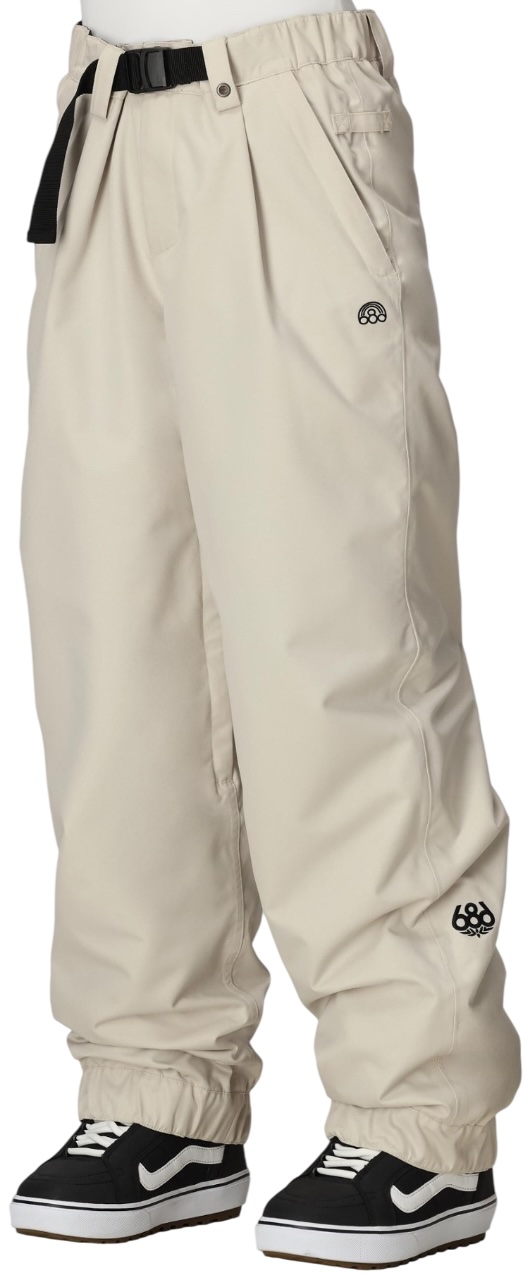 Best for: Resort
Waterproofing: 2L infiDry
Insulated: No
What we like: A baggy resort shell reminiscent of sweatpants.
What we don’t: Not much versatility.
It’s hard to know what style is “in” these days, but it seems like baggy pants are having a moment of late, specifically with the park crowd. 686’s Outline Shell pant is essentially a waterproof sweatpant, which could either scream “comfort” or “style” to you, or a little bit of both. This 2-layer shell is equipped with a waterproof membrane, fully taped seams, and all of the ski essentials, including gaiters, hem reinforcements, hand pockets, and 686’s pant/jacket connect system. And if you’re worried about these fitting too loose, know that 686 tacked on an integrated belt and elastic waistband, so you can dial in your fit. Put together, the Outline Shell is big on both style and performance points, easily earning it a place among our favorites.
That said, we do wish the Outline Shell was a bit more performance-oriented. In our research, we couldn’t find a women’s equivalent to 686’s Dojo Gore-Tex pant, which we really like for its more versatile, lightweight (the Outline weighs over 2 pounds), and breathable 3-layer construction and proven waterproofing, but no such pant exists in 686’s portfolio. To be fair, we think that the Dojo Gore-Tex pant can be worn by women (686 even has some photos of women doing exactly that), but the Dojo is still technically billed as a men’s pant. Gripes aside, the Outline is a great pick for resort riding—specifically in the park—and it comes at a reasonable price to boot.
See the 686 Outline Shell Pant
| Pant | Price | Best for | Waterproofing | Insulated | Weight |
|---|---|---|---|---|---|
| Helly Hansen Sogn Shell | $335 | Resort/backcountry | 3L Helly Tech Pro. | No | 1 lb. 6.9 oz. |
| REI Co-op Powderbound | $159 | Resort | 2L Peak | Yes | 1 lb. 6.6 oz. |
| Burton Reserve 2L Pants | $210 | Resort | 2L DryRide | No | 1 lb. 8.0 oz. |
| Patagonia Powder Town | $269 | Resort | 2L H2No | Yes | 1 lb. 8.0 oz. |
| Arc'teryx Sentinel | $600 | Resort/backcountry | 3L Gore-Tex ePE | No | 1 lb. 2.0 oz. |
| Black Diamond Recon | $449 | Backcountry | 3L BD.dry | No | 1 lb. 4.4 oz. |
| Trew Gear Chariot Bib Classic | $459 | Resort/backcountry | 3L PNW | No | 1 lb. 11.0 oz. |
| Patagonia Storm Shift | $399 | Resort | 3L Gore-Tex ePE | No | 1 lb. 8.3 oz. |
| OR Trailbreaker Tour | $249 | Backcountry | 3L Ventia | No | 1 lb. 6.4 oz. |
| Roxy Rising High | $210 | Resort | Softshell (DryFlight) | Yes | Unavailable |
| 686 Outline Shell Pant | $250 | Resort | 2L infiDry | No | 2 lb. 0.2 oz. |
The Switchback Travel team has tested countless ski pants over the years, putting them through the wringer on lift-assisted days at the resort, multi-day trips into the mountains, and everything in between. To supplement our unisex ski pants guide, former Switchback editors started this list in 2021 with 19 women's-specific designs, combining firsthand experience on the slopes with info from other trusted female testers. Editor Maddie Downie has managed this guide since early 2024 and is based in Washington, where the cold and wet are frequent companions while playing in the snow. Maddie has grown to appreciate "Cascade concrete" and spends her winters ski touring all around the North Cascades.
Our current lineup of 11 women's ski pants is an ongoing labor of love: Between our in-house editors, network of freelancers, and friends in the skiing community, we’ve put a lot of laps into these pants. When evaluating their overall performance, we place a high priority on comfort and protection, which often means getting out in unfavorable weather. We also make note of how well each pair of pants moves, breathes, and keeps us cozy in variable conditions, as well as how they hold up over time. And because looking good and feeling good go hand in hand, fit and styling are also part of our review process. As the ski pant market evolves, we'll continue updating the list above with our current favorites. And to complete your kit, we took a similar approach with our round-up of the best women's ski jackets.
.jpg)
Most ski pants are designed with a specific type of skiing in mind—either resort, backcountry, or both. To help guide your decision, we’ve included a “best for” specification in our product descriptions and table above. Starting with inbounds-focused models, these pants are built tough: You typically get strong face fabrics, waterproof and windproof constructions, and generous fits for layering. If you ski consistently in frigid temperatures, it may be worth considering an insulated design, although we sometimes prefer the versatility of a non-insulated shell for season-long use.
Those traveling uphill on the skin track or bootpack will have an entirely different set of needs. First off, freedom of movement is very important for backcountry use, so you’ll often find some form of built-in stretch and an athletic fit so you can high step without extra fabric getting in the way. Additionally, breathability is essential—the materials are thinner, and large zippered side vents (sometimes on both the inside and outside of the legs) are crucial for staying cool. Finally, all-out weather protection can sometimes be compromised in the quest to keep you from overheating, including panels of breathable softshell or thin and stretchy hardshell (whether or not this is a good idea for you will depend on your local weather and snow conditions).
As you’ll see above, many pants toe the line for both resort and backcountry use. Generally, these are premium, uninsulated models that use high-end technology like 3-layer Gore-Tex to strike a nice balance between protection and breathability. These pants aren’t cheap—the Arc'teryx Sentinel is a case in point—but for those who get out a lot both in and out of bounds, the versatility is well worth the investment.

In general, modern ski pants are built with one of three types of shell fabric: hardshell, hardshell with mechanical stretch, or softshell. The type of fabric you opt for will depend on where you're skiing (we favor hardshells for resort use) and how much mobility you need (stretchy designs are great for mogul skiers and uphill enthusiasts). Most skiers will opt for a pant that uses hardshell or hardshell with integrated stretch, but we've also included a few softshell models on our list above.
Hardshell
For most resort uses, we prefer the traditional hardshell. Hardshells provide a reliable barrier against wet snow and harsh winds (great for long chairlift rides), and pricier options can have impressively long lifespans. Due to their stalwart construction, hardshells aren't particularly breathable (although 3-layer designs usually beat out 2-layer), and you'll have to put up with their more rigid feel. But resort skiers generally don’t need a particularly breathable or supple pant, and the good news is that most hardshells here have side vents to dump heat on warmer days. Our top-rated Helly Hansen Sogn Shell is a standout example, with bombproof Helly Tech Professional 3-layer protection, a protective face fabric, and long side vents.

Hardshell with Stretch
Hard-charging resort skiers, sidecountry fanatics, and backcountry skiers will want a waterproof pant, but some amount of stretch is a nice touch. Designs like the Black Diamond Recon Stretch feature a hardshell construction with built-in stretch, which is a lot more supple than a standard hardshell—you don’t get that rigid and crinkly feel—and places a premium on freedom of movement and breathability. However, you do compromise a bit in the way of all-out protection: Stretchy fabrics allow more air to flow than a hardshell, so they feel less impervious in strong gusts. Additionally, they’re more prone to wetting out after extended exposure. But it doesn’t get much better for most backcountry skiers, and it’s for good reason that we see more stretch-infused hardshell pants on the shelves each year.
.jpg)
Softshell
On the far end of the spectrum are pants that feature full-on softshell constructions, such as the Roxy Rising High. Softshell fabrics are stretchy, air-permeable, and soft against the skin, which makes them great for high-output pursuits or (in the case of the Roxy) those who prize stylish, form-fitting designs. On the flipside, softshells absorb moisture much more readily than hardshells, which can cause them to grow heavy and less breathable (not to mention, some softshell designs do not come with a waterproof membrane). As a result, a softshell pant will fall short in wet weather, but they're still an intriguing choice for a lot of reasons. And hybrid designs, like Outdoor Research Trailbreaker Tour, offer a nice mix of hardshell and softshell fabrics for weather protection where its needed, but we still don't recommend them for particularly soggy days out or resort use.
In terms of warmth, ski pants can be categorized into two general types: uninsulated shells and models with built-in synthetic insulation. Resort skiers, and especially those who stick to groomed runs, will be best off with an insulated model. The boost in warmth is useful to fend off the chill, and the thicker construction provides an additional barrier between you and a frigid chairlift seat (or when sitting on snow). The vast majority of insulated ski pants use synthetic fill due to its affordability and because it continues to insulate even when wet (unlike goose or duck down). The amount of warmth offered doesn’t vary too widely, and most use somewhere between 40- and 80-gram fill. The ideal amount for you will depend on your local conditions, skiing style (aggressive or casual), and if you’re prone to running hot or cold. Opting for a pant with 60-gram synthetic is a safe bet, and a design like the Patagonia Powder Town is often the sweet spot for many skiers.

That being said, an uninsulated pant makes a lot of sense for hard chargers or those that plan to ski the side- and backcountry. A shell pant won’t be as prone to overheating if you’re a mogul rider, spend a lot of time off-trail in soft snow, or if you do any extended hiking. And if you’ll be ski touring, a shell pant is a must-have to stay as cool as possible. A final benefit of foregoing insulation is that you can tune your baselayer depending on conditions: For springtime or active use, you can opt for a lightweight model, and mid- or heavyweight baselayers are great in the cold. Again, those planning on lapping the resort will most likely prefer the extra isolation and comfort of an insulated design, but there are a number of situations where a shell is the preferred option.
Most premium ski pants have a 3-layer construction, which incorporates three separate pieces of fabric: an outer shell, the actual waterproof and breathable membrane, and an inner lining. This makes it less bulky compared to a 2-layer design (these require a separate, hanging liner along the interior) and also improves breathability and next-to-skin comfort. 3-layer pants are more expensive than 2-layer models and often involve big names like Gore-Tex. As a result of their strengths, 3-layer pants are popular among serious downhill and backcountry skiers.
.jpg)
Many mid-range and budget ski pants have a 2-layer construction, in addition to most of the insulated models above. These are less breathable than 3-layer designs, although they often use thick fabrics that are quite durable. We’ve found that 2-layer pants are perfectly suitable for resort use, where ventilation and mobility aren't as important, and they make a lot of sense for an insulated design (when an extra liner is required, regardless). Further, you can save by going this route: Some of our favorite 2-layer pants—like Burton's Reserve 2L Pants, 686's Outline Shell, and, of course, the REI Powderbound—undercut much of the 3-layer competition.

Quality water resistance in a ski pant is an absolute must. They come in contact with snow on nearly every run (not to mention each lift ride) and really put the membrane and outer fabric to the test. For ultimate waterproof protection, look for a burly hardshell pant made with Gore-Tex. Mid-range and entry-level options often utilize manufacturers' in-house laminates (Patagonia’s H2No and OR’s AscentShell, for example) that are still fully waterproof but most likely won’t have as long of a lifespan. Seam taping and a durable water repellent (DWR) coating are also important for hard chargers to keep moisture from sneaking through. And keep in mind that some budget offerings only feature seam taping in critical areas, which can result in compromised waterproofing. Like most things, spending a little more does get you a nice upgrade in quality and longevity.

Backcountry skiers have a different set of priorities, so they do not always require full waterproofing. Less time sitting on a chair and more time on the skin track means that some backcountry skiers only need waterproofing in specific areas or a very water-resistant construction (especially in regions known for dry snow, like the Rocky Mountains). Your needs will vary, but don't automatically discount a partially waterproof or non-waterproof pant for backcountry use, especially in warmer spring conditions when you need the added breathability.
.jpg)
As we touched on above, breathability needs are closely aligned with your intended use(s). Resort riders—especially those that plan to stay on groomed runs—usually don’t require a light and airy design. Most standard 2-layer constructions will offer sufficient breathability, and you can always select one with zippered vents to dump a little excess heat as needed. However, if you venture into the sidecountry, plan to mix in some touring, or are a backcountry enthusiast, breathability becomes an important consideration. Among hardshell designs, lightweight 3-layer constructions are the best ventilators, and many stretchy hardshells or designs with panels of softshell fabric are even more impressive. You make compromises in all-out protection in harsh winds and wet snow, but air-permeable options like the Black Diamond Recon Stretch are great performers when working hard.

Ski pants see a lot of rough use—everything from ski boot buckles, metal edges, and chairlifts can wreak havoc on the materials. As a result, they’re a tough bunch overall. The most common way of determining ski pant durability is the fabric denier (D), which measures the thickness of the threads used for the shell material. Most resort-oriented designs are pretty substantial, including the Patagonia Storm Shift (150D). On the other end of the spectrum, touring-focused pants make the most compromises in durability to maximize comfort, mobility, and performance on the go. Our top-rated pant, the Arc’teryx Sentinel, does an excellent job of balancing needs for both activities with its high-quality 70D shell. Finally, it’s worth noting that many pants include a reinforced patch along the inside of the cuff (sometimes referred to as a scuff guard) for additional protection from ski edges.
.jpg)
Pockets
Typically, your jacket or ski backpack will be your primary place to store personal items, but it’s still worth checking the pocket situation on a pair of ski pants you’re eyeing. We recommend keeping it simple and looking for a couple of zippered pockets that can fit snacks or personal effects. Unless you really need the extra capacity, we’re not huge fans of cargo pockets for resort skiing—filling them with larger items feels ungainly on the mountain. Backcountry-specific pants like the Black Diamond Recon Stretch put a greater emphasis on storage with dedicated pockets for items like an avalanche beacon and extras like a map or GPS device.
.jpg)
Ventilation
To aid in breathability, most ski pants boast a zippered ventilation system (essentially pit zips for your legs). The most common locations for the zippered panels are along the inside or outside of your thighs. We’ve found that outer-thigh vents do a better job dumping heat, while those on the inner thigh add unwanted bulk and can occasionally impact comfort (on the bright side, they are less conspicuous). Backcountry-specific pants often have the zippers on the outside of the legs in part for this reason, and some even place them on the back of the hamstrings to keep fabric from puffing out at the sides.

Jacket-to-Pant Attachment Systems
Let’s face it: Wipeouts happen, regardless of your skill level. And if you’ve had the pleasure of experiencing a tumble on the slopes, you know that snow is adept at finding its way into the crevices of your ski jacket or pants. To help prevent this, some manufacturers place a button or loop on the jacket’s powder skirt to connect it to a corresponding attachment on the pants, forming a solid seal from the wet and cold. It’s certainly not a required feature for either resort or backcountry use, but it's a nice addition for many. It’s worth noting that in nearly all cases, you’ll need to purchase a ski pant from the same brand for the system to work and integrate properly.
Recco
You may run into Recco listed as a feature on some mid-range and high-end ski pants. These are for skiers who make their way out of bounds or into areas where they may experience avalanche dangers. The Recco reflector is a passive unit that doesn’t require batteries and can be picked up by detectors often carried by resort search and rescue personnel. They lack the technology and strong signal of a dedicated avalanche beacon and should not be considered a substitute, but they do provide an additional safety measure for resort skiers who venture off-trail. For more information, Recco's website provides a good breakdown of the tech.

Ski pant fit largely comes down to a matter of style and personal preference, but we can offer a few pointers for the uninitiated. Generally, most beginner and intermediate downhill skiers will opt for a comfortable fit that is neither too tight nor too baggy. Backcountry touring types lean towards a slimmer cut for less bulk (usually with built-in stretch to help with mobility). And then there’s the style component, which runs the gamut from classy, snug-fitting numbers like the Roxy Rising High to baggier designs inspired by street style. In the end, the most important thing is to find a pant that’s comfortable for you, and be sure to leave enough room for a light or midweight baselayer underneath (you’ll want this option even with the insulated styles).
To help you get a good fit, many women’s pants come in a range of sizes, including regular, short, and tall lengths. Designs like the Trew Gear Chariot and REI Co-op Powderbound lead the charge here and are great picks for women who are particular about fit or have body shapes that fall outside the industry norm (the Powderbound notably comes in petite and plus-size versions). Also look for Velcro waist adjustments and stretchy panels on bibs, which can help dial in a slightly loose pant and accommodate for varying layers as the season progresses.

Another “either or” decision when choosing ski pants is whether you should opt for regular ski pants or a bib. Ski pants are the traditional choice and what most folks are familiar with and comfortable in. They’re completely capable for resort or backcountry skiing and are much easier to slip on and off. The primary downside is felt when cold air or moisture finds its way up your back on the chairlift or after taking a fall. Bibs are the remedy for these maladies as they offer better protection from the snow, wind, and wet. They also run a little warmer thanks to the extra layering that covers part of your upper body. While you don’t have to worry about any discomfort from a waistband, the straps that run over your shoulders can take some getting used to, and you’ll need to dial in the fit to keep them from moving around excessively or pulling the pant legs up too high.
On a related note, fit can be a challenge when it comes to women’s ski bibs. For this reason, we especially love the Trew Gear Chariot, which comes in a range of sizes, including short, regular, and tall lengths. A bib with a shorter bib upper like that of the Patagonia Untracked (not listed here) is another great option—you get above-the-waist protection without too much extra bulk. For more of our top picks, see our article on the best women's ski bibs.
%20.jpg)
In recent years, there’s been an important shift in sustainable practices throughout the outdoor gear industry, and ski pants are no exception. With brands like Patagonia at the helm, we’ve begun to see a greater use of recycled materials, more responsible production practices (including the use of perfluorocarbon-free water repellent finishes—aka PFC-free DWR), and an emphasis on the ethical treatment of workers. What’s more, many companies are now recognized as certified B Corps and/or utilize the Bluesign system for sourcing materials responsibly. If you want to shop sustainably and support a healthy planet, the buzzwords above are a great place to start. On the other hand, we’re big advocates of reducing consumption and reusing old gear: The good news is that many brands now offer repair programs and used marketplaces for their offerings, including Patagonia, Arc’teryx, REI Co-op, and more.
.jpg)
The layers you wear under your ski pants don’t get as much attention as those warming your core, but they nevertheless remain an important consideration. To start, it’s almost always a good idea to throw on at least a thin pair of long underwear, both for resort and backcountry skiing. The extra layer not only provides insulation and protection from cold snow and freezing chairlift seats, but it also wicks moisture away from your skin. Further, the interiors of ski pants (especially uninsulated designs) are often not very plush, with exposed mesh, zippers, and minimalist liners that become less comfortable as the day wears on.

In choosing a baselayer, it’s worth getting a soft and close-fitting design to maximize warmth. The best models are made with either synthetic or merino wool—cotton doesn’t insulate when wet, so it’s a bad idea even on a resort day. Synthetics are the cheaper option and efficiently wick moisture, but merino wool is our favorite. It’s very warm for its weight, cozy and soft, and naturally resists odor better than a polyester alternative. Baselayers are offered in a range of thicknesses, including lightweight designs for warm days or backcountry use, as well as mid- and heavyweight options for cold days at the resort. And in particularly frigid conditions, you can always double up your baselayers to increase warmth.
Matching your ski jacket and pants is by no means a requirement to looking good on the slopes, but manufacturers make it easy to do. The vast majority of the pants above have a jacket counterpart, and often under the same name. For example, the Arc'teryx Sentinel is available both as a jacket and a pant, as is the Patagonia Powder Town. In almost every case, the jacket features similar fabric and construction as the pant (for example, both the Sentinel jacket and pant are made with 3L Gore-Tex) and comes in a matching color.

Purchasing the complete set is fine, but penny pinchers in particular will find that they can save a lot by opting for a premium jacket and more budget-oriented pants. The reasoning is this: Mid-range pants lag behind premium models in two key ways—breathability and added bulk. And while we don't like to make compromises when it comes to the look and feel of our top layers, in most cases (particularly at the resort), the trade-offs are less obvious in a pant. Plus, switching it up allows you to put together a fun, complementary ski set, whereas most matching designs feature the same color for both the pants and the jacket. For a look at the best options of the season, check out our article on the best women's ski jackets.
Back to Our Top Women's Ski Pant Picks Back to Our Women's Ski Pant Comparison Table



%20(s)0852.jpg?h=fbc67360&itok=5TSJ7abA)
fa23.jpg?h=fbc67360&itok=ucp5dn7n)
jpg209a.jpg?h=fbc67360&itok=rCRkeZ6s)
aebf.jpg?h=fbc67360&itok=Dx4xzQIu)
c8ee.jpg?h=fbc67360&itok=qF2arFUM)
0f2e.jpg?h=fbc67360&itok=s2_Z1uwG)
569f.jpg?h=fbc67360&itok=-to2I6ZO)