Photo Credit
Switchback Travel (Jason Hummel)
It’s that time of year! Time to find the perfect present for our adventurous loved ones. For that person in your life who loves all things cold weather, check out our gift guide for skiers and snowboarders. For ideas tailored to other pursuits, we also have more editor-recommended gift guides to explore. Happy gift giving!
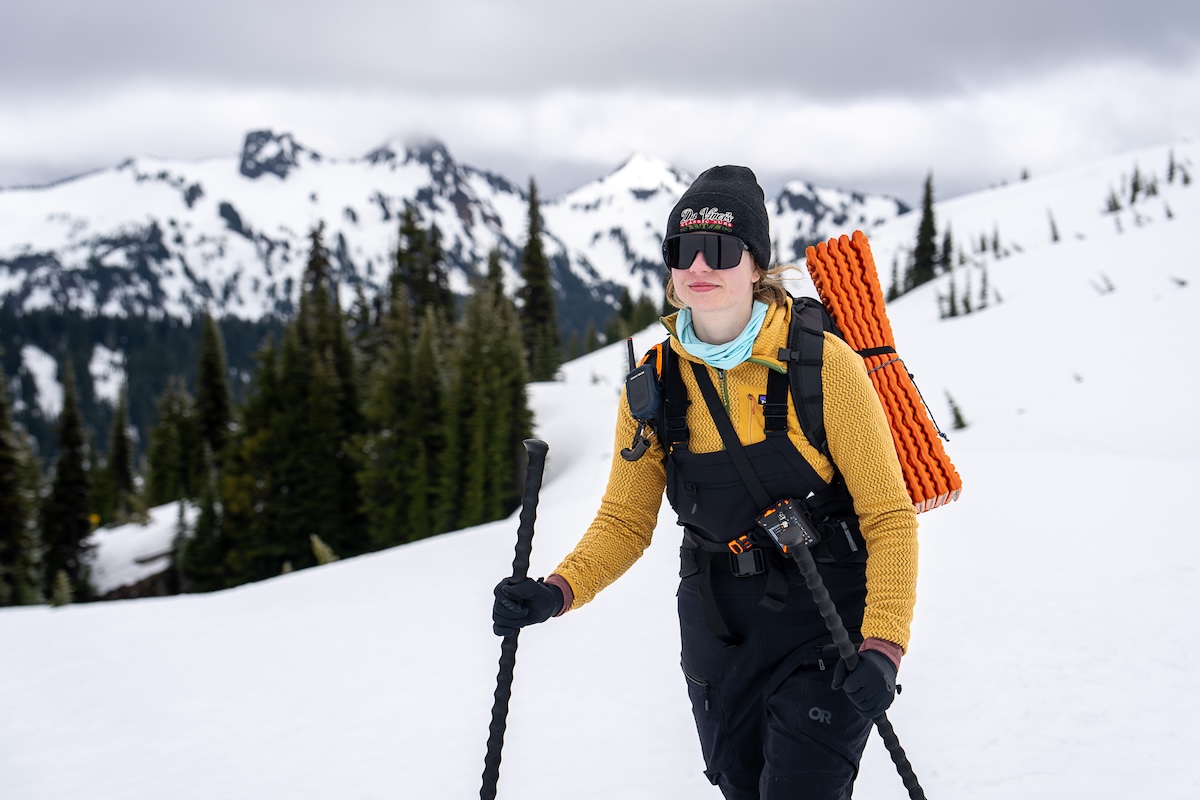
Whether you’re a resort ripper or earn your turns in the backcountry, ski bibs are a nice alternative to pants, offering unmatched protection alongside a healthy dose of style. And there are more women's-specific options now than ever: Brands like Flylow and Trew Gear have made a name for themselves with their cult-classic designs, and all the traditional players—including Patagonia, Arc’teryx, and Helly Hansen—have their hat in the ring, too. The bibs featured here range from entry-level models to burly hardshells and stretch-infused designs that maximize mobility and breathability, with the Trew Gear Chariot Bib Primo landing at the top for us. Below we break down the best women’s ski bibs of the 2025/26 season. For more information, see our buying advice and comparison table below the picks, as well as a rundown on how we test women's ski bibs. And for a wider look at the market, our unisex ski bibs round-up includes both men's and women's designs.
Editor's note: We updated this guide on November 15, 2025, to replace the Trew Gear Chariot Bib Classic with the more premium Chariot Bib Primo as our best overall pick. Going forward, the brand won't be offering the Classic, but we had great experiences testing the Primo and believe it's a suitable replacement.
Best for: Resort/backcountry
Waterproofing: 3L PNW Primo
Insulated: No
What we like: A stylish yet high-performance bib with a women’s-specific fit and feature set.
What we don’t: A bit heavy and bulky for backcountry use; expensive.
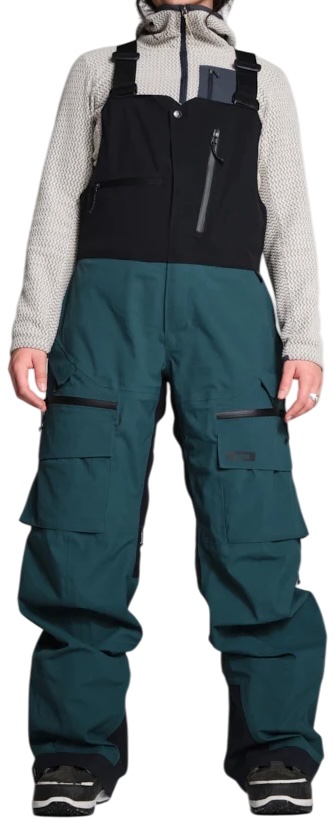
Trew Gear has gained a lot of traction in the ski market of late thanks to their clean styling and high-performing gear. The Chariot Bib Primo earns our top pick of the year for these exact reasons. To start, the durable 3-layer construction is reminiscent of more premium (and expensive) Gore-Tex designs in both look and feel. Plus, you get full seam taping with reinforcements, smooth-operating water-resistant zippers, and great coverage. We’re also big fans of the Chariot’s wide drop seat, which is easy to use when nature calls. Tack on a high-quality fit and finish, including a plethora of pockets, your pick of six sizes and three inseam lengths, and stylish freeride vibes, and the Chariot Bib is the full package for skiers looking for a quiver-of-one bib.
The Chariot Bib can hold its own for backcountry excursions, too. The fabric is breathable, and a front zipper makes it possible to dump heat on the skin track. That said, it's a bit overbuilt for dedicated backcountry use. The freeride cut isn’t the easiest to skin in, and the number of pockets adds unnecessary weight. Our other gripe is the price. Trew Gear used to offer a cheaper version of the Chariot called the Chariot Classic, which is a bit less breathable and waterproof, but plenty reliable for most resort skiers and backcountry dabblers. You can still find the Classic online while supplies last, but going forward, the brand will be sticking with the Primo line. The other cheaper alternative is the Flylow Gear Foxy below, which is a better crossover design thanks to its thinner and stretchier fabric. We hesitate to recommend it as our top bib because we've had fit issues in the past (it leans trim), but it's worth considering if your budget is tighter. If the price isn't a concern, however, it really doesn't get much better than the Chariot Primo, especially if you care about styling as much as performance.
Read more: Trew Gear Chariot Bib Primo review
See the Trew Gear Chariot Bib Primo
.jpg)
 Best for: Resort
Waterproofing: 2L Peak
Insulated: Yes (40g polyester)
What we like: A waterproof and insulated bib at a low price.
What we don’t: Only critically seam-sealed and doesn't have the most flattering fit.
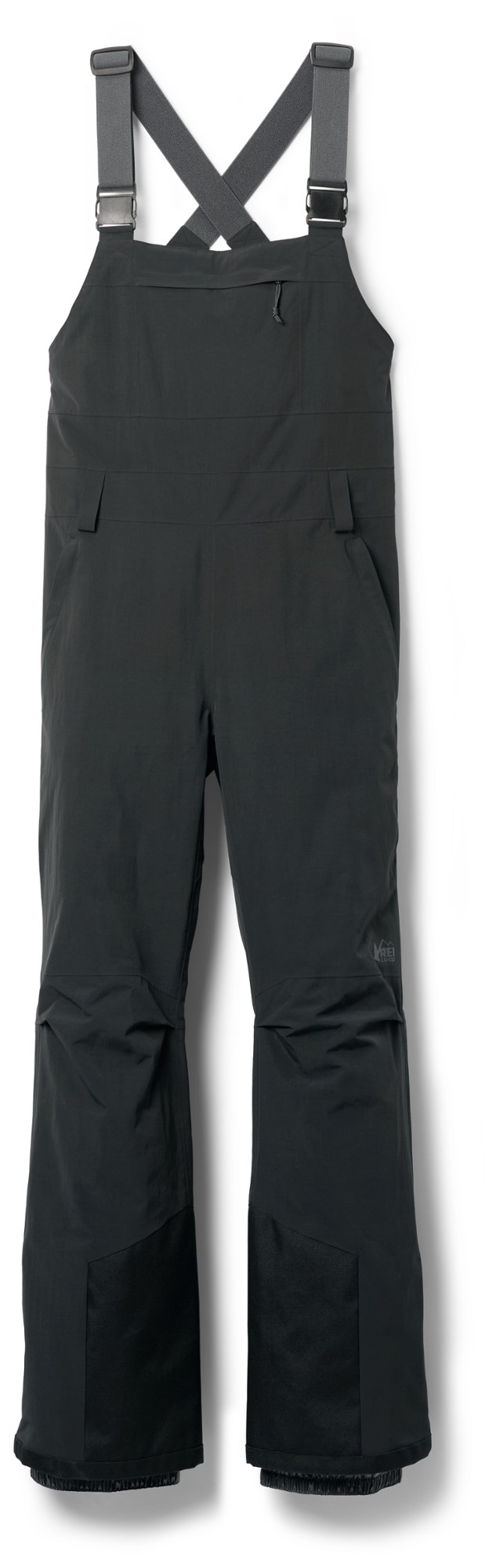
When the wind’s whipping and the snow’s flying, a ski bib provides a really nice dose of protection against cold drafts and moisture. Most offerings here feature a simple shell construction, but a few designs incorporate a thin layer of synthetic insulation for added warmth, as well as wind- and waterproofing. The first of these is REI's Powderbound, which checks all the boxes for casual resort-goers and first-time skiers. For a competitively low price, the Powderbound has everything you need for a day on the slopes, including long side zips for easy entry (which double as a hatch for bathroom breaks), inner thigh vents, a stretch-knit backpanel to boost breathability and freedom of movement, and a variety of pockets. REI’s Peak membrane guards against snow and short bouts of wet weather, and several features help dial in a good fit, including adjustable suspenders, belt loops, and availability in a range of sizes and inseam lengths.
But while we like REI’s entry-level design for recreational resort skiers (especially in dry climates like Colorado), many will find that it’s worth spending up for a higher-quality option. We don't recommend pushing the Powderbound's limits: The Peak membrane doesn’t offer the same stalwart protection as Gore-Tex, and only the critical seams are taped, which keeps costs low but isn’t ideal for keeping you dry in sustained and wet snowfall (or even worse, rain). Furthermore, the bib’s 2-layer construction is bulky due to the hanging liner and lacks breathability compared to 3-layer competitors. Finally, we're not huge fans of the generic styling and cheap-feeling fabric flaps covering the pockets (we prefer sleeker watertight zippers). Even so, as a low-cost option for those who only get out a few times a year, the Powderbound is hard to beat.
See the REI Co-op Powderbound Insulated Bib
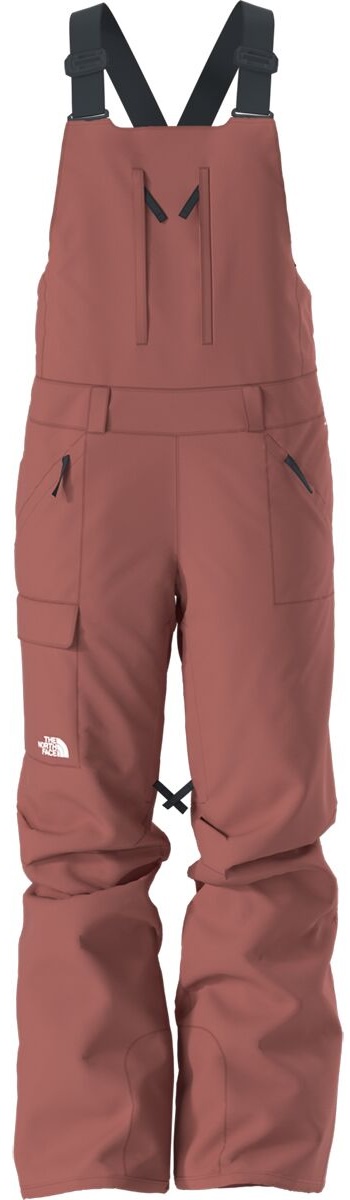
Best for: Resort
Waterproofing: 2L DryVent
Insulated: No (available)
What we like: A step up in most ways from the REI Powderbound above.
What we don’t: Cheap-feeling fit and finishes; will wet out in sustained moisture.
The North Face’s Freedom collection is another budget favorite: The shell version of the Freedom Bibs (which also come in an insulated model) features a waterproof membrane, fully taped seams, and a hardy 160-by-140-denier (D) recycled nylon face fabric that holds up well to repeated chairlift use and being tossed haphazardly in the back of a vehicle. Tack on a thoughtful set of ski-specific features—inner thigh vents, boot gaiters and scuff guards, and an assortment of functional pockets—and it’s a high-value option for resort skiers. Not to mention, the design is available in a nice assortment of eye-catching colorways and seven sizes for women (XS to 3XL).
If you’re deciding between the insulated REI Powderbound above and the uninsulated Freedom Bibs here, know that uninsulated designs offer a good deal more versatility and are our strong preference for most days on the slopes— you can always add warmth with thicker baselayers. Additionally, the TNF is fully seam-taped (the REI is only taped at critical seams), which makes a significant difference in wet weather. On the flip side, the Powderbound gets you a waterproof shell and insulation for the same price as the uninsulated Freedom, although we consider overall value to be about the same. Neither design is ideal for very wet conditions or high-output use, but we think the Freedom is an excellent alternative to the Powderbound for those who don't need or want the added warmth.
See The North Face Freedom Bibs
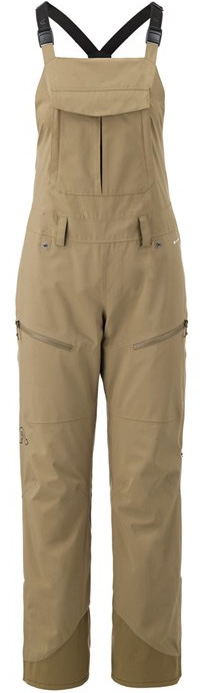 Best for: Resort
Waterproofing: 2L Finish
Insulated: Yes (40g Greenloft)
What we like: Built-in warmth for those who tend to run cold.
What we don’t: Lacks the versatility of an uninsulated bib; tricky fit.
Flylow Gear's Sphynx Bib is a staff favorite for those willing to spend up for a high-quality and toasty warm resort bib. In sum, the Sphynx puts it together better than most: The 40-gram (g) synthetic insulation adds warmth without too much bulk, and you get a low-profile back and vents along the outer thighs to help guard against overheating. Among ski bibs, Flylow's styling is hard to beat, and we really love the stretchy fabric, which is comfortable and doesn’t restrict movement like a rigid hardshell. Plus, it offers a more flattering fit than the REI Powderbound above. For frigid winter climates or women who tend to run cold, the Sphynx is well worth a closer look.
But before you spring for an insulated bib, it’s worth considering the trade-offs. As we touched on above, our primary gripe is the lack of versatility: The built-in warmth is a great companion on particularly cold days, but quickly becomes overkill when the mercury rises. Further, we never recommend an insulated bib for backcountry use—even on the coldest of days, the insulation still adds too much bulk and detracts from breathability. We also have some specific concerns with the Sphynx: The bib only comes in one inseam length, and some users report issues with fit (Flylow tends to run small, so you may want to size up). In the end, we think most skiers are better off opting for a non-insulated bib and building a quiver of different baselayer options.
See the Flylow Gear Sphynx Bib
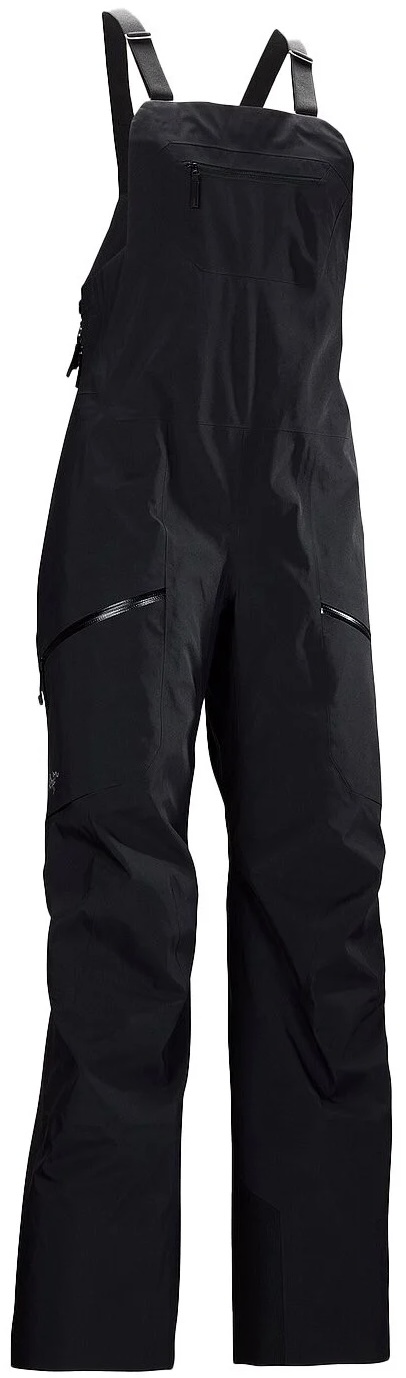 Best for: Backcountry/resort
Waterproofing: 3L Gore-Tex ePE
Insulated: No (flannel backer)
What we like: Premium Gore-Tex protection and soft backer.
What we don’t: Expensive and not a standout breather.
Arc’teryx is generally a cut above the rest when it comes to premium construction and build quality, and the Sentinel Bib is no exception. The Sentinel nails all of the components of a capable ski bib, with a robust 80D nylon shell, a 3-layer Gore-Tex ePE construction with a soft C-Knit liner, and outer thigh vents. We've found the Sentinel perfectly capable of weathering the wet and rowdy conditions in the Pacific Northwest. Arc’teryx also paid close attention to the bottom of the legs, which feature their stretchy cuffs and burly, seamless insteps to guard against wear and tear. It all adds up to a fantastically well-built ski bib that offers impressive weather protection and durability in a lightweight and streamlined package.
That said, the price is simply hard to justify when there’s a lineup of good to great competitors for hundreds of dollars less. What’s more, the Sentinel lacks built-in stretch, which many backcountry skiers appreciate on the skin track, and it's not as breathable as unlined competitors like the SnowDrifter below. And in our experience, women have struggled with the Sentinel’s sizing, although we appreciate that Arc'teryx opted for a more accommodating "regular" cut with more recent updates (past versions were labeled as "trim" and fit as such). If you're looking for similar performance but a different style, check out the Norrøna Tamok GTX Performance Bib. But in the end, it’s hard to beat the protection of Gore-Tex for rough winter weather or wet spring conditions, making the Sentinel a great choice for serious skiers who spend a lot of time on the slopes.
Read more: Arc'teryx Sentinel Bib review (prior version)
See the Arc'teryx Sentinel Bib
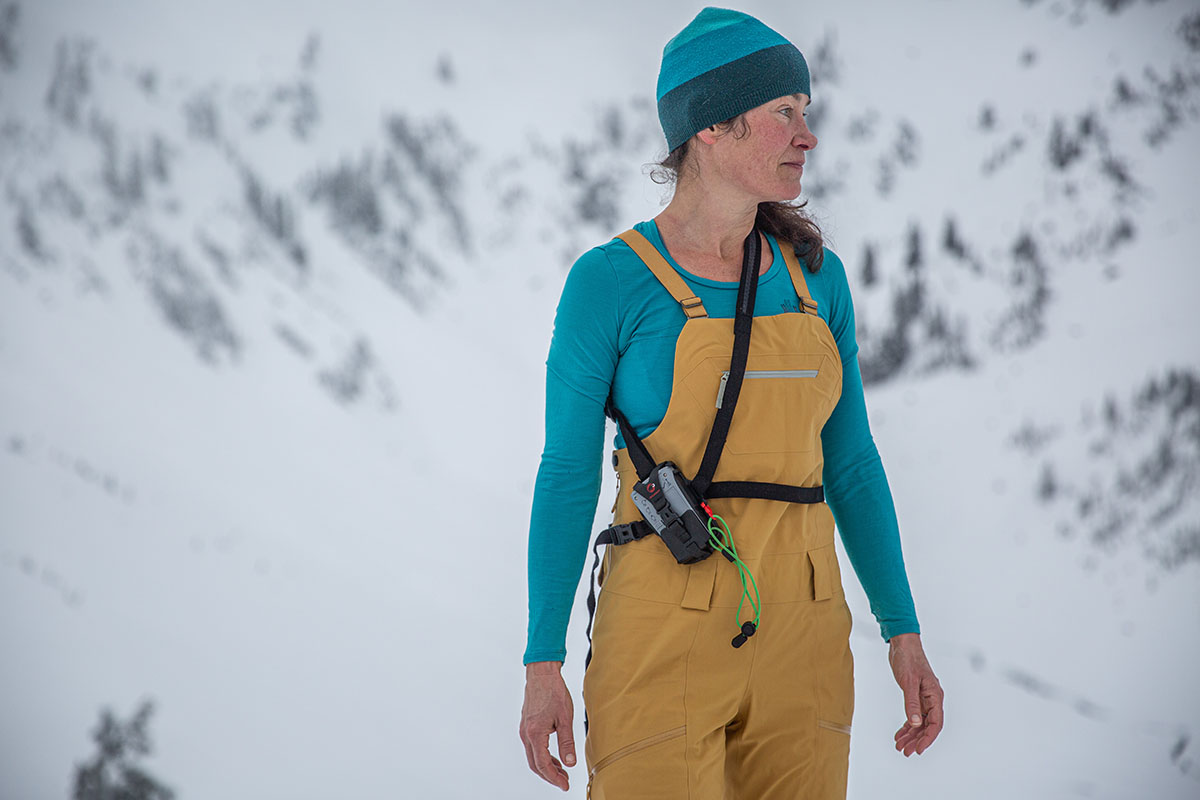
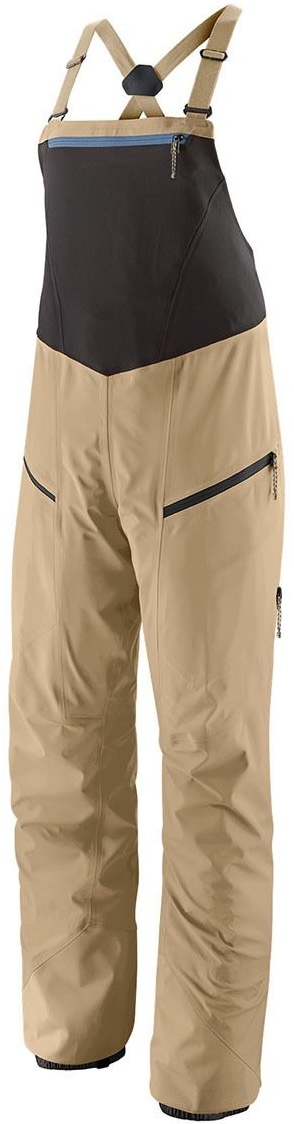
Best for: Backcountry
Waterproofing: 3L H2No Performance
Insulated: No
What we like: Creative mix of weather protection and comfort in a lightweight design.
What we don’t: Trim fit, especially around the legs; not the warmest bib.
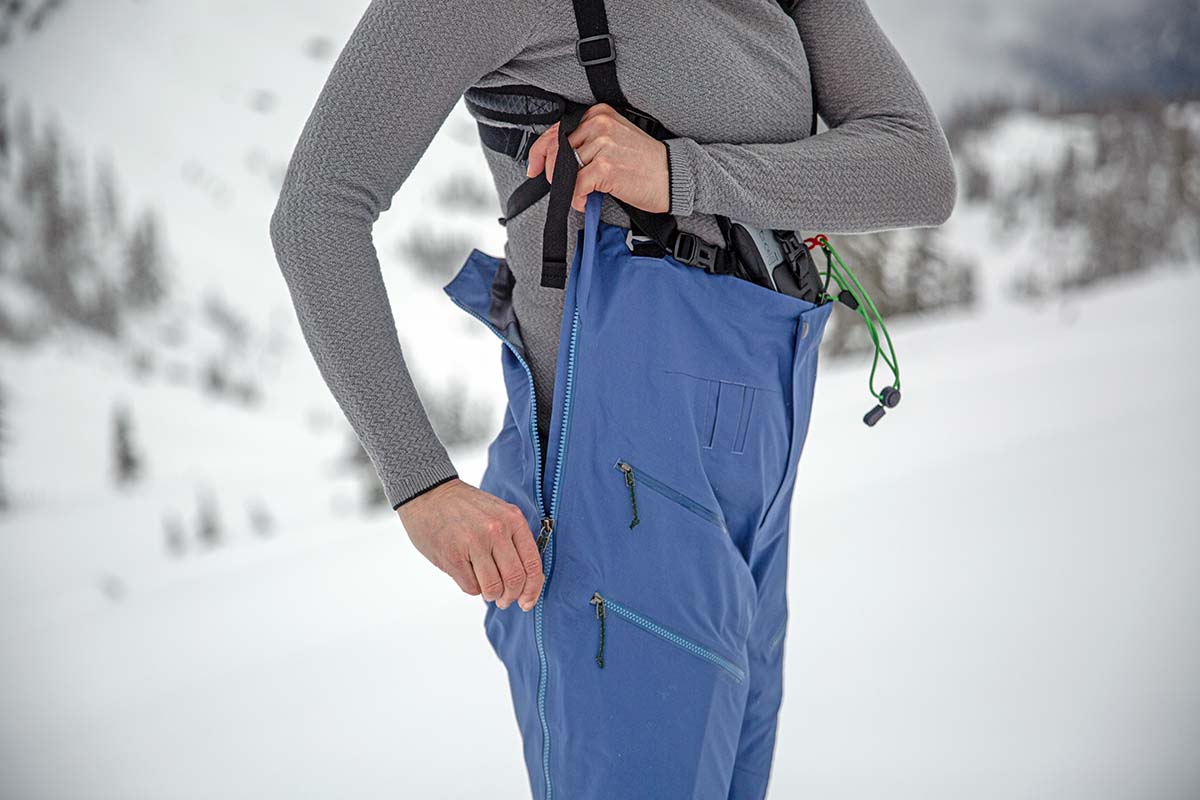
For backcountry skiing, you'll want a lightweight bib that doesn’t restrict movement, top-notch breathability and ventilation, and tough fabrics and components that can withstand heavy use. Within this category, the Patagonia SnowDrifter is our runaway favorite. The design essentially has two parts: a stretchy 3-layer waterproof hardshell protects you below the waist, while a supple softshell covers the upper body. Along with a two-way side zip for easy on/off, and venting, the result is a bib that deftly balances weather resistance for occasional resort use with range of motion for extended hikes to the sidecountry. Plus, the SnowDrifter comes with a few essential features, like a modest number of pockets (one kangaroo pocket in the upper and two thigh pockets), side ventilation that doubles as a drop-seat, and a streamlined, skin track-ready fit.
That said, our biggest gripe with the SnowDrifter is its fit. Specifically, it’s noticeably tight around the thighs, which make the leg pockets difficult to access (especially when wearing gloves). We’ll also point out that in opting for a dedicated backcountry bib with thin fabric, you do sacrifice durability and weather protection a bit. Patagonia’s waterproofing hasn’t failed us yet, but the bib is cold, and the trim fit makes it tough to layer thicker baselayers underneath (you might want to size up). The thinner fabric also makes this one more prone to damage, so we don’t recommend it for repeated chairlift rides. However, for the dedicated backcountry skier, the SnowDrifter has considerable appeal.
Read more: Patagonia SnowDrifter Bibs review
See the Patagonia SnowDrifter Bibs
Best for: Backcountry/resort
Waterproofing: 3L Tactic
Insulated: No
What we like: A stylish yet high-performance bib with built-in stretch.
What we don’t: We've run into some issues with fit; the stretchy build makes small sacrifices in weather protection.
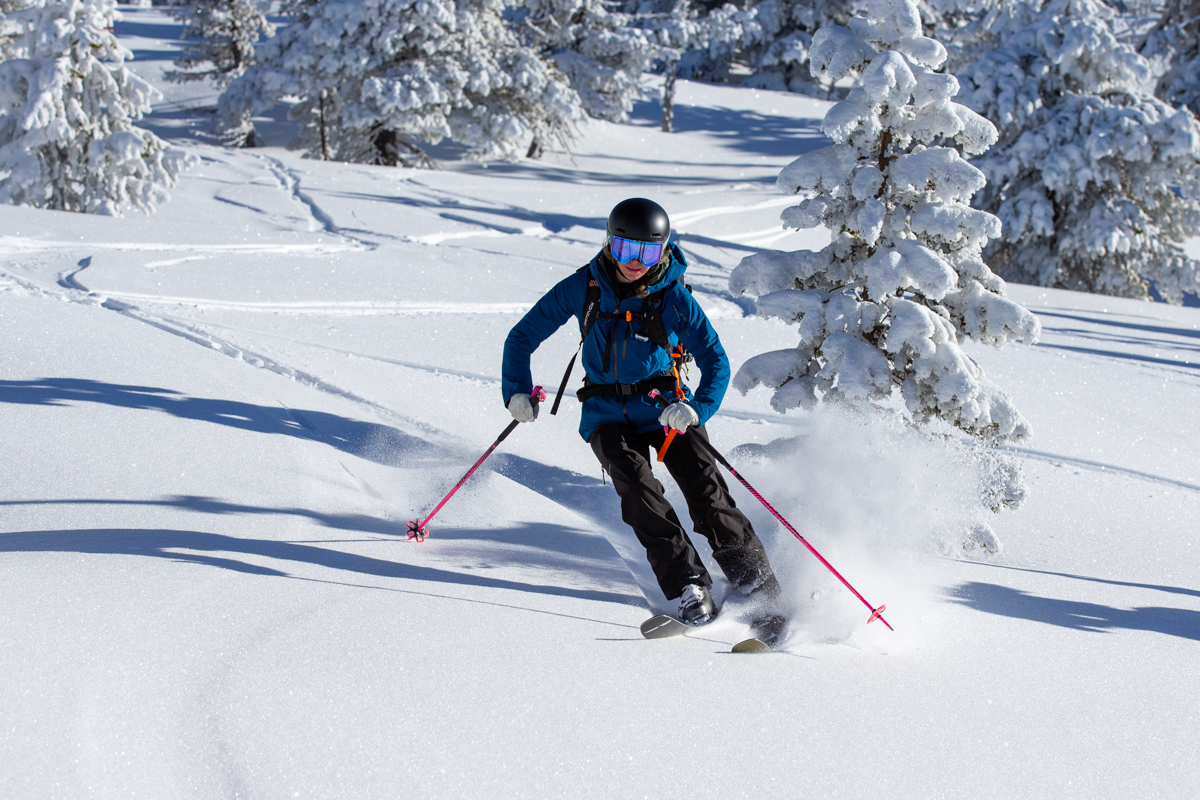
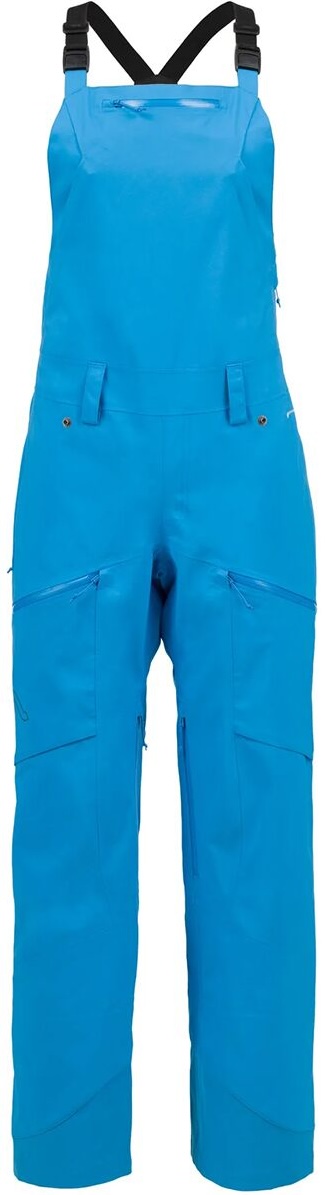
Flylow Gear holds a special corner of the ski bib market, with a wide variety of offerings that hit the sweet spot between style and performance (as evidenced by the Sphinx above). The Foxy is their best all-rounder: This bib is versatile and hip, comfortable yet protective thanks to a stretch-infused hardshell fabric (which is also impressively durable at 100D), and fully featured with vents on both the inside and outside of the thighs, as well as no shortage of pockets. We also love that it comes in three different inseam lengths, which really helps to nail the fit (bibs can be particularly finicky). We tested the Foxy throughout a season in the Pacific Northwest and give it our wholehearted endorsement for those looking for a top-of-the-line bib for both resort and backcountry use.
Truth be told, we had a hard time choosing between the Chariot above and the Foxy here for our Best Overall pick. On one hand, the Foxy is a better crossover pick: Its stretchy hardshell fabric and trimmer fit excel on the skin track. The Foxy is also slightly cheaper than the Chariot. But the Chariot ultimately prevailed due to its stronger resort appeal. Most notably, the Foxy foregoes a bit of weatherproofness in opting for a stretchy hardshell, making it a less ideal choice for wet chairlift rides and deep days out. Additionally, the Foxy doesn't include a built-in pocket clip for an avalanche beacon, which is disappointing for backcountry use. Lastly, testers have reported a tight fit on the Foxy, particularly around the thighs, and the sizes max out at a trim 14, excluding many curvier and plus-size skiers. However, if the sizes work for you and you're willing to make a few minor trade-offs, Flylow Gear's most popular bib is a comfortable, high-performance, and stylish option for resort skiers, casual backcountry enthusiasts, and those who enjoy a mix of activities. It’s available in an insulated version, too.
See the Flylow Gear Foxy Bib
 Best for: Backcountry/resort
Waterproofing: 3L Pertex Shield
Insulated: No
What we like: The most affordable 3-layer bibs here; offered in sizes from XS to 4X and three inseam lengths.
What we don’t: Doesn't stand out in any one area; 40D shell is on the thinner end for frequent resort use.
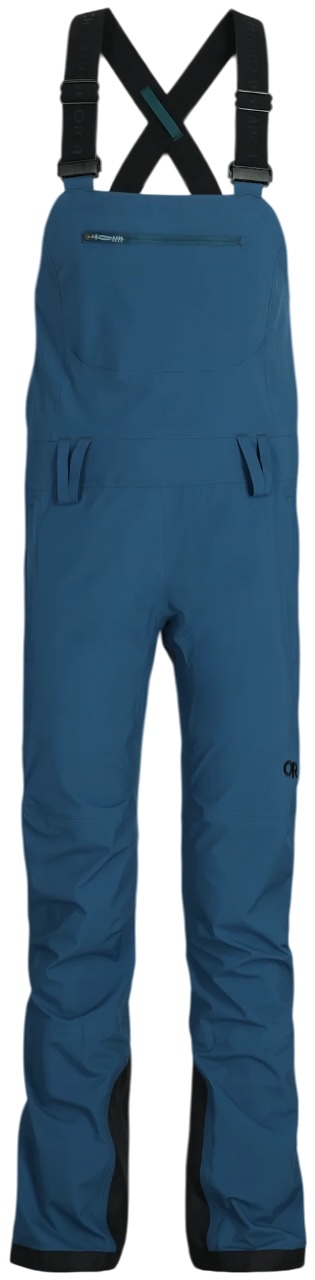
Slotting in between budget offerings and premium competitors, Outdoor Research’s Carbide Bibs offer an impressive combination of price and performance. The most affordable 3-layer design, the Carbide breathes better than 2-layer alternatives, features a lighter and less bulky build, and has a noticeably higher-quality feel. It also crosses over nicely for backcountry use with a host of touring-ready features: generously sized outer thigh vents (one of which doubles as a side flap for bathroom breaks), durable scuff guards and elastic boot gaiters, and a chest pocket with a beacon clip. Taken together, the Carbide is a great all-rounder that's better suited for the resort than the SnowDrifter above due to its non-stretchy build and soft tricot backer.
However, as with many jack-of-all-trades designs, the Carbide verges on master of none. Resort-only riders who don't venture off-piste can save with a 2-layer option like the Freedom above, while spending up for the SnowDrifter will get you better breathability and mobility on the skin track. Additionally, the Carbide's face fabric is on the thinner end for resort use at 40D, and attention to detail is a step down from the painstaking craftsmanship you get from Arc'teryx or Patagonia—the thick suspender hardware proved uncomfortable under pack straps, for instance. But for weekend warriors who spend time on both sides of the ropes and don't demand too much out of their bibs, the Carbide is a solid value.
See the Outdoor Research Carbide Bibs
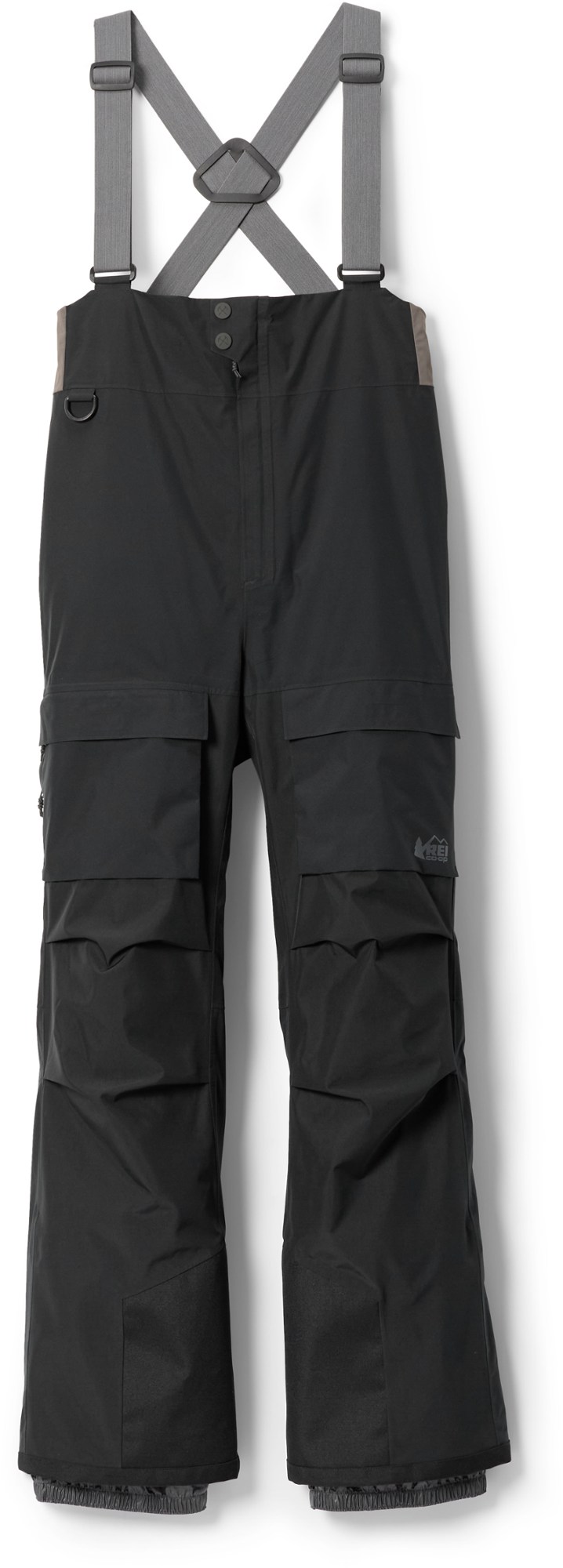 Best for: Resort
Waterproofing: 2L Gore-Tex ePE
Insulated: No
What we like: Gore-Tex protection at an excellent value.
What we don’t: Not as premium-feeling as the OR Carbide above.
Gore-Tex is the gold standard for skiers who face rough conditions on the regular, like those you might find in the Pacific Northwest. While the more premium Gore-Tex options above are great options, their steep price tags are undeniably tough to swallow. Enter REI Co-op's First Chair Bibs, which slot in as the most affordable Gore-Tex design to make our list this season. Like Sentinel and Untracked above, the First Chair is equipped with Gore’s venerable membrane, but cuts costs by using a 2-layer rather than a 3-layer construction. This results in added bulk and reduced breathability, but the First Chair is nevertheless a sizable step up from REI's own Powderbound above, offering more reliable protection alongside features like mechanical stretch for mobility, a cozy knit panel at the back, and improved ventilation for mild spring days or sidecountry jaunts.
It's no surprise that the REI First Chair falls short of the pricier Sentinel and Untracked above in all-out performance, but even OR's Carbide above has a higher-quality feel. The Carbide is noticeably thinner, which translates to reduced durability, although the upside is that you get better ventilation for heart-pumping tours (the First Chair is a decidedly resort-focused piece). Additionally, while both bibs come in a healthy range of sizes, the OR technically gets the edge with three inseam lengths to choose from (compared to two for the REI) and plus sizes up to 4X (the First Chair only goes up to 3X). Still, for casual resort-goers looking to maximize protection and minimize costs, the First Chair GTX lands in a great spot.
See the REI Co-op First Chair GTX
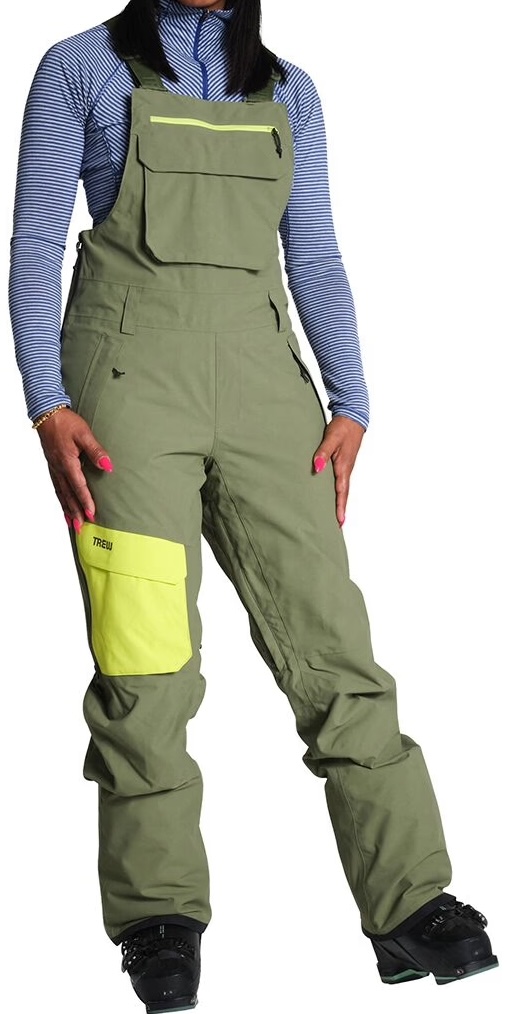
Best for: Resort
Waterproofing: 2L PNW
Insulated: No
What we like: A well-rounded bib with excellent styling and protection from Trew's affordable resort line.
What we don’t: 2-layer construction is limiting and not as durable as 3-layer.
Trew Gear’s Astoria fits somewhere in between a high-styling and high-performing (and expensive) 3-layer design and our dedicated budget picks above. This 2-layer bib is definitely limited to the resort (the hanging liner doesn’t breathe as well as 3-layer designs), but we’ve come away impressed with how well it tackled high winds and wet, heavy snow during testing in the Lake Tahoe area. Styling is attractive for inbounds use, and the flattering, freeride-inspired cut is rounded out by six large and practical pockets, inner thigh vents, and a two-way side zipper that opens wide for bathroom breaks. The “comfy middle” price tag makes the Astoria a nice alternative to the Chariot Primo above for casual weekend skiers and those who don't plan to venture outside the ropes.
However, the Astoria does come with some downsides. For one, we feel the storage layout could use some improvement: The rear zippered pocket went unused all season due to its placement, and it’s easy to overload the overlapping chest pockets. And durability-wise, it's worth noting that our pair accumulated a couple of snags and loose threads along one of the cuffs after minimal wear, although the rest of the design is holding up well. In the end, while certainly not the most performance-ready option, the Astoria is a nice upgrade from true budget bibs and checks most of the boxes for resort days.
Read more: Trew Gear Astoria Bib review
See the Trew Gear Astoria Bib
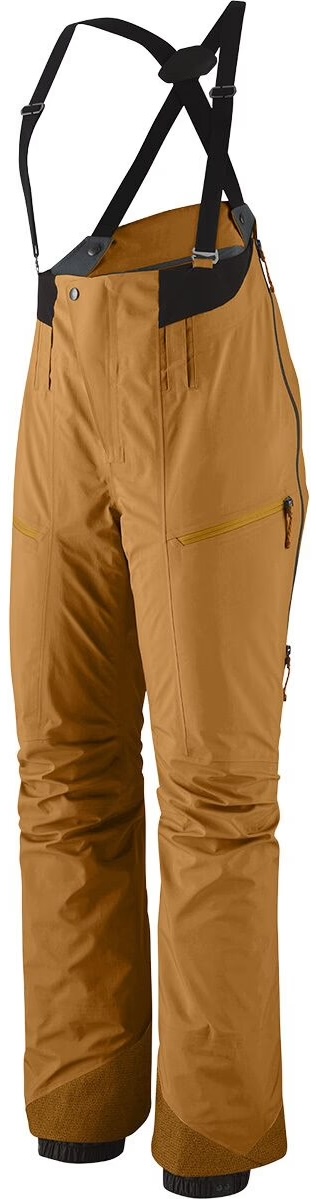
Best for: Backcountry
Waterproofing: 3L Gore-Tex ePE
Insulated: No (flannel backer)
What we like: Highly protective; minimalist bib upper and stretch-mesh panels boost mobility and breathability.
What we don’t: Expensive; only available in five sizes and one inseam length.
As their name suggests, the Untracked Bibs are built for venturing deep into the backcountry in search of untouched powder. And they've got the chops to back it up: With a high-quality, 3-layer Gore-Tex shell—which is dependable in harsh weather while offering better breathability than most in-house membranes—and streamlined build that leaves most of your torso exposed, the Untracked offers solid protection alongside a low weight. It's also built to last with a burly 80D shell and tacks on a soft flannel backer for next-to-skin coziness. Rounding out the design are stretchy mesh panels at the sides (also great for comfort), side zippers that work as vents or a drop seat, and two zippered thigh pockets for storage—along with the standard gaiters, scuff guards, and watertight zippers, all of which we expect at this price point.
The Untracked is a nice alternative to the Sentinel above, and we think it's overall the smarter choice for dedicated backcountry skiers. The construction is virtually identical—including the same 80D face fabric, Gore-Tex membrane, and flannel backer—but the Untracked’s streamlined bib upper and extra stretch-mesh panels give it the clear edge in breathability and freedom of movement for uphill enthusiasts (although the Sentinel gets our vote for resort riding). It is worth noting that we haven’t loved Patagonia’s drop seat designs in the past—the snaps can be hard to reach with a jacket on—and the Untracked only comes in five sizes compared to the Sentinel’s 10. But if it fits, the minimalist Untracked has clear appeal for weight-conscious backcountry riders who don't want to skimp on protection.
See the Patagonia Untracked Bibs
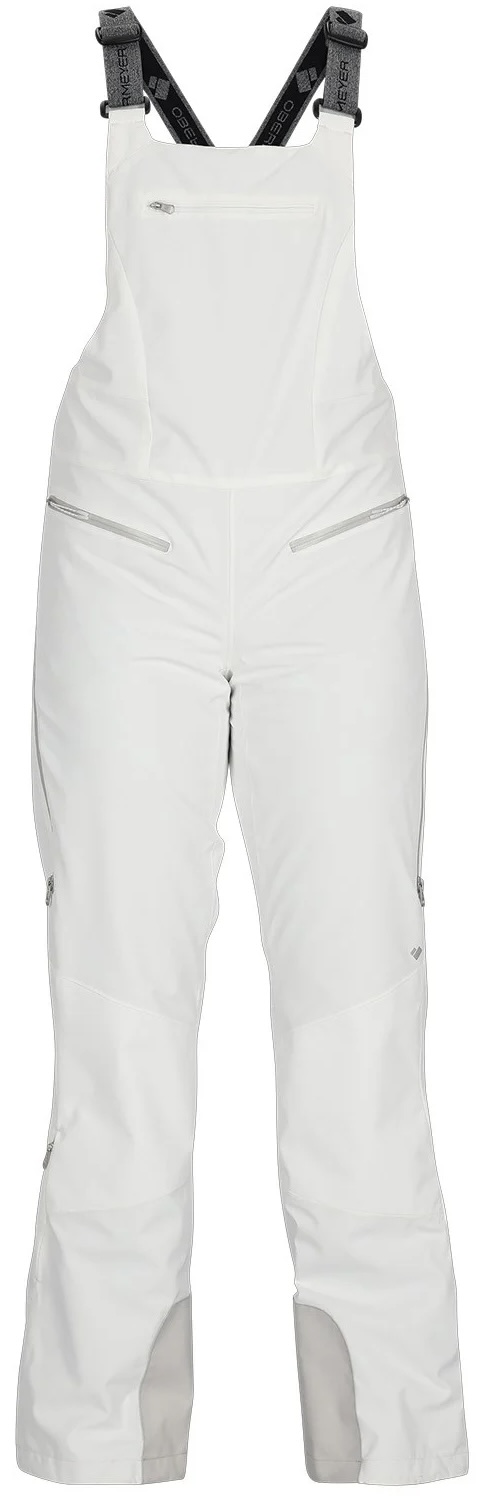 Best for: Resort
Waterproofing: 2L HydroBlock Pro
Insulated: Yes (40g Thinsulate Platinum Flex)
What we like: Stylish and feminine resort vibes.
What we don’t: Trim-fitting and not particularly breathable.
Based in Aspen, Colorado, Obermeyer has been designing skiwear since 1947, which means they’ve seen the sport through a heckuva lot of fashion trends. But as resort style has moved from one pieces and snow bunnies to baggy, snowboard-inspired garb, Obermeyer has stuck close to their original formula with sophisticated yet functional offerings. The Bliss here is their mid-range women’s bib, with a trim fit, 40g insulation, and a stretchy hardshell face fabric that comes in a few classy colorways. To be sure, weather protection doesn’t measure up to Gore-Tex (or comparable) models, but the Obermeyer will get the job done for casual resort use in mostly dry conditions.
What women love most about the Obermeyer is the flattering fit: The Bliss’ fleece-lined waistband adjusts to ride snugly against a range of body types, and the cuffs feature a stylish flare and rear zipper that look classy at the resort. Further, while the insulation provides decent levels of warmth, it’s inconspicuous enough to keep bulk low. And to help dial things in, the Bliss comes in nine sizes from 2 to 18, including short and long lengths. But you do get what you pay for: With critical seam taping, we only recommend the Bliss for use in dry and cold climates like Colorado, and it’s not particularly breathable, either. The end result is a bib that looks better than it performs—the Bliss will excel at après but might show its weakness on the slopes.
See the Obermeyer Bliss Bib
 Best for: Backcountry
Waterproofing: 3L TourTech
Insulated: No
What we like: Purpose-built for spring ski touring.
What we don’t: Niche use case and not the most weather-proof.
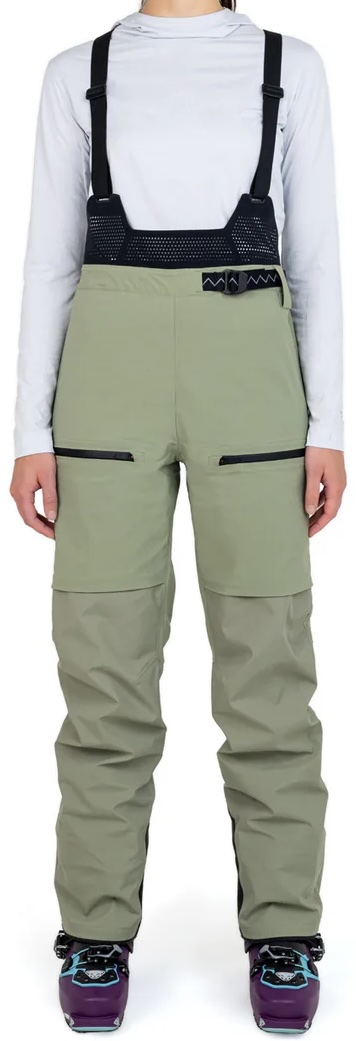
Colorado-born Raide is a relative newcomer to the ski apparel market, but they hit the ground running with their TourTech Bibs. While many of the bibs on this list make it on for their versatility, the TourTech does one thing really well: spring skimo-ing. The main event is the bib’s half-softshell, half-hardshell construction. You heard us right: While most backcountry bibs just use softshell on the upper (the part of the bib least exposed to the elements), the TourTech has softshell fabric from the knees up, and hardshell on just the bottom. The result is a highly mobile, lightweight, and breathable bib that excels during high-output activities in mild conditions. Tack on a minimalist feature set—including side vents, two thigh pockets, an integrated belt—and a mesh upper, and you get the ideal bib for mountain ski tours in April and May.
There’s no denying the TourTech’s generous use of softshell material makes it pretty much a no-go for resort riding—soggy chairlifts will soak right through the backside, despite the softshell’s DWR coating. This bib will also be pretty chilly for mid-winter use. Like the SnowDrifter above, the TourTech has a slim, athletic fit, which is great for the skin track, but makes it harder to layer underneath. Our male tester also reported some fit issues and found that the suspenders sat uncomfortably under a ski pack. Raide does offer the TourTech in two inseam lengths, which should help dial in fit. We’ll also give the young company a bit of leeway with this first version and hold out hope for a dialed-in revision. In our opinion, it’s worth it for the supreme performance on spring ski touring missions.
See the Raide TourTech Bib
| Ski Bib | Price | Best for | Waterproofing | Insulated | Weight |
|---|---|---|---|---|---|
| Trew Gear Chariot Bib Primo | $599 | Resort/backcountry | 3L PNW Primo | No | 1 lb. 15.5 oz. |
| REI Co-op Powderbound Bib | $219 | Resort | 2L Peak | Yes | 1 lb. 11.5 oz. |
| The North Face Freedom Bibs | $220 | Resort | 2L DryVent | No (avail.) | 1 lb. 5.7 oz. |
| Flylow Gear Sphynx Bib | $330 | Resort | 2L Finish | Yes | 1 lb. 9.6 oz. |
| Arc'teryx Sentinel Bib | $700 | Backcountry/resort | 3L Gore-Tex ePE | No | 1 lb. 6.4 oz. |
| Patagonia SnowDrifter Bibs | $399 | Backcountry/resort | 3L H2No Performance | No | 1 lb. 5.2 oz. |
| Flylow Gear Foxy Bib | $440 | Resort/backcountry | 3L Tactic | No | 1 lb. 5.6 oz. |
| Outdoor Research Carbide Bibs | $329 | Backcountry/resort | 3L Pertex Shield | No | 1 lb. 5.8 oz. |
| REI Co-op First Chair GTX ePE | $269 | Resort | 2L Gore-Tex ePE | No | 1 lb. 9.4 oz. |
| Trew Gear Astoria Bib | $329 | Resort | 2L PNW | No | 1 lb. 12.0 oz. |
| Patagonia Untracked Bibs | $649 | Backcountry | 3L Gore-Tex ePE | No | 1 lb. 5.5 oz. |
| Obermeyer Bliss Bib | $339 | Resort | 2L HydroBlock Sport | Yes | 1 lb. 9.0 oz. |
| Raide TourTech Bib | $449 | Backcountry | 3L TourTech | No | 1 lb. 2.9 oz. |
During the snowy months, you can catch the women at Switchback Travel on the slopes— whether we're enjoying groomed laps at Palisades Tahoe in California or skiing off the summit of volcanoes in the North Cascades. Former senior editor Jenny Abegg debuted this guide in 2022 with 17 bibs. Based in Washington state, Jenny is no stranger to the wet and cold but doesn’t let that keep her from reaching summits in the winter months. Editor Maddie Downie took on the guide in 2024. Maddie’s love for backcountry skiing often takes her A-framing and bushwhacking through dense forests just to reach snow, so she knows the importance of a durable and comfortable pair of bibs.
All of the bibs we test are put through real-world use, meaning they see everything from mellow days lapping lift-assisted terrain to multi-day pushes into the backcountry. When testing bibs, we’re constantly taking notes on their performance, closely analyzing how warm they keep us, how well they breathe when we're working up a sweat, and how effective they are at keeping us protected in inclement weather. We also pay close attention to comfort and overall build quality, as well as fit (for the latter, we try to incorporate as many body shapes and sizing into testing as possible). Finally, we give all the features a thorough test run, from the smoothness of the zippers to the effectiveness of the gaiters and scuff guards. As we continue to test new and noteworthy designs, we'll be sure to add any standouts to the list above. And for those who prefer the easier on/off and added mobility of pants, we took a similar approach with our round-up of the best women's ski pants.
.jpg)
When heading to the slopes, you’ll likely be deciding between ski pants or bibs. While the choice mostly comes down to personal preference, there are several key factors to consider. One of the biggest advantages of ski bibs is their superior coverage. Unlike pants, bibs rise above the waist, eliminating the need for a belt or powder skirt and providing excellent protection against snow and cold drafts. This extra coverage is particularly beneficial for skiers tackling deep snow or beginners who want to stay dry after falls.
Another benefit of bibs is the additional storage space, with pockets often placed at both the chest and legs. This is especially useful if you prefer to ski without a jacket on warmer days, as it provides a convenient place to store essentials like a phone, snacks, or an avalanche beacon. Additionally, bibs have gained popularity for their stylish look, making them a fashionable choice on and off the slopes.
.jpg)
However, bibs do come with some drawbacks. They tend to be more expensive than ski pants—REI's Powderbound Insulated Pants, for example, cost much less than the bib version. The extra fabric also makes them bulkier, which can be a downside for those who prefer a more streamlined backcountry kit. Additionally, while bibs generally offer excellent weather protection, they can be less breathable than ski pants, though features like softshell uppers, torso vents, and stretch panels help mitigate this issue. One of the biggest challenges, especially for women, is bathroom convenience. Fortunately, many designs now include rear or side zippers to make things easier.
Some ski bibs work well in both resort and backcountry settings, but others are designed specifically for one environment. To simplify your decision, we’ve identified the best use case(s) for each model in our product descriptions and comparison table above.
Starting with resort designs, these bibs are built tough. They typically feature thick, rigid hardshell fabrics that withstand chairlift wear, fully waterproof and windproof constructions, and generous fits for layering, like Trew Gear's Chariot Bib and Arc'teryx's Sentinel. Some resort bibs also come with insulation, which is ideal for those who run cold or frequently ski in temperatures that dip down to freezing or below. The biggest drawback is that resort bibs tend to be fairly bulky and heavy, which aren't great characteristics for backcountry use.
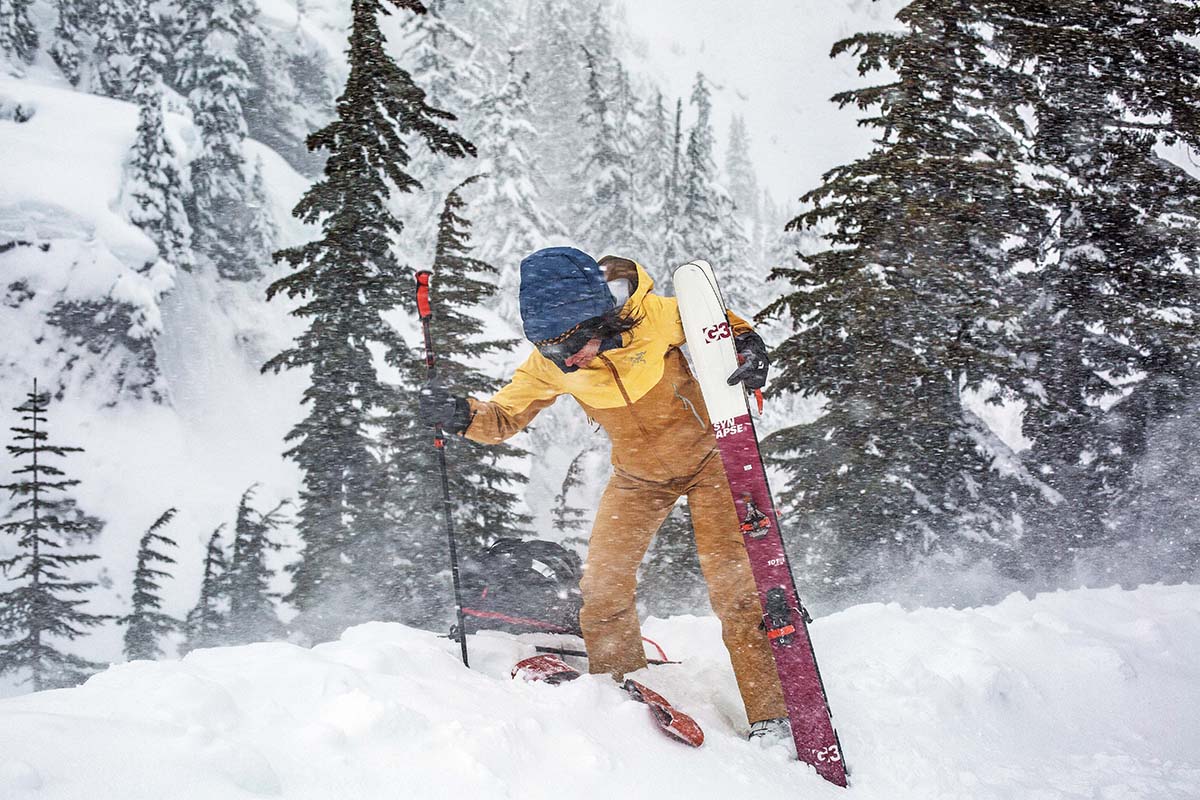
Backcountry-focused bibs prioritize mobility and breathability. They often incorporate stretch—either in the form of softshell panels or built-in stretch—and have an athletic fit for unrestricted movement. Ventilation is another key factor, with many backcountry bibs featuring zippered side vents and breathable backpanels to help regulate temperature. That said, the emphasis on breathability can sometimes compromise weather protection, and the use of thinner materials may affect durability. Whether these trade-off are worthwhile depends on your local conditions and personal skiing style. Additionally, backcountry bibs typically include large chest or thigh pockets (sometimes both) with clips for securing an avalanche beacon. Some of our favorites in this category include Outdoor Research's Carbide and Raide's TourTech bibs.
Most ski bibs are made from hardshell fabric for its waterproofing capabilities, but there are variations in construction. The three main types include rigid hardshell, stretch-infused hardshell, and softshell. The type of fabric you opt for will depend on where you're skiing (we favor rigid hardshells for resort use) and how much mobility you need (stretchy designs are great for mogul skiers and uphill enthusiasts). And while all of the bibs above feature hardshell below the belt, some use supple and stretchy softshell fabric in the bib (like the Patagonia SnowDrifter).
.jpg)
Hardshell
For resort skiing and extreme weather conditions, rigid hardshell bibs (like those that feature Gore-Tex) provide top-tier protection. These waterproof and windproof bibs keep moisture and cold air out, making them ideal for long chairlift rides. High-end hardshells are also known for their impressive longevity. However, due to their thick and durable construction, they are less breathable and often stiffer, although most hardshell bibs include zippered vents to help release excess heat. Two of our favorite high-performance hardshell bibs include the Arc'teryx Sentinel and Patagonia Untracked, which offer 3-layer protection, substantial shell fabrics, and efficient venting systems.
Hardshell with Stretch
For aggressive resort skiers, sidecountry adventurers, and most backcountry riders, stretch-infused hardshells provide a great blend of protection and flexibility. Models like the Flylow Foxy and Patagonia SnowDrifter feature waterproof shells with built-in stretch, eliminating the stiff and crinkly feel of traditional hardshells. These bibs prioritize freedom of movement and breathability but come with some trade-offs—stretch fabrics allow more airflow, making them slightly less protective in strong winds and more prone to wetting out in prolonged exposure. Despite these minor compromises, stretch-infused hardshells have become increasingly popular among backcountry skiers.
.jpg)
Softshell
Softshell fabrics provide excellent stretch, air permeability, and comfort compared to hardshells. They also offer a bit more insulation. However, softshells are water-resistant rather than waterproof, meaning they absorb moisture more easily and typically lack waterproof membranes. While some ski pants designed for spring conditions use softshell exclusively, most bibs only incorporate softshell fabric in the upper torso portion. Models like the Patagonia SnowDrifter take this approach, featuring a softshell bib while retaining hardshell protection on the legs. This hybrid design improves breathability and mobility while maintaining adequate weather resistance when paired with a ski jacket.
.jpg)
Most high-end ski bibs feature a 3-layer (3L) construction, consisting of an outer shell, a waterproof and breathable membrane, and an inner liner bonded together. This results in a streamlined, less bulky design (2-layer constructions require a separate, hanging mesh liner along the interior) with improved breathability and durability. As a result, 3-layer bibs are the more expensive choice between the two.
.jpg)
Budget and mid-range bibs often use 2-layer (2L) construction, which is less breathable but still offers solid protection. These designs incorporate a separate mesh or fleece liner, making them bulkier than 3-layer models. However, 2-layer bibs are well suited for resort skiing, where ventilation is less of a priority (unless you're prone to overheating or a diehard mogul rider). This construction is also cheaper, which makes sense for our budget picks (REI Co-op Powderbound Insulated and TNF Freedom Bibs).
Since ski bibs prioritize full-body protection, waterproofing is a crucial factor. For top-tier moisture defense, rigid hardshell bibs with a Gore-Tex membrane are the gold standard. Mid-range and entry-level bibs use in-house laminates (like Trew Gear’s PNW or REI’s Peak), which still offer reliable waterproofing but may not be as breathable or durable over time. Features like seam taping and durable water-repellent (DWR) coatings further enhance water resistance, and aftermarket products (like Nikwax's Tech Wash and TX.Direct) can help restore DWR performance over time. In terms of waterproofing, spending a little more will get you a nice upgrade in quality and longevity.
.jpg)
For backcountry skiers, waterproofing needs differ from those of resort skiers. Since they spend less time on chairlifts and more time skinning uphill, many opt for bibs that balance waterproofing with breathability. All of the backcountry-focused bibs on our list feature waterproof legs, but many integrate stretch-infused hardshells that are more air-permeable and slightly less water-resistant than rigid hardshells. Some designs also include softshell fabric in the bib portion for added comfort and breathability, though these should be paired with a waterproof ski jacket or hardshell jacket in wet conditions.
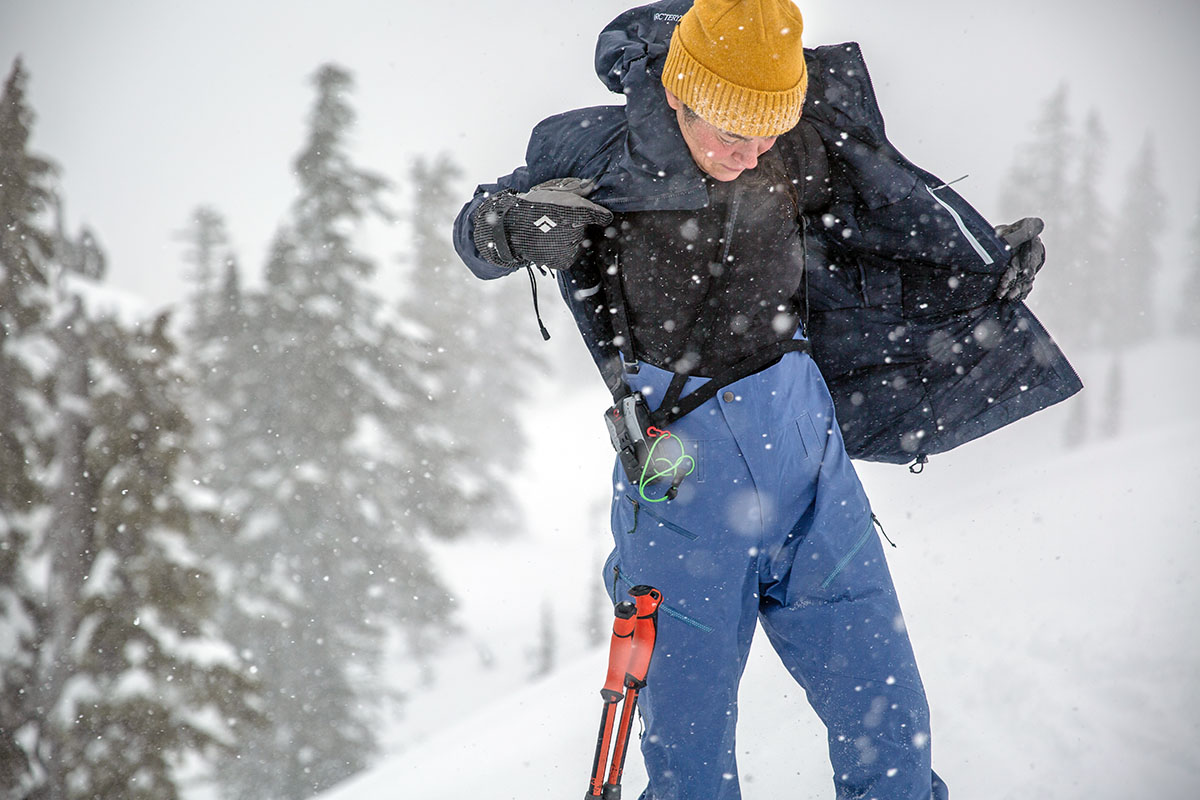
Breathability is most important for backcountry riders and those who frequently hike in their gear. Standard 2-layer resort bibs provide adequate ventilation for most riders, especially when equipped with zippered vents. For the best breathability, uninsulated 3-layer bibs, such as the Flylow Gear Foxy Bib, offer excellent moisture management. Some bibs also feature softshell panels in the torso to enhance airflow, like the Patagonia SnowDrifter, or Raide’s TourTech, which extends softshell fabric down to the knees. If breathability is your top priority, ski pants may be a better choice than bibs. Pants provide more ventilation and reduce heat retention, making them a great alternative for skiers who frequently overheat.
.jpg)
Unlike ski pants, which have a near-even split between insulated and uninsulated models, the majority of women's ski bibs are uninsulated. This is largely due to their inherent bulk and the natural warmth they provide through extended core coverage and draft protection. Additionally, bibs are a top choice among backcountry skiers, who prioritize breathability and tend to avoid insulated designs. That said, a few insulated bibs cater to resort riders who run cold or frequent particularly frigid areas like the Mountain West or Northeast of the U.S.
.jpg)
Most insulated ski bibs use synthetic fill, which is favored for its affordability and ability to retain warmth even when wet (unlike down). The insulation level typically falls between 40g and 60g fill, with the ideal amount depending on your local climate, skiing style, and personal warmth preferences. A 40g-insulated bib (like Obermeyer's Bliss Bib) is a solid, versatile choice—allowing you to layer up as needed—while models with built-in vents help regulate temperature. Among insulated bibs, the Flylow Gear Sphynx stands out with its 40g Greenloft insulation, outer thigh vents, and a softshell backpanel for added breathability.
Even among uninsulated bibs, warmth varies due to differences in fabric thickness and air permeability. For example, the Arc'teryx Sentinel's 80D hardshell does an excellent job of blocking wind and retaining heat, whereas the Outdoor Research Carbide Bib has more breathable fabric (40D) allows significantly more airflow. For resort skiers looking for maximum warmth, we recommend a thicker hardshell bib with no built-in stretch, paired with a cozy baselayer.
.jpg)
Ski bibs endure a significant amount of wear and tear—from boot buckles and metal ski edges to chairlifts and tree branches—so durability is an essential factor. The most common way to measure a bib’s toughness is fabric denier (abbreviated "D"), which indicates the thickness of the threads used in the shell material. Heavy-duty options like the Trew Gear Astoria (200 x 320D) and Flylow Foxy (100D) are built for longevity and make excellent quiver-of-one choices for serious skiers. Lighter options, such as the Outdoor Research Carbide (40D, trade durability for weight savings and a more mobile feel. Models like the Arc'teryx Sentinel (80D) strike a balance between durability and weight savings. Finally, most bibs include reinforced scuff guards along the inner cuff to protect against ski edges and other sharp objects (more on this below).
Sustainability has become a growing focus in the outdoor industry, and ski bibs are no exception. Key advancements include the use of recycled materials and PFAS-free waterproofing, which eliminates harmful perfluorocarbons (PFAS) from waterproof membranes and DWR coatings. Additionally, bluesign-approved fabrics are becoming more common, indicating that the materials meet strict environmental and safety standards. Many brands also produce Fair Trade-certified products, ensuring ethical labor practices.
Transparency has improved significantly in recent years, with most brands clearly labeling their sustainability efforts. Patagonia leads the way with their use of recycled materials, bluesign approved textiles, and Fair Trade certification. Other companies making strides in sustainability include REI, Trew Gear, and Flylow Gear. While the industry still has progress to make, the momentum toward environmentally responsible production is promising. Finally, one of the best ways to shop sustainably is to invest in high-quality gear that lasts and repair worn-out items rather than replacing them frequently.
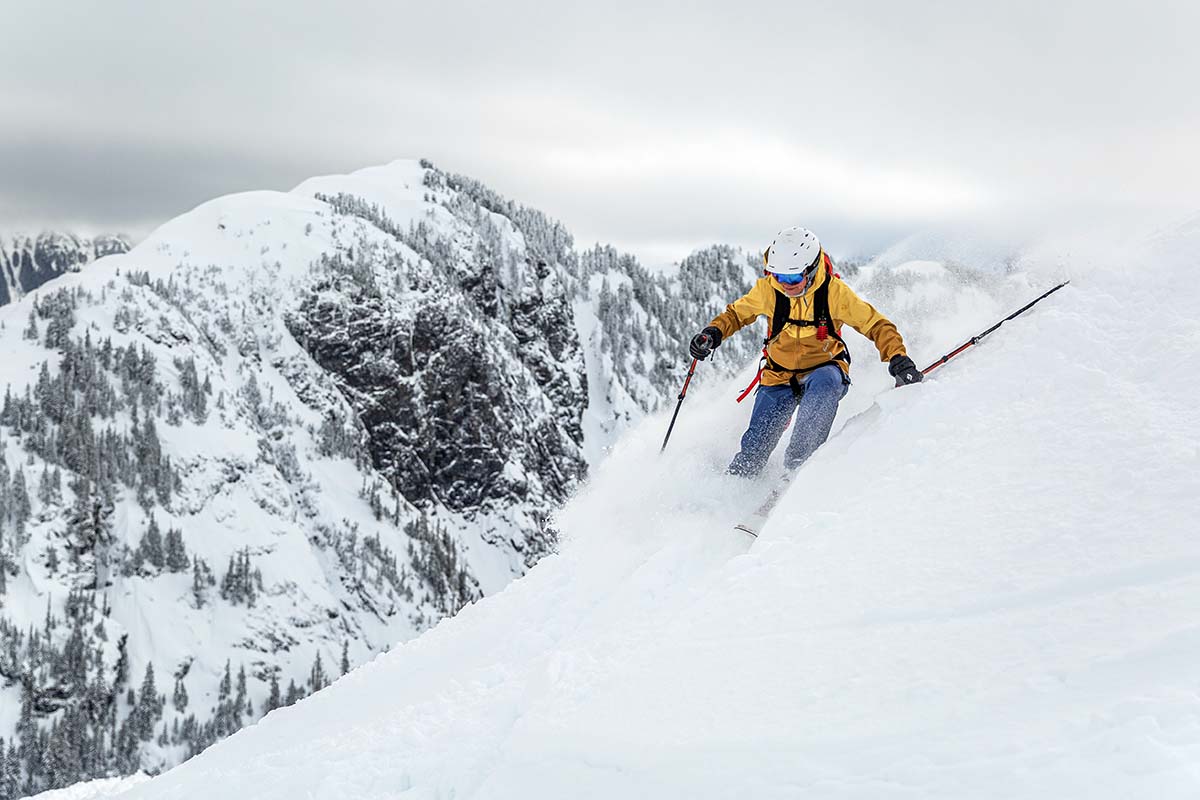
Bathroom breaks in ski bibs have long been a challenge, particularly for women. However, many modern designs address this issue with either full drop seats (zippers that extend from the lower back down the outer legs) or swing hatches (a side-opening design). These features are often integrated into the ventilation system to reduce bulk. Among the best designs is Trew Gear’s half-moon rear zip, which is convenient and easy to use. In contrast, options like the Patagonia SnowDrifter, which relies on hard-to-reach snaps, can be more cumbersome. For those who prefer to pee standing up using a Shewee, Freshette, or similar device, consider a men’s bib with a front fly, as this feature is currently unavailable in women’s-specific models.
.jpg)
Bib Upper
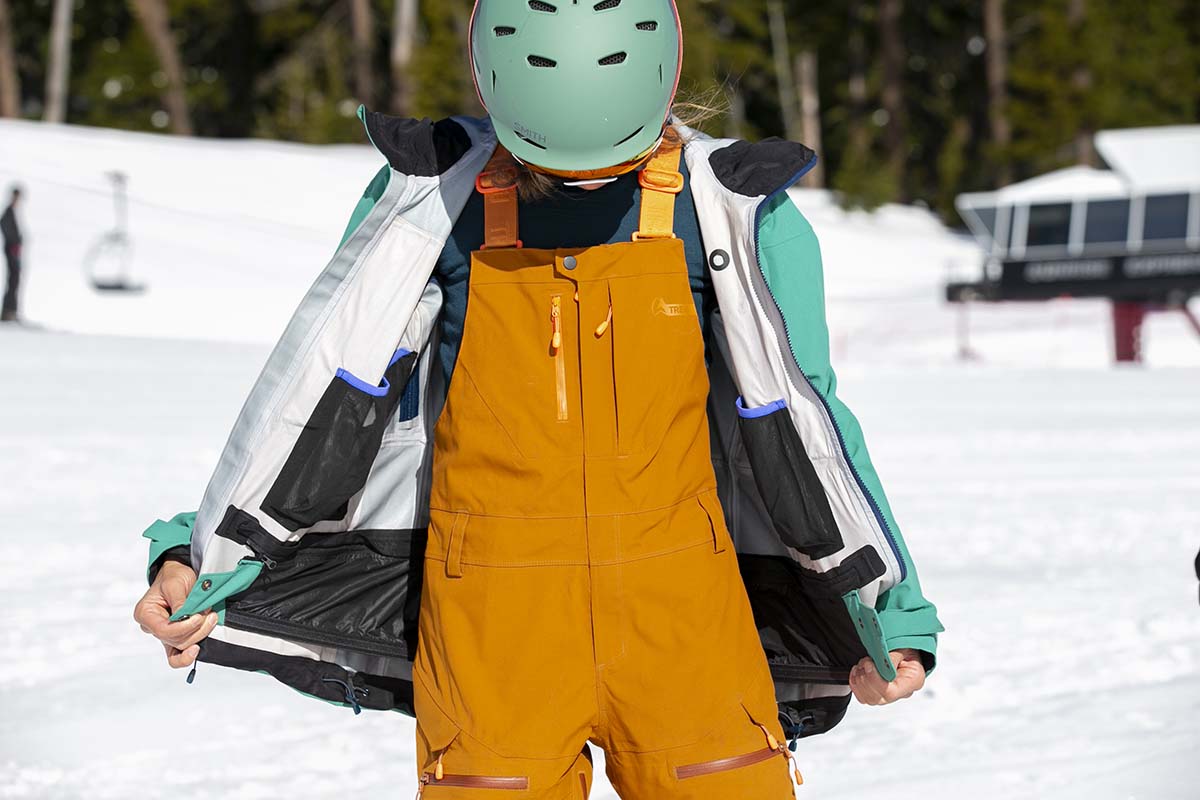
The bib upper is the portion of fabric that wraps around the torso and is secured with suspenders. While most bibs extend to the chest for maximum coverage, some streamlined designs—like the Patagonia Untracked or REI's First Chair GTX—feature a lower-profile cut that retains the benefits of a bib while reducing bulk. Many bib uppers are made from the same material as the pant legs, but some incorporate softshell or stretch panels for added breathability, comfort, and mobility. Backcountry-focused bibs like the Patagonia SnowDrifter take it a step further with fully softshell uppers.
.jpg)
Suspenders
Ski bibs are held up by adjustable suspenders, and it’s important to choose a model with a dialed-in fit, particularly if inseam length options are limited. Quick-release front buckles or metal clasps make adjustments easier, and those wearing a backpack should prioritize low-profile suspenders to avoid pressure points. The Outdoor Research Carbide, for example, has thicker backpanels and bulky chest buckles that can create discomfort under a ski backpack, while the Patagonia SnowDrifter offers a more streamlined, pack-friendly fit.
Pockets
One of the main advantages of ski bibs over pants is extra storage space, which is particularly helpful on warm days when you might not wear a jacket. Most bibs include one or two chest pockets and at least one thigh pocket. Backcountry-specific models often have built-in clips in at least one pocket for securing an avalanche beacon (we recommend using the included harness unless the pocket has a dedicated clip). Low-profile bibs generally offer less storage—for example, the Patagonia Untracked has no chest pockets—but they reduce bulk in exchange.
.jpg)
Ventilation
Most ski bibs include zippered vents to help with temperature regulation. These vents are typically located along the inside or outside of the upper legs. While both styles are effective, inside vents can add unwanted bulk and sometimes interfere with comfort, which is why many backcountry bibs place vents on the outer legs instead. In addition to zippered vents, some bibs integrate softshell or stretch-mesh panels for added breathability. These panels are commonly placed in the lower back area. Since the torso generates a lot of heat, this is a useful feature to look for. However, fully hardshell bib uppers can become overly warm and swampy, particularly for those prone to sweating.
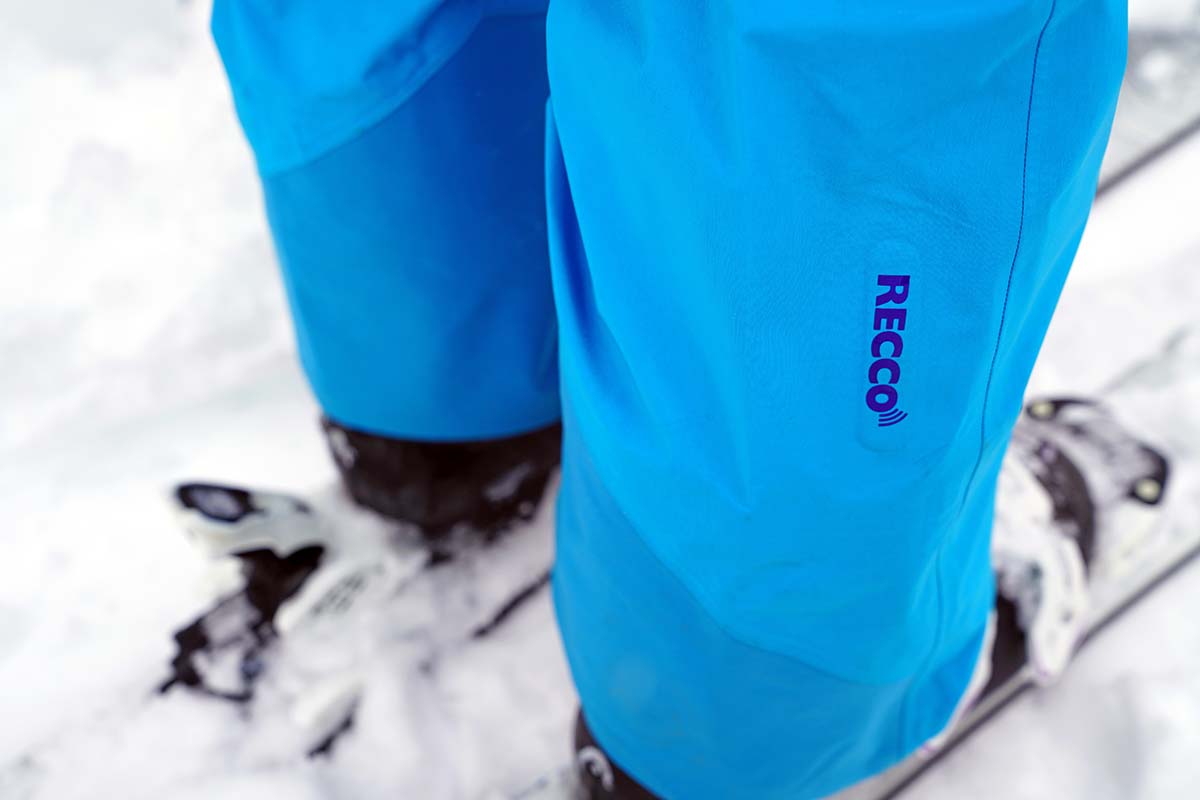
Recco
Some mid-range and high-end ski bibs come with a built-in Recco reflector. This passive unit doesn’t require batteries and can be detected by Recco search-and-rescue equipment. While not a substitute for an avalanche beacon, Recco reflectors provide an additional safety measure for skiers who venture beyond resort boundaries. More information on the technology is available on the Recco System website.
Scuff Guards and Gaiters
Scuff guards (also known as kick patches) are reinforced panels placed along the inner cuff to protect against ski edges, boot buckles, and other sharp objects. Most ski bibs include this feature, though durability varies depending on the material used. Inside the hem, gaiters extend downward and typically feature elastic cuffs that secure around ski boots to keep snow out. Some designs also include slits, allowing for power strap adjustments without having to reposition the gaiter. For backcountry skiers who spend time bootpacking, it’s essential to ensure the gaiters fit securely and won’t ride up over time.
.jpg)
Finding the right fit for a ski bib can be a challenge since it needs to accommodate both your torso and legs comfortably. We highly recommend bibs that offer a broad range of sizes, particularly those available in multiple inseam lengths—such as the Trew Gear Chariot Primo and Flylow Foxy Bib. If you have a particularly tall or petite frame, these options are worth considering. Additionally, features like highly adjustable suspenders, Velcro waist tabs, and stretchy softshell panels at the back help improve fit by minimizing bulk and bagginess around the waist. To ensure the best fit, we suggest trying on bibs before purchasing whenever possible. Fortunately, many brands, including Flylow and Patagonia, offer generous return policies, and REI and other specialty retailers carry a wide selection of ski bibs to try in-store.
.jpg)
For women seeking a more tailored fit, some bibs stand out for their inclusive sizing. The Trew Gear Chariot Primo, Outdoor Research Carbide, and REI Co-op First Chair GTX Bib offer up to six standard sizes and three or four plus-size options (ranging from 1X to 4X), as well as multiple inseam lengths (short/petite, regular, and tall). These variations make it easier to find a well-fitting bib, particularly for those whose body shapes fall outside traditional industry sizing norms.
The layers worn under ski bibs don’t always get as much attention as upper-body layers, but they are just as important. At a minimum, we recommend wearing a thin pair of long underwear for both resort and backcountry skiing. This base layer not only provides extra insulation but also helps wick moisture away from your skin, keeping you dry and comfortable. Additionally, many ski bib interiors feature exposed mesh, zippers, and minimalist liners, which can become uncomfortable over a full day of wear—another reason why a good baselayer is key.
.jpg)
When selecting a baselayer, opt for a close-fitting, soft material to maximize warmth. Wool and synthetic fabrics are the best options, while cotton should be avoided, as it retains moisture and loses its insulating properties when wet. Synthetic baselayers are typically more affordable and wick moisture efficiently, but merino wool is our top choice. Not only is it exceptionally warm for its weight, but it also regulates body temperature effectively and naturally resists odors better than polyester alternatives. Baselayers are available in different weights to suit varying conditions: lightweight options are ideal for warm days or active backcountry use, while midweight and heavyweight versions are best for colder temperatures. On particularly frigid days, doubling up on baselayers can provide additional warmth without requiring a heavily insulated bib.
Back to Our Top Women's Ski Bib Picks Back to Our Women's Ski Bib Comparison Table


bcdc.jpg?h=fbc67360&itok=wmPMXiEZ)
569f.jpg?h=fbc67360&itok=-to2I6ZO)
aebf.jpg?h=fbc67360&itok=Dx4xzQIu)
jpg209a.jpg?h=fbc67360&itok=rCRkeZ6s)
6754.jpg?h=fbc67360&itok=XJLgXTM5)
0f2e.jpg?h=fbc67360&itok=s2_Z1uwG)
50c9.jpg?h=fbc67360&itok=2EUORrFb)
0ec1.jpg?h=fbc67360&itok=oGaifWVw)
e530.jpg?h=fbc67360&itok=T2wyPtl3)