
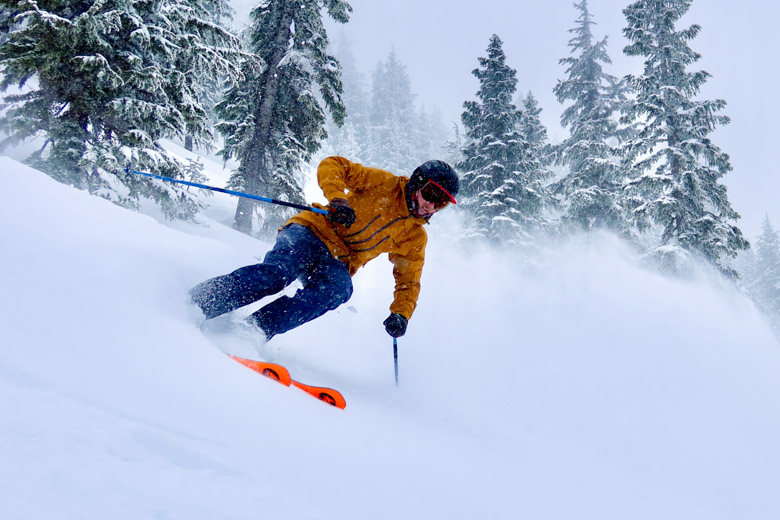
Photo Credit
Price: $449
Waterproofing: 3L H2No Performance Standard
Insulated: No
What we like: Reliable backcountry protection in a light, breathable, and streamlined package; the current design is an improvement over the previous version.
What we don’t: Fits tight around the thighs and loose in the midsection; DWR coating doesn't last.
See the Men's Patagonia Stormstride Pants See the Women's Stormstride Pants
Patagonia has an extensive ski shell collection, and their Stormstride Pants slot in among the backcountry-specific models. Built to balance protection and breathability, these pants are equipped with Patagonia’s in-house waterproof membrane and have a stretchy shell fabric for ample mobility on the skin track. To be sure, they forego bombproof weather protection in an effort to stay lightweight and supple, but we found the sacrifice well worth it for the breathability on spring ski mountaineering missions. We also had a few gripes with the fit (specifically around the waist and thighs), but we’re overall impressed with the design and its ability to keep up on the skin track. Below, we break down our experience with the Stormstride Pants. To see how they stack up to the competition, check out our articles on the best ski pants and best snowboard pants, both of which feature men's and women's models.
Editor's note: We updated this guide on December 15, 2025, after retesting the current men's and women's Stormstride Pant. The review below details our experiences with both the men's and women's models, but we only currently have photos of the men's pants. We're working on getting some pictures of the women's version and will update the guide when we do. We also kept several images of the previous version we tested (the lighter blue pant) and have made comparisons to the previous model where applicable.
Backcountry skiers typically seek an effective balance between weight and protection, and the Patagonia Stormstride Pants deliver reliable weatherproofing in a lightweight, streamlined design. We’ve tested several iterations of the Stormstride over the years on long ski tours, multi-day hut trips, ski mountaineering objectives, and occasional resort days, and have been continually pleased with their protection. Matthew put the latest men's version to the test on a mission up Washington’s Glacier Peak, where he faced the full gamut of conditions, from full-on downpours to gusty alpine and warm spring weather. Sofie tested the women’s version on several ski touring missions in Montana and Washington state, where conditions ranged from dry and sunny to wet and cold. Both testers were impressed with the waterproofing; even after the rain penetrated the durable water repellent (DWR) coating, the membrane kept the inside of the pants relatively dry.

However, like many backcountry-specific ski pants that prioritize breathability, the Stormstride did fall short of full weather protection. As mentioned above, the DWR coating was quick to wet out in a downpour. While the waterproof membrane kept us relatively dry on the inside, the moisture bogged down the fabric. This both limited breathability and made the pants feel heavier. The wet fabric also clung to our baselayers, which was slightly uncomfortable. That said, we can’t fault the Stormstride entirely; this issue isn’t unique to the Patagonia design. Most thin, breathable shells struggle in heavy rain. Those who ski in wet areas like the Pacific Northwest might want to opt for a burlier ski pant like Arc’teryx’s Sabre Pant (or women’s Sentinel). But in our experience, if you time the weather right and don’t mind getting a little wet if the conditions shift, the Stormstride is well worth the trade-off for its breathability and mobility.
Breathability is a standout feature of the Stormstride Pants. The fabric is much thinner (40D) than that of many hybrid or resort-focused ski pants, which makes them efficient at shedding heat. They breathed so well that Matthew didn’t have to open the side vents when hiking through the forest on the approach to Glacier Peak. However, we did find the side vents helpful when skinning at higher elevations where the sun was more intense. Breathability was an issue in the previous generation of the Stormstide Pant we tested, so we’re glad to see an improvement in the current design. To be fair, they’re no match for a softshell pant for ski touring in warm spring temps, but they’re also far more weatherproof than a softshell pant. In our opinion, the Stormstride balances those conflicting traits well.
.jpg)
Overall, we found the Stormstride Pant to be comfortable, with a few exceptions. The thin, supple fabric is easy to move in and doesn’t have the same bulk as other hardshell ski pants. The high-quality stitching, taped seams, and soft backer make for a silky smooth interior that doesn’t cling to the skin when things get sweaty. In fact, even when wetted out, we still found the Stormstride stretchy and comfortable while bushwhacking and crawling over downed logs.

However, we have two complaints about the comfort: First, we found the interior Velcro waist adjusters somewhat bulky and uncomfortable when worn under a backpack hipbelt, and they were prone to rubbing against our waists. The men's version fit fairly loose around the midsection, and our tester had to cinch the waist adjusters all the way to keep them from falling. We also found the thighs to be restrictive, which is a common complaint of Patagonia’s outerwear. These issues weren’t dealbreakers, however, but we do hope future versions of the pant address these issues.
The men’s Stormstride Pants weigh 1 pound 4.1 ounces, and the women’s come in at 1 pound 2.3 ounces. For reference, Trew Gear’s Eage Pant Primo (a men’s backcountry/resort hybrid pant) weighs much more at 1 pound 13.4 ounces on average. Even Outdoor Research’s Trailbreaker Tour, which uses softshell fabric in the top half, is heavier at 1 pound 7.9 ounces for the men’s and 1 pound 6.4 ounces for the women’s. Arc’teryx’s Sabre and Sentinel come close to meeting the Stormstride at 1 pound 5 ounces and 1 pound 2 ounces, respectively, but don’t let this fool you: the thick 80 denier (D) fabric isn’t as breathable as the Stormstride’s thin shell.
The feature set on both the men’s and women’s Stormstride Pants is relatively minimalist and streamlined to keep weight low, but it should meet most skiers’ needs. Starting with storage, you get two zippered pockets (one at each thigh) that are positioned for easy access even under a harness or the hipbelt of a ski backpack. Size-wise, they’re on the smaller end and just big enough to swallow a cell phone and a few snacks, and the narrow opening made it tough to retrieve items when wearing gloves. The slimmer design also means larger gear, such as an avalanche beacon, stays closer to the body, and ours rubbed against our legs when skinning. The pants also have outer thigh vents that extend from about the middle of the top to just above the knee. Zippers on all vents and pockets are waterproof, and all seams are fully taped.
.jpg)
The waist of the pant is equipped with the aforementioned interior Velcro adjustments, as well as exterior belt loops. The cuffs are reinforced with a thicker fabric, which helps prevent wear and tear from ski boots, and the snow gaiters have three adjustment positions to fit over a variety of ski and snowboard boots. Patagonia also included a RECCO reflector above the cuff, which can help rescuers locate you in an emergency, but it’s not a replacement for a beacon and other avalanche safety gear.
Patagonia’s build quality rarely disappoints, and the Stormstride Pants have held up admirably to rigorous testing. To be sure, the thin fabric requires care around sharp equipment and gear, but our pairs show no signs of wear or delamination after testing them in the Glacier Peak Wilderness and tours around the North Cascades and Montana Rockies. We’re impressed at how well the fabric has held up to bushwhacking through slide alder and fallen logs. In fact, the stretchy fabric appears to enhance durability: instead of tearing when snagged, it stretches until released. The only major issue we encountered was the fading of the DWR coating, which began to wear down after just 10 to 15 days of use. It’s possible to renew the coating using Nikwax’s wash-in water repellent treatment, which we use on all of our waterproof garments. Sofie also noted that the fabric stained easily, which is only an aesthetic issue, but still worth pointing out.

For the most part, we found that the Stormstride fit true to size with a few exceptions. Sofie’s size women’s medium fit as she expected, but Matthew had some issues with the fit on the waist of his men’s large. He had to cinch the waist straps down all the way to keep them from falling, which caused some bunching in the midsection. The thighs were on the tight end for both pants, and although the stretchy fabric kept them from feeling too restrictive, it was tricky to access the thigh pockets. If possible, it’s best to try this pant on in person before purchasing to ensure you’re getting the best fit.

Patagonia is well known in the outdoor world for their focus on social responsibility and sustainability, and the Stormstride Pants are a case in point: they're made with 100% recycled nylon, use a PFAS-free DWR coating that’s free of any additional “forever chemicals”, and are Fair Trade Certified, which ensures workers are compensated fairly and have access to programs like healthcare and childcare services. Patagonia is also a Certified B Corp—a designation that entails meeting strict social and environmental standards and being transparent about production practices and other processes.
We tested the men’s and women’s Stormstride Pants, which have a nearly identical build (aside from fit and color options), the same feature set, and are priced the same. Rounding out the collection, the Stormstride Jacket is available in both men’s and women’s versions, with a retail price slightly higher than the pants. Like the pants, the Stormstride Jacket uses Patagonia’s proprietary H2No Performance membrane for waterproofing, has a “slim” fit, and includes added stretch in the fabric for mobility. They also feature ski-specific elements, including a helmet-compatible hood, underarm vents, four pockets, and an integrated powder skirt that seals out snow at the waist.


| Pant (Men's/Women's) | Price | Best for | Type | Waterproofing | Weight (M/W) |
|---|---|---|---|---|---|
| Men's Patagonia Stormstride/ Women's Patagonia Stormstride | $449 | Backcountry | Hardshell w/stretch | 3L H2No | 1 lb. 4.1 oz./ 1 lb. 2.3 oz. |
| Men's Patagonia Untracked/ Women's Patagonia Untracked | $599 | Backcountry/resort | Hardshell | Gore-Tex ePE | 1 lb. 5.6 oz./ 1 lb. 4.8 oz. |
| Men's Arc'teryx Sabre/ Women's Arc'terx Sentinel | $600 | Backcountry/resort | Hardshell | Gore-Tex ePE | 1 lb. 5.0 oz./ 1 lb. 2.0 oz. |
| Men's OR Trailbreaker Tour/ Women's OR Trailbreaker Tour | $249 | Backcountry | Soft & Hardshell | 3L Ventia | 1 lb. 7.9 oz./ 1 lb. 6.4 oz. |
| Men's BD Dawn Patrol/ Women's BD Dawn Patrol | $279 | Backcountry | Softshell | DWR coating | 1 lb. 8.0 oz./ 1 lb. 7.2 oz. |
Patagonia’s Stormstride Pants are a great choice for those who spend most of the season in the backcountry, but they aren’t the only touring pants on the market. From within Patagonia’s line, the Untracked Pants are a viable alternative for those who need a bit more wet-weather protection. With an 80D shell and Gore-Tex waterproofing, the Untracked Pants are better equipped for truly wet conditions. However, the thicker fabric will negatively impact breathability, and the premium protection comes at a higher price point. If cost isn’t an issue, it’s worth considering Arc’teryx’s Sabre and Sentinel Pants, which have a similar burly construction and reliable waterproofing. The Sabre and Sentinel are closer in weight to the Stormstride, and while they aren’t standout breathers, they cross over better between the resort and backcountry. We’re also continually impressed by Arc’teryx’s build quality and fit, which sets a high standard for the market.

If waterproofing isn’t a concern, dedicated backcountry skiers can get even more breathability out of a softshell pant. Outdoor Research’s Trailbreaker Tour utilizes both softshell and hardshell materials. The softshell material on the top of the pants enhances breathability and mobility, while the hardshell material on the bottom provides protection from deep snow and wet undergrowth. Another option to consider is Black Diamond’s Dawn Patrol Pants, which are a fully softshell design. This makes for a very comfortable, mobile, and breathable layer for spring ski tours when the weather isn’t a concern. The Dawn Patrol is reinforced with a DWR coating, but it won’t hold up to a consistent deluge. Both the Dawn Patrol and Trailbreaker Tour are a bit less expensive than the Stormstride and have a trim, athletic cut. For us, the Stormstride is a more compelling design thanks to a better balance in weather protection and breathability.
Back to the Patagonia Stormstride Pant Review See Our Ski Pants Guide


bcdc.jpg?h=fbc67360&itok=wmPMXiEZ)
%20(s)0852.jpg?h=fbc67360&itok=5TSJ7abA)

b078.jpg?h=fbc67360&itok=13rKRbX2)
-tfe3e.jpg?h=fbc67360&itok=tQQ0SQx9)
c8ee.jpg?h=fbc67360&itok=qF2arFUM)
6de5.jpg?h=fbc67360&itok=VO_H7uGS)
