.jpg)
.jpg)
Photo Credit
It’s that time of year! Time to find the perfect present for our adventurous loved ones. For that person in your life who loves all things cold weather, check out our gift guide for skiers and snowboarders. For ideas tailored to other pursuits, we also have more editor-recommended gift guides to explore. Happy gift giving!
No bugs, no crowds, and no overheating–winter may be the most underrated time to get out for a hike. Snowshoes can open up your favorite terrain and hiking trails for all kinds of fun. We've tested dozens of designs over the years across the country, from snow-laden peaks in Colorado's San Juan Mountains to frosty trails in the Pacific Northwest. We break down the 11 best models for the 2025-2026 season, including top trail/recreational snowshoes, powder-ready backcountry models, and specialized running designs. The good news is that there's no shortage of quality options from well-known brands like Atlas, Tubbs, TSL, and MSR, such as the MSR Evo Trail, which is our best overall trail snowshoe. For more background, see our comparison table and buying advice, along with details on how we test snowshoes.
Editor's note: We updated this guide on December 17, 2025, with recent testing notes, updated reviews, and specs to reflect information on the women's and unisex versions. We also added superlatives to all snowshoes in the guide to help readers determine which option is best for their use case. Lastly, we refreshed the imagery with some new photos from testing.
 Category: Trail
Length: 22 in.
Weight per pair: 3 lb. 10.0 oz.
What we like: A well-rounded and well-built snowshoe at an excellent value.
What we don’t: Plastic decking can be noisy; on the short side for powder (tails sold separately).
For those on the hunt for a casual snowshoe that can keep up on weekend jaunts on established trails, look no further than MSR’s Evo Trail. This snowshoe has everything we look for in a well-rounded trail snowshoe: a durable plastic decking, solid toe crampons and steel side rails, and a comfortable, easy-to-adjust binding system (the mesh on the front of the foot is a great improvement from basic strap designs). We tested the latest version of the Evo Trail and found it had no issues tackling hardpack terrain, and the multi-directional crampons provided great grip on icy and steep snowmobile tracks. Heck, we could even side-hill in them, which isn’t always the case for trail-specific snowshoes. Best of all, the Evo Trail comes in at a palatable price that undercuts most of the competition.
That said, the design does have its limitations. The biggest issue we faced was floatation: The Evo Trail is on the short side for hiking through powder at just 22 inches, and we struggled to cross a field of fresh snow in testing. MSR does have 6-inch tail add-ons if you want more versatility, however. The construction is also fairly basic. The plastic decking isn’t as flexible as more premium designs, which can make the hike clunky and loud. Lastly, we wish that MSR included heel lifts to help with calf fatigue on extended climbs. For the price, however, we can’t complain. If you’re sticking to relatively mellow trails, forest roads, and hardpack snow, the Evo Trail is a great choice.
Read more: MSR Evo Trail review
See the MSR Evo Trail Snowshoe
_0.jpg)
 Category: Trail
Lengths: 24, 28 in. men's; 22 in. women's
Weight per pair: 3 lb. 8.0 oz. men's (24 in.); 3 lb. 5.6 oz. women's (22 in.)
What we like: A fully capable trail snowshoe that won’t break the bank.
What we don’t: Basic binding design lacks the fit customization and security of pricier options.
Those new to snowshoeing don’t need the most tech-forward model; a more basic but capable design like Tubb’s Flex STP is plenty for getting out on the trail. Despite its low price, this snowshoe is far from cheaply made. In fact, the composite deck is more flexible and quieter than the MSR Evo Trail’s plastic decking without any major compromise in durability. The flexible material on the tail is helpful for those still getting used to walking in snowshoes: It encourages a natural gate and absorbs shock from the heel strike. The Flex STP is offered in both 24- and 28-inch lengths for men (the women’s only comes in 22 in.), and Tubb’s site has a handy size chart to help narrow down which one is best.
For the price, the Flex STP gives the Evo Trail a run for its money. In fact, the longer sizes give the Flex STP the advantage in deeper conditions. That said, the Flex STP does have its limitations, particularly on trickier terrain. The Evo Trail’s stiffer construction gives it more support on steeper terrain, and it can sidehill more effectively than the Flex STP. That’s not to say the Flex STP has bad traction—the crampons both underfoot and on the side railings are reliable—but the flexible decking is better suited for mellow trails. The Flex STP also has a fairly basic strap design that isn’t as comfortable as the Evo Trail’s on long outings. But for those just starting, the Flex STP is a fantastic first snowshoe and has everything you need to get out on beginner-level terrain. If you’re building your kit from scratch, Tubbs has Flex STP kits for both men and women that include adjustable hiking poles and gaiters. Note: At the time of publishing, both the men’s and women’s Flex STPs are low on stock, but we’re optimistic they will be available again soon.
See the Men's Tubbs Flex STP See the Women's Tubbs Flex STP
 Category: Backcountry
Lengths: 22, 25, 30 in. men's; 22, 25 in. women's
Weight per pair: 4 lb. 5.0 oz. men's, 4 lb. 0 oz. women's (25 in.)
What we like: Top-notch performance with best-in-class traction and comfort.
What we don’t: Expensive and overkill for easy terrain.
Those venturing off established trails and into deep snow and aggressive slopes will need something more capable. If that’s your intended use, MSR’s top-end Lightning Ascent is the better match: Built on a quality aluminum frame with nylon decking, this snowshoe feels light, is nimble underfoot, and can take on anything from packed trails to powder and challenging mountain terrain. Its traction system is best-in-class with a sturdy crampon and rails running both length- and width-wise that confidently bite into anything from ice to soft snow. And like the Evo Trail, the Lightning Ascent has a comfortable mesh forefoot strap that does a better job at evenly distributing pressure than traditional straps.
The biggest downside to choosing the Lightning Ascent is its eye-wateringly steep price. Recreational and occasional snowshoers can spend less with models like the MSR Evo Trail, but expect sacrifices in overall performance and build quality. In terms of lengths, the Lightning Ascent is offered in 22-, 25-, and 30-inch variations (22 and 25 in. for women). Your local snow conditions and weight will dictate which version is best (go longer for more flotation), but we prefer the shortest option. Its trimmed-down shape and reasonable weight make it well-suited for everything from quick walks over rolling terrain to winter peak bagging (flip the heel bars up on extended climbs). And for deep snow, you can throw on the optional 5-inch Lightning Tails for more flotation.
Read more: MSR Lightning Ascent review
See the Men's MSR Lightning Ascent See the Women's MSR Lightning Ascent
.jpg)
 Category: Backcountry
Lengths: 25, 30, 36 in. men's; 21, 25, 30 in. women's
Weight per pair: 5 lb. 4.8 oz. men's (30 in.), 4 lb. 12.2 oz. women's (25 in.)
What we like: Awesome flotation and grip.
What we don’t: Heavy for long distances.
Of any snowshoe on this list, the Tubbs Mountaineer is perhaps the best for breaking trail. The frame and decking are burly and wide, and if you opt for the long 36-inch model, you can make your way through some deep powder. Looking underneath, it may not appear that the crampons and traction are much of an upgrade from standard Tubbs models, but trust us, there’s real performance there. The deep, strong (and appropriately named) Anaconda crampons feature eight teeth under your toes and at the ball of your foot. And the 36-inch version can handle up to 300 pounds (depending on snow conditions), which is top-of-the-pack in the backcountry category.
Keep in mind that the Tubbs Mountaineer is less versatile than other models on this list. Both the 30- and 36-inch models are hefty at over five pounds, which can make for some tired legs during longer treks (if weight is a significant concern, we recommend checking out the MSR Lightning Ascent). And the large frame size and aforementioned traction system are overkill for easy winter hikes. But for those who like to venture deep into the fluffy stuff, the Tubbs Mountaineer should provide maximum flotation and is in a class of its own. Note: At the time of publishing, the men’s version of the Mountaineer is low on stock, though we do expect it to return soon.
See the Men's Tubbs Mountaineer See the Women's Tubbs Mountaineer
 Category: Trail
Length: 24 in.
Weight per pair: 3 lb. 8.0 oz.
What we like: Intuitive binding system and comfortable foam construction.
What we don’t: Does not excel on steep or technical terrain.
Crescent Moon’s all-foam EVA snowshoe received a lot of fanfare at its release, and for good reason. Unlike the hard-plastic or aluminum-framed designs, this unique snowshoe is built from two layers of EVA foam. The top is relatively soft and provides cushioning, while the bottom is a denser and tougher variety for traction and durability. The flexible construction, Velcro binding system, and rockered shape make these snowshoes comfortable and easy to handle. With the addition of six small “Icespikes” on the bottom of each shoe, the Crescent Moon is no slouch on slick terrain either.
There’s a lot to like about this design's simplicity: It’s easy to use and includes a fair number of thoughtful touchpoints (most notably the Icespikes), but it isn’t overbuilt or too technical, unlike many of the other options on this list. That said, the Crescent Moons are best suited for flat terrain and casual snowshoeing adventures. They aren’t as adept at tackling tough terrain or deep powder as the technical models here. But for weekend outings and mellow hikes, the Crescent Moon is full-capable and comes in at a reasonable price, too.
See the Crescent Moon EVA

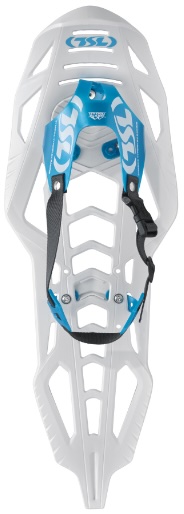
Category: Running
Length: 21 in.
Weight per pair: 1 lb. 6.6 oz.
What we like: A great design for those who like to move fast.
What we don’t: Limited versatility.
The majority of snowshoes on this list are built for everything from casual winter hiking to getting off-trail in more serious terrain, but there is another category altogether: running. When the snow starts falling, that doesn’t mean you have to give up your favorite pastime, and that’s where the TSL Symbioz Hyperflex Racing comes in. With a trimmed-down build and ultralight design (the total weight of both shoes is a feathery 1 lb. 6.6 oz.), the Hyperflex is built for moving fast. Don’t expect serious flotation here—the minimalist frame performs best over packed snow, and the narrow tails aren’t meant for powder. And the 4 small spikes on the bottom of the shoe offer just enough traction for slick bits of trail, but fall well short of the beefier designs on this list. But for runners and racers, it’s our top pick this winter.
There’s no denying that the Symbioz Hyperflex Racing is niche, and you shouldn’t expect them to crossover well into backcountry or steep trail use. There are also a few other options to consider. Atlas’s Race snowshoes cost more but feature quieter nylon decking, upgraded binding systems, and aluminum “cleats” for reliable grip in firm conditions. Crescent Moon also offers their Luna, an all-foam running design modeled after their popular EVA, and Yellowstone, a shorter (24.5 in.) and lighter (3 lb. 5.0 oz.) iteration of their Sawtooth 27. We consider the TSL to be the most well-rounded of the bunch, but a final decision will come down to preferences on weight, construction, and price.
See the TSL Symbioz Hyperflex Racing
 Category: Trail
Length: 27 in.
Weight per pair: 4 lb. 6.5 oz.
What we like: Great price for what you get; intuitive binding system.
What we don’t: Average traction.
Crescent Moon operates differently from most outdoor gear manufacturers. This Boulder-based company specializes in snowshoes, assembles them in the U.S.A. with top-end materials, and has a standout repair and warranty policy. From their lineup, the Sawtooth 27 offers solid versatility for trail hiking: Its rockered shape and 27-inch length balance walkability with flotation in soft snow, the binding system provides a secure and comfortable hold, and the steel traction is sturdy and reliable. Tack on a fairly reasonable price, and you get a well-rounded snowshoe.
The Sawtooth is a great step up from the MSR Evo Trail. It does cost more, but the high-rise toes make them easier to walk in, and the heel lifts are a serious help in steep terrain. That said, you still shouldn’t expect the off-trail performance of MSR’s Lightning Ascent. The Sawtooth’s claw-like crampons grip reasonably well in soft snow and hardpack, but for steep slopes and sketchy traverses, they lack the aggressive bite that you get from the Lightning Ascent. So long as you aren’t trying to get too technical on your outings, the Sawtooths have a compelling mix of price, build quality, and on- and off-trail performance, earning them a high spot on our list.
See the Crescent Moon Sawtooth 27
 Category: Trail/backcountry
Lengths: 20.5, 23.5, 27 in.
Weight per pair: 4 lb. 6.0 oz. (23.5 in.)
What we like: Impressive combination of comfort, traction, and stability.
What we don’t: Narrow profile isn’t great in soft snow.
TSL’s Symbioz Hyperflex Elite offers a different take on performance snowshoes. Rather than having a rigid frame like the MSR Lightning Ascent, the Symbioz Hyperflex has a flexible build that grips well on uneven terrain. Essentially, the snowshoe conforms to uneven terrain, engaging all the teeth on the bottom of the shoe rather than just a few at a time, unlike stiff designs. This makes for great underfoot traction, a stable feel, and comfortable hiking. We also like the binding system, which is similar to an alpine ski touring frame binding: There’s a plate under the foot that moves with you as you walk, resulting in rock-solid support and technical abilities for steep terrain.
No design is without faults, and the Symbioz Hyperflex falls behind the Lightning Ascent in floatation. The length does help (it’s available in 20.5, 23.5, and 27 in. lengths), but the narrow profile doesn’t provide as much floatation as the wider Lightning Ascent. And while the sturdy underfoot binding does help with stability, the stiffer Lightning Ascent has better support for long stretches of side-hilling. Further, the binding system takes some time to set up properly—we don’t recommend doing it for the first time out in the frigid cold as we did. And because the plate has to match the length of your boot sole, it can be a pain to adjust if multiple people share the snowshoe. But these are small complaints about an otherwise outstanding design that's comfortable and performs extremely well.
See the TSL Symbioz Hyperflex Elite
 Category: Backcountry
Lengths: 25, 29 in. men's; 21, 25 in. women's
Weight per pair: 4 lb. 5.9 oz. men's (25 in.); 3 lb. 13.4 oz. women's (21 in.)
What we like: Nimble, light, and a good fit with the Boa system.
What we don’t: Expensive and shorter than their Mountaineer model.
Tubbs’ Flex VRT is a great choice for those who often find themselves in steep terrain. The combination of features on the Flex VRT makes this snowshoe adept at both ascending and descending. To start, as the name suggests, the Flex VRT has a flexible construction that’s nimble and easy to move around in. It also conforms to the terrain better than stiffer designs, which engages all of the steel crampons with every step (the Flex VRT has the most aggressive crampons in the Flex line). And the 19-degree heel lift is ideal for preventing calf fatigue during extended climbing sessions. We’re also big fans of the Boa closure, which not only provides a precise and comfortable fit (the one-dial cable system tightens the entire binding with a few turns), but a snug hold on the foot that won’t slip on tricky descents. Put together, the Flex VRT is a reliable companion for most steep, snowy missions.
That said, the Flex VRT won’t be the best choice for deep days. It does come in relatively long 25- and 29-inch versions (21- and 25-inch for women), but it’s narrower than most dedicated powder snowshoes. The bigger Mountaineer is a better powder snowshoe, though much clunkier and heavier than the Flex VRT. Some may also find the flexible design lacking in support compared to the MSR Lightning Ascent and TSL Symbioz Hyperflex (the latter of which has more underfoot support than the Flex VRT). But if your priorities include weight savings, nimbleness, and comfort, the Flex VRT is a great choice. Note: At the time of publishing, the women’s version is out of stock. We’re optimistic that it’ll return soon, however.
See the Men's Tubbs Flex VRT See the Women's Tubbs Flex VRT
 Category: Trail
Lengths: 23, 26, 30 in.
Weight per pair: 3 lb. 7.0 oz. (26 in.)
What we like: Lighter and more length options than the MSR Evo Trail.
What we don’t: We still have concerns about flotation in soft snow.
Most snowshoes—particularly those in the trail, powder, and technical categories—aren’t considered lightweight, usually hovering around four to five pounds. Atlas aims to trim a few ounces with its Helium-Trail design. Interestingly, Atlas added a healthy number of “gills” in the frame, which means less material overall and a sizable drop in weight (the 23-in. Helium-Trail is 8 oz. lighter per pair than the 22-in. Evo Trail). You also get a steel crampon for grip, three length options (23, 26, and 30 in.), and even a heel lift for big ascents. And Atlas tacked on a webbing toe strap at the front of the foot for comfort and ease of use. For the price, the Helium-Trail offers many attractive upgrades over the similar MSR Evo Trail.
It’s a tough choice between the Evo Trail and the Helium-Trail, especially with the Helium-Trail’s built-out feature set, longer sizes, and lower price. But in practice, we prefer the Evo Trail for a couple of reasons. First, the Evo Trail’s multi-directional crampons are more reliable than the Helium-Trails. And secondly, the Evo Trail boasts better overall floatation. The cut-outs on the Helium-Trail’s decking are nice if weight is a concern, but it does limit the snowshoe’s ability to stay on top of fresh snow. For mellow terrain, both are capable designs, and choosing between the two will ultimately come down to your priorities.
See the Atlas Helium-Trail
 Category: Trail/backcountry
Lengths: 25, 30, 36 in. men's; 21, 25, 30 in. women's
Weight per pair: 4 lb. 13.0 oz. men's (30 in.); 4 lb. 4.5 oz. women's (25 in.)
What we like: A capable, user-friendly option for a wide variety of conditions.
What we don’t: Expensive and underbuilt for truly challenging terrain.
Sitting at the top of Tubbs’ day hiking category is their Panoramic, which ticks most of the boxes we look for in an all-rounder snowshoe. The simple nylon decking is quieter and softer on snow than plastic, and it comes with a healthy set of functional features, including steel-toe crampons, side rails for grip, and a heel lift for extended climbs. Additionally, Tubbs included an upturned tail that helps users maintain a more natural gait. And like Tubbs’ Flex VRT, the Panoramic also sports a Boa system that makes it quick and easy to dial in fit. And with a nice selection of lengths ranging from 25 to 36 inches (21 to 30 in. for women), it’s a quality shoe for both on- and off-trail use.
All that said, the Panoramic falls into an awkward in-between spot: too aggressive for mellow outings but underbuilt for big backcountry missions. The simple frame rails are noticeably small and shallow compared to options like MSR’s Lightning Ascent and Tubbs’ own Mountaineer, making it less appealing for truly challenging days or icy and steep ascents. But if you’re a dedicated trail snowshoer who wants something more premium and aggressive than the other trail snowshoes on this list, the Panoramic is worth spending up for.
See the Men's Tubbs Panoramic See the Women's Tubbs Panoramic
| Snowshoe (Men's/Women's) | Price | Category | Length(s) (M/W) | Weight (M/W) | Decking | Crampon | Heel Lift |
|---|---|---|---|---|---|---|---|
| MSR Evo Trail | $170 | Trail | 22 in. | 3 lb. 10.0 oz. | Plastic | Steel | No |
| Men's Tubbs Flex STP/ Women's Flex STP | $110 | Trail | 24, 28 in./ 22 in. | 3 lb. 8.0 oz./ 3 lb. 5.6 oz. | Composite | Steel | No |
| Men's Lightning Ascent/ Women's Lightning Ascent | $390 | Backcountry | 22, 25, 30 in./ 22, 25 in. | 4 lb. 5.0 oz./ 4 lb. 0 oz. | Nylon | Steel | Yes |
| Men's Tubbs Mountaineer/ Women's Mountaineer | $280 | Backcountry | 25, 30, 36 in./ 21, 25, 30 in. | 5 lb. 4.8 oz./ 4 lb. 12.2 oz. | Nylon | Steel | Yes |
| Crescent Moon EVA | $150 | Trail | 24 in. | 3 lb. 8.0 oz. | Foam | Brass spikes | No |
| TSL Hyperflex Racing | $210 | Running | 21 in. | 1 lb. 6.6 oz. | Plastic | Steel spikes | No |
| Crescent Moon Sawtooth | $200 | Trail | 27 in. | 4 lb. 6.5 oz. | Nylon | Steel | Yes |
| TSL Symbioz Elite | $290 | Trail/BC | 20.5, 23.5, 27 in. | 4 lb. 6.0 oz. | Composite | Steel | Yes |
| Men's Tubbs Flex VRT/ Women's Flex VRT | $280 | Backcountry | 25, 29 in./ 21, 25 in. | 4 lb. 5.9 oz./ 3 lb. 13.4 oz. | Composite | Steel | Yes |
| Atlas Helium-Trail | $150 | Trail | 23, 26, 30 in. | 3 lb. 6.9 oz. | Composite | Steel | Yes |
| Men's Tubbs Panoramic/ Women's Panoramic | $270 | Trail/BC | 25, 30, 36 in./ 21, 25, 30 in. | 4 lb. 13.0 oz./ 4 lb. 4.5 oz. | Nylon | Steel | Yes |
The Switchback Travel team is no stranger to long days in the backcountry, and we've gotten good at scooting around the mountains in the winter months. Snowshoes are frequently part of our adventure kit, and we've tested just about every top model to narrow the list. Former editor-in-chief John Ellings drew from his experiences on frosty trails in the Pacific Northwest to whip up our initial selection of 10 snowshoes back in 2015. Editor Maddie Downie took the reins in 2024. Also hailing from Washington, Maddie can often be found bushwhacking into the far reaches of the North Cascades in the winter months.
In putting together our current selection of 11 snowshoes, we took into account our own experiences on snowy trails throughout the country, as well as feedback from seasoned contributors and the online snowshoeing community. All-day comfort is always at the top of our list when testing snowshoes, and we look for designs that go largely unnoticed throughout the day. Overall quality and ease of use also factor in, with bindings being a key point of differentiation between models. Other factors we look closely at include weight, durability, and traction. To make our list, each design had to stand out in one or more categories and hold up well over the long term. Since the market is competitive and constantly evolving, we keep our finger on the pulse of new products as they surface, adding any standouts to our list along the way.
Trail
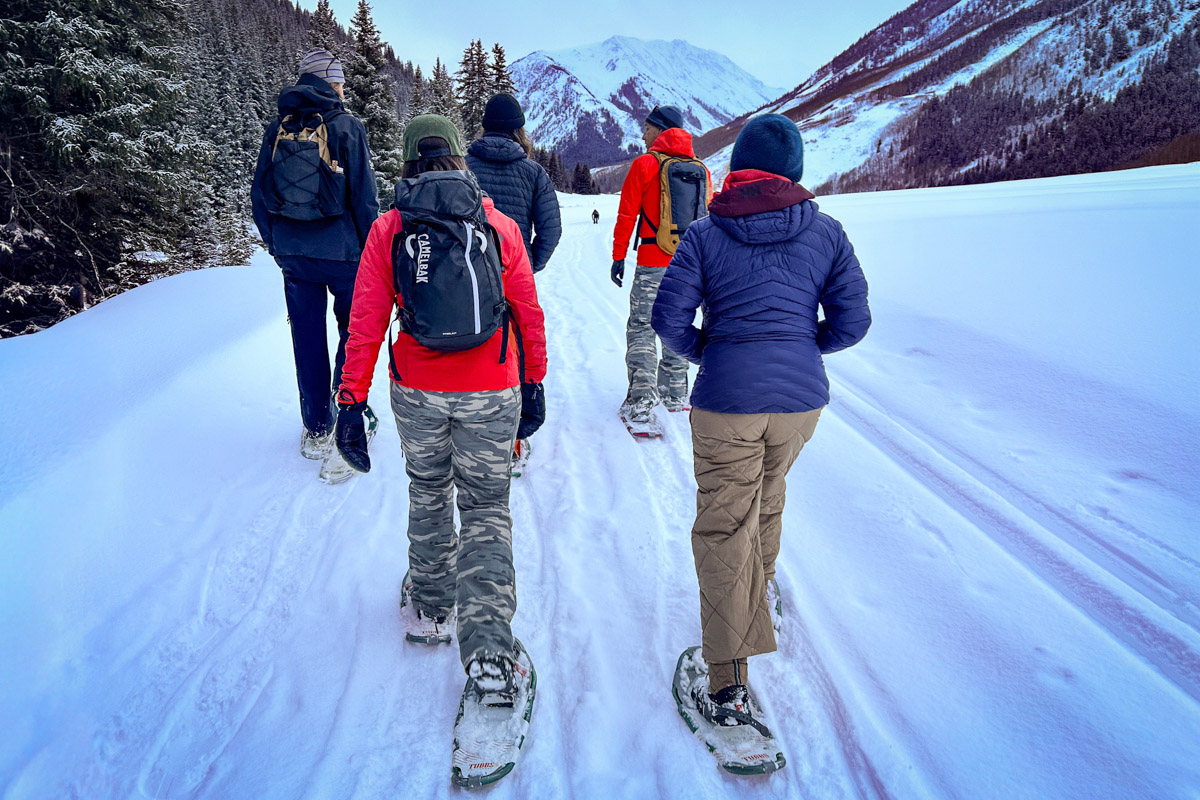
Trail/recreational snowshoes are great for moderate hiking trails that fall somewhere between groomed hardpack and knee-deep powder. In short, they are built for flat terrain or rolling hills, but not for steep mountain ascents or the less predictable backcountry. In terms of build, these snowshoes are shorter in length than backcountry models because you require less flotation (especially on maintained paths). Additionally, their traction designs are simpler and less aggressive. Some have heel lifts, as this has become a popular feature, but we don't find them necessary for most moderate terrain (they're useful for extended climbs). Popular snowshoe designs in the trail category include the MSR Evo Trail, Crescent Moon EVA, and Atlas Helium-Trail.

Backcountry
Backcountry snowshoes are more performance-oriented than the trail category and ideal for those heading out into powder, tackling challenging terrain, and spending longer days out. First, they are longer, providing more float in deep snow and increased traction for handling a variety of conditions, including steep terrain and ice. Backcountry snowshoes are also the most expensive of the bunch due to the burlier builds and more complete feature sets. Keep in mind that a true backcountry model like the Tubbs Mountaineer will be overkill for casual winter snowshoeing, but many of our picks are hybrids that can work well for both uses (and you can hone this in even further based on the length you choose). Leading models in this category include the aforementioned Mountaineer, MSR Lightning Ascent, and TSL Symbioz Hyperflex Elite (in longer sizes).

Running
A small but notable snowshoe subcategory is those built for running, also known as racing snowshoes. A lot of people don’t want to quit their favorite pastime when the snow starts to fall, and regular winter traction devices can fall short. In terms of build, running snowshoes place a premium on lightweight materials, often have a trimmed-down frame that favors speed over floatation (it’s tough to run through powder, so most are tuned for hardpack or small amounts of fresh snow), upturned noses, and special traction designed to keep you moving. Popular models in this category include the TSL Symbioz Hyperflex Racing, Atlas Run, and Crescent Moon Luna.
Kids
Last but not least, a family winter adventure requires snowshoes for all parties, including the kiddos. As expected, these models are smaller versions of their adult counterparts, with similar designs overall but shorter lengths and lower load limits. Depending on your child's size, we like the Atlas Spark (50 to 120 lb.) and Mini (30 to 80 lb.). MSR also makes its own line of youth shoes in the Shift and Tyker. The bad news is that the kids will eventually outgrow them and require an adult pair, but if chosen correctly, you should get many winters of use before that happens.
Once you get an idea of the snowshoe category you want, it's time to nail down the ideal length. This measurement is key to balancing walking comfort with enough flotation to avoid sinking too deeply into the snow with each step (known as “postholing”). Most snowshoes range from 22 inches at the short end (MSR's Lightning Ascent and Evo Trail) up to 36 inches at the long end (the Tubbs Mountaineer and Panoramic). As a general rule, shorter snowshoes are best for on-trail use, and longer models are ideal for deep snow and the backcountry. In addition, the type of snow matters a great deal—in the United States, the crusty hardpack you’ll find in the East contrasts sharply with deep powder in the West. Longer snowshoes provide better flotation in soft snow, so if you’re planning on getting off-trail in Colorado or Utah, a longer snowshoe is better. If you’ll be primarily on hardpack, less flotation is required, and you can stick with a shorter snowshoe.

Along with snow type and terrain, your weight also plays an important role in the length of the snowshoe you choose. Snowshoe manufacturers often list a recommended weight range (or "recommended load") for each shoe, which includes your body weight plus anything you’ll be carrying, such as clothing and a daypack. Heavier loads need longer snowshoes to stay afloat, so try to pick a length that best suits your weight with gear. For example, Atlas’ Range-Trail is rated to 200 pounds for the 26-inch length, 250 pounds for the 30-inch variation, and 300+ pounds for the largest 35-inch model. Finally, it's worth noting that some snowshoes have optional tails to add length depending on the user and conditions (including MSR's popular Lightning, Revo, and Evo lines).
The binding system is your link to trail comfort and also plays a significant role in stability. A good binding should comfortably hold your feet for hours on the trail without requiring constant readjustments. Interestingly, the various systems are one of the few places where manufacturers differentiate significantly from one another. One commonality you will find is that no matter the brand, comfort and adjustability improve as the price goes up.
Multiple Straps or Single-Pull
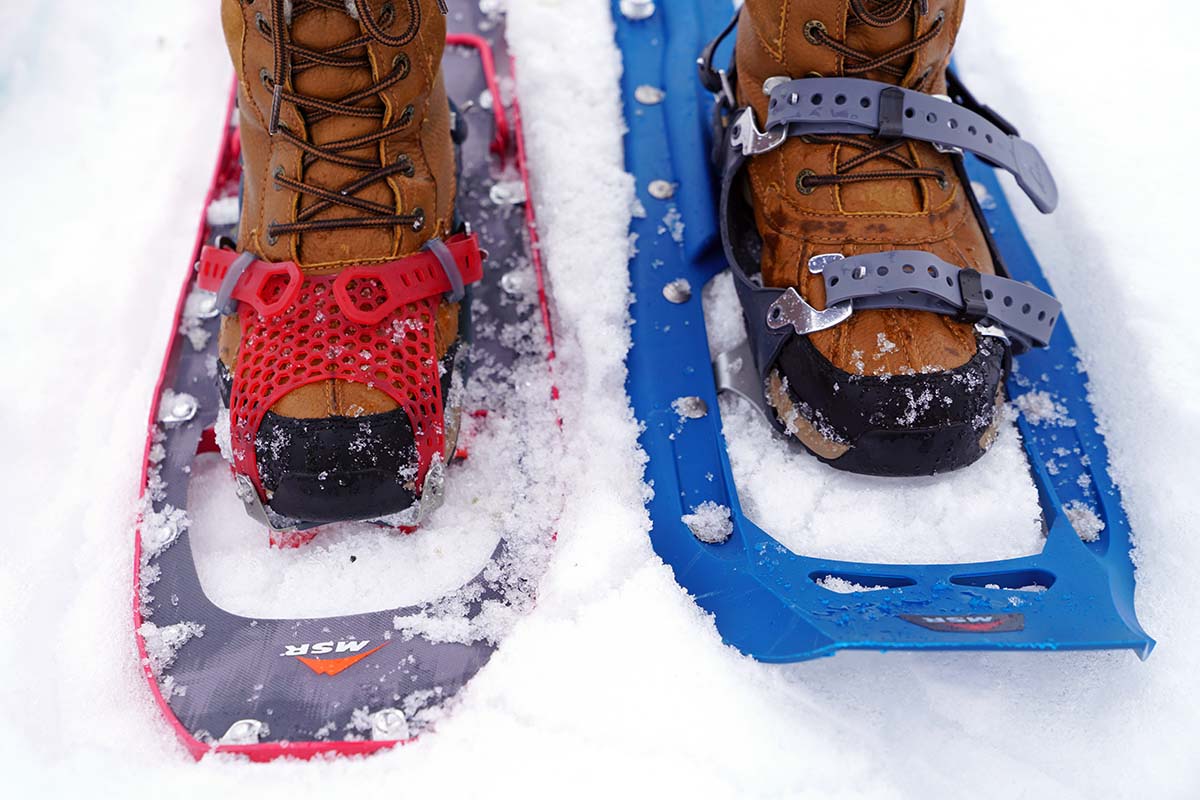
The most common binding styles are either a plastic wraparound binding secured by a series of crisscrossing webbing or individual straps secured over the foot and around the heel. Atlas and Tubbs utilize the more traditional binding and webbing design for their core models, while MSR has transitioned to their upgraded Paraglide, Paragon, and Paradigm systems (a flexible mesh strap that hugs the front of the foot) that offer a sizable boost in all-day comfort and security. Crescent Moon has a binding system that shares characteristics of both, but its single-pull loop system falls more into the traditional binding category.
2.jpg)
Boa
A third binding design gaining some serious traction is Boa. This system uses a pretty traditional wrapped binding, but the standard webbing is replaced with wiring tightened with the turn of a dial (the entire system cinches down on you simultaneously, delivering impressive evenness and comfort). The technology was popularized by snowboard boots, but nowadays you’ll find it on a growing number of snowshoe models from Atlas, Tubbs, and more. Getting a snowshoe like the Tubbs Flex VRT on and off is incredibly easy and quick, particularly when compared with the three- or four-strap systems you’ll find with MSR. The main limitation is that with a single adjuster (and occasionally two), you can’t fine-tune the fit should you need to cinch down in one place and loosen another. For most folks, however, that’s a non-issue.

Needless to say, it’s important to check the bottom of the snowshoes you’re considering to make sure they’ve got real traction. The amount of grip and quality of the crampons and side rails can vary a surprising amount by model and price. Low-cost models commonly have a small steel crampon under your toes, additional cleats around the middle of your foot, and that’s about it. On the other hand, ultralight models like the Crescent Moon EVA and TSL Symbioz Hyperflex Racing have lightweight steel spikes rather than crampons. While reasonable for casual walking on flat ground, these designs can be overmatched on hills or in snowy conditions.
.jpg)
In addition to crampons, most backcountry snowshoes (and some trail models) will feature frame rails for added traction on a variety of terrain. Frame rails run lengthwise along the sides of snowshoes and are a source of excellent lateral stability should you find yourself traversing a slope. They’re also helpful when maximum traction is needed on an ascent or descent, biting in for that extra level of grip. You’ll most often find frame rails on backcountry snowshoes like the MSR Lightning Ascent, but folks who hike on icy trails will appreciate them as well.
Keep an eye on the material and depth of your snowshoe traction. Occasionally, manufacturers will look to save money by using lower-grade aluminum teeth that aren't as burly or as tough over the long haul. Stainless steel bindings are found on most shoes, and the deeper and more aggressive the teeth, the better the grip.
2.jpg)
There are two general types of snowshoes: an aluminum outer frame with flexible nylon decking, and a frameless, solid deck made of plastic or composite. Recently, hybrid models have emerged that use a partial aluminum frame at the front of the snowshoe, with a plastic tail.
Aluminum
Traditional aluminum-framed snowshoes are what most people are familiar with, seen in a variety of models above, including the Crescent Moon Sawtooth 27, Tubbs Panoramic, and more modern-looking MSR Lightning Ascent. This is a functional design, with a strong frame that protects you from trail hazards and a pliant yet tough nylon deck that makes covering long distances comfortable. The disadvantage is traction. Although some high-end models do a great job of maximizing traction, they still fall short compared to plastic, particularly given their weight (MSR's Lightning is one exception). Moreover, the decking materials are more prone to tears, and the occasional rivet can come loose from the nylon decking. But these malfunctions are rare from the quality brands we’ve listed in our picks, and plastic can break, too.

Plastic or Composite
The principal advantage of plastic or composite decking is cost—strong aluminum isn’t cheap—along with the ability to more easily incorporate traction along the sides. The downsides of plastic are that it can break, and it’s noisy over crusty snow. Much more than with a traditional snowshoe, plastic has a harsher and louder heel impact when your foot comes down on hard pack. To summarize, plastic is cheaper and easier to attach traction to, but it's louder and slightly more prone to damage.
.jpg)
EVA Foam
Crescent Moon made waves with the introduction of its EVA foam snowshoe. Unlike hard-plastic or aluminum-frame models, the unique EVA is built with two layers of foam—a softer compound on top for shock absorption and a firmer layer on the bottom for toughness. We had some initial concerns about durability, but our pair has held up well over more than a season of use. The design is geared towards beginners, and the lack of a crampon underfoot does impact traction, but it has a nice cushioned feel that is noticeably quieter than a traditional snowshoe when walking on firm or icy snow. Overall, we think EVA's foam build has a lot of promise and could be a sign of things to come in the industry.

Heel Lift (Climb) Bars
Most high-end trail—and nearly every backcountry—snowshoes come with a heel lift, also known as a riser. The feature is exactly as it sounds: a single metal bar under your heel that can be raised and locked into place for climbs. The raised bar plays the role of a rigid mountaineering boot, keeping you from dropping your heel while climbing up a sustained grade. The benefit of this feature is reduced calf fatigue, but is it worth it? Some companies, like Crescent Moon, were reluctant to include them in their lineup because they determined that most users don’t need them. But customer demand has remained strong, and even Crescent Moon now includes them with most of their offerings (including the Sawtooth 27).
In our experience, heel lift bars have been helpful in reducing calf burn and conserving energy during long climbs, such as a spring snowshoe to Camp Muir on Mount Rainier. One of our editors had to snowshoe over 100 miles through the San Juan Mountains of Colorado in early May during a thru-hike of the Continental Divide Trail and couldn't have done it without heel lifts. But for most casual uses, we generally don’t bother. Unless the hill is steep and will remain steep for a long time, it’s just not worth the effort to reach down to raise and lower the bar. A grippy snowshoe and poles play an equally—if not more—important role in making climbing easier.
.jpg)
Flotation Tails
One of our favorite snowshoe accessories—and an underrated one at that—is the additional snowshoe tails offered with MSR snowshoes. These add-ons are available for their Evo and Lightning lines and are a great way to get all-in-one functionality from a single pair of snowshoes: Throw on the tails for greater flotation in the soft stuff, then stuff them away in your pack when you're traveling over firm snow. They’re ideal for places like the Pacific Northwest or Colorado when snow conditions can vary dramatically throughout the season, so it's no surprise that Seattle-based MSR is leading the charge.
Additional Add-Ons
In addition to heel lifts and tails, several manufacturers offer repair kits and other extras that may prove useful. MSR’s offerings are fairly extensive, from a backpack that’s specifically designed for carrying snowshoes to a handy maintenance kit and replacement straps, strap keepers, and mesh for their Paragon, Paraglide, and Paradigm bindings. Crescent Moon also has a few add-ons, including small and large snowshoe carry bags, neoprene booties, and repair parts. Finally, for those inclined to DIY, TSL sells crampons and spikes that you can install on many of their snowshoes to boost grip—just make sure to check compatibility ahead of time.
.jpg)
Many hikers choose to hit the trail without trekking poles, but what about snowshoeing? Our short answer to the "Do I need poles?" question is yes: In snow in particular, poles increase stability and make uphill and downhill travel much easier. Even though snowshoes themselves have a wide base, it’s easy to get off balance and take little tumbles. And the good news is that most snowshoers also hike, so it’s fairly common that they already own a pair of quality trekking poles for those purposes.

If you already have trekking poles, you'll want to pick up a pair of snow baskets that are specifically designed to fit with your make and model. If you need new sticks, we’re big fans of Black Diamond and MSR, and our favorite model for 4-season use is the Black Diamond Alpine Carbon Cork, which boasts a sturdy design that isn’t prone to flexing under heavy strain and is compatible with both trekking and powder baskets for year-round use (the latter are sold separately). Should you want a more affordable option or prefer to do some further research, we’ve compiled a complete list of the best trekking poles.
Most snowshoers will be comfortable with their regular waterproof hiking boots and a pair of warm wool socks (think medium thickness rather than your lightweight summer hikers). If you’re looking at the running models, then a pair of waterproof trail running shoes should do the trick. With high levels of exertion in moderate temperatures in the 20s and 30s Fahrenheit, these types of footwear are all that most people need. But if you’re snowshoeing in truly cold conditions (or are prone to running cold), the alternative is a lightly insulated winter boot (the Merrell Thermo Chill Mid is a fine choice). We don’t recommend using a full-on winter boot like the Sorel Caribou for anything except very short walks—they’re too cumbersome and often far too warm.
.jpg)
For extended, multi-day treks in snowshoes, we've found it helpful to pair our preferred hiking boots or shoes with waterproof socks to keep our feet dry over the long haul. Our favorite socks for this application are Sealskinz, which are fully waterproof but decently breathable. They're also made with cozy merino wool that effectively wicks moisture (i.e., sweat) and helps fend off odors. We've snowshoed hundreds of miles in Sealskinz socks and have had zero issues with blisters or cold, damp feet—even after long slogs through heavy slush.
.jpg)
Most snowshoe manufacturers make a unisex model and a corresponding women’s version that may look like the same exact snowshoe with a splash of color (where applicable, we've listed these with our picks). But take heart: Most of these models have undergone some changes. First and foremost, women’s snowshoes are shorter. Rather than a 25-inch length being the standard "small" size, women’s models start at about 23 inches. The shape is also different, tapering at the back of the snowshoe to accommodate a shorter stride. Finally, the bindings are designed to accommodate smaller footwear. It all adds up to a more customized fit that will suit most women better than opting for the unisex (men’s) model.

If you’re just getting into snowshoeing, it can make sense to buy an all-in-one kit that includes poles and other accessories, and the good news is that many of these kits are offered in prepackaged setups. An option like the Tubbs Flex STP kit has a lot of appeal from a value and convenience perspective: You get snowshoes, adjustable poles, and a carrying case in one fell swoop. Several other brands, including MSR and Atlas, also offer all-in-one options that include a pair of snowshoes plus a few handy accessories. Those who already own poles will likely be better off purchasing their snowshoes separately, but for beginners who want to remove any guesswork, a prepackaged kit is hard to beat.
Snowshoes provide flotation and some traction on powdery or semi-packed snow, but their underfoot spikes—often called “crampons”—aren’t true crampons. While they provide sufficient grip on steeper hillsides, dedicated crampons are required for technical ascents. Paired with a mountaineering boot, they are built to withstand serious abuse and provide confidence-inspiring grip on everything from glaciers and crevasses to vertical ice walls and slick, treacherous mountainsides. For less technical adventures, those in need of traction rather than floatation might want to consider a set of winter traction devices (also known as microspikes), which can be attached to a standard pair of hiking or winter boots. The underfoot spikes are much less aggressive than what you get with crampons, but microspikes can help considerably with navigating icy parking lots and winter trails. For a full breakdown of options, check out our article on the best winter traction devices.
.jpg)
Outside of poles, one of the most common snowshoe accessories that folks overlook is the trusty gaiter. Typically associated with mountaineering, these waterproof and tough leg protectors are great for snowshoeing. Not only do they keep snow from sneaking through the opening between your pant leg and your boots, but they also help protect your pants should you catch a crampon or other sharp object. For most uses, a mid-range model should treat you well. Our favorite model is the Outdoor Research Rocky Mountain High II for its tough, waterproof yet lightweight design. And for serious backcountry use, look to OR's Crocodile gaiters.
Back to Our Top Snowshoe Picks Back to Our Snowshoe Comparison Table


cf3a.jpg?h=fbc67360&itok=H_noUcFU)
-tfe3e.jpg?h=fbc67360&itok=tQQ0SQx9)


_099a8.jpg?h=fbc67360&itok=J5FNnfpJ)
14ab.jpg?h=fbc67360&itok=1n06ZZey)


